


Lykoi
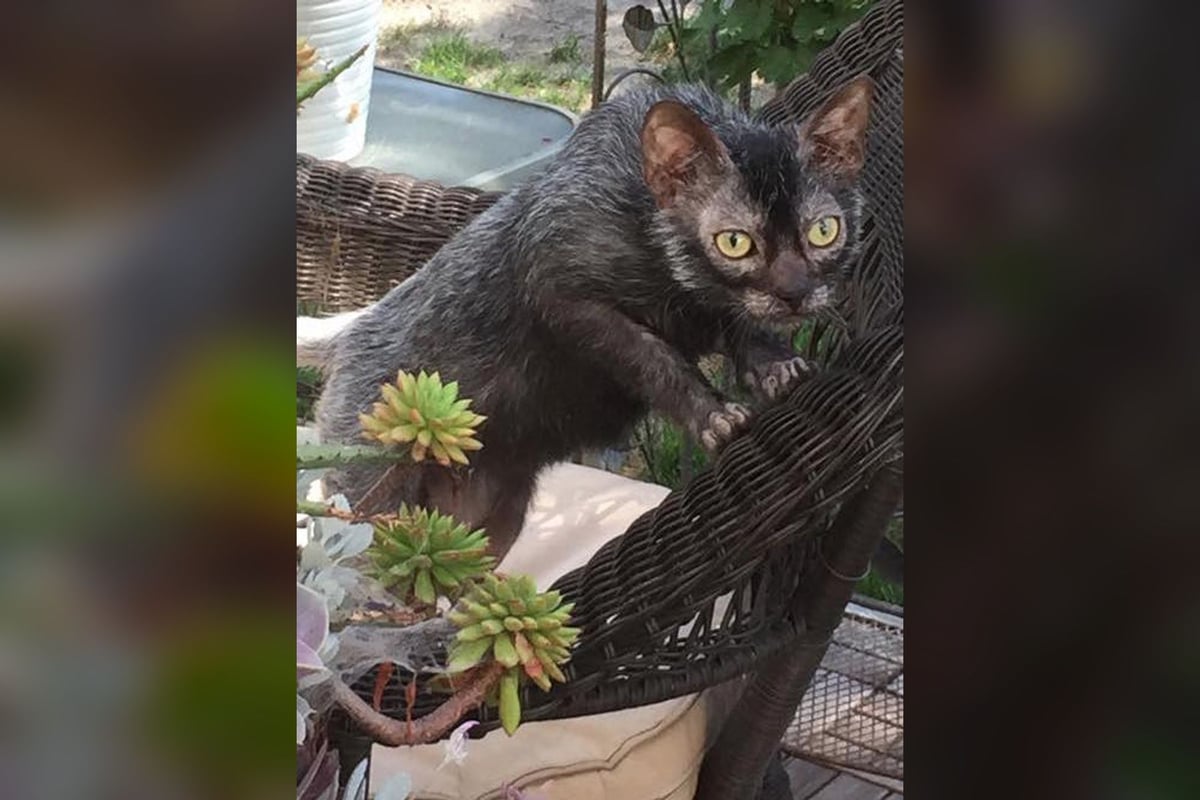
The Lykoi is the only cat in the world whose appearance deliberately evokes a werewolf: a black coat that is partially absent, a facial mask that is often bare, a piercing gaze and a lean silhouette. Born in 2010-2011 from a natural mutation spotted in litters of stray cats in Tennessee and Virginia, it ranks among the most recently admitted cat breeds in the TICA championship. Its spectacular look hides an affectionate, playful, curious character — a perfectly ordinary cat under its nocturnal-creature costume.
- Weight
- 2.5 to 5kg
- Height
- 18 to 23cm
- Life expectancy
- 14years
- Monthly cost
- 70 to 120€
Personality profile
Energy 4/5
Independence 3/5
Trainability 3/5
Good with children 4/5
Talkativeness 3/5
Space needed 3/5
Attachment to home 4/5
Good with strangers 3/5
Good with cats 4/5
Good with dogs 3/5
Coat care 3/5
Exercise needs 4/5
Scores given on measured axes, data confidence: medium.
Living with a Lykoi
Description
This is a small to medium-sized cat, moderately slender in build without being delicate. Its constitution is firm and athletic, with medium-sized bones and well-defined muscle beneath its irregular coat. The head, moderately wedge-shaped, is dominated by large round gold or yellow eyes with an intense expression, and large pointed ears slightly angled outward. The utterly distinctive feature lies in the coat: partial hypotrichosis caused by a specific genetic mutation results in no undercoat and irregular shedding of guard hairs, creating a coat in sparse patches, sometimes almost bald in certain areas of the body. The facial mask — nose, peri-ocular area, chin — is frequently completely hairless, heightening the masked look. The most characteristic and common color is black roan, a mix of black and white hairs giving a silvery, wolf-like shade, but other colors are registered. Males generally weigh 3.5 to 5 kg, females 2.5 to 4 kg.

Temperament
Beneath its creature-of-the-night appearance, the Lykoi is a deeply endearing, playful, sociable cat — though more reserved around strangers than the Sphynx or the Devon Rex. It forms a strong bond with its human family and shows its affection through intense play sessions, long purrs and a constant curiosity about household activity. It is not as clingy as the Sphynx: it also knows how to take its space and explore alone. Its hunting instinct is pronounced — a direct inheritance from its stray ancestors — and shows up as a strong need for daily stimulation (chasing toys, interactive play). It generally gets along well with calm, respectful children. It tolerates other cats provided the introduction is gradual, but can show some initial caution toward strangers, whatever their species. Its alert nature and sharp powers of observation make it a lively, attentive indoor companion.
Training
Intelligent and curious, it remains, due to its relative independence, slightly less trainable than the Sphynx or the Abyssinian. It responds well to clicker training and enrichment games — food puzzles, obstacle courses, recall by name — provided sessions are short (5 to 8 minutes), varied and consistently based on positive reinforcement. Its pronounced hunting instinct is its best teaching lever: wand toys and laser pointers are far more effective than treats alone at capturing its attention. Its daily activity need is real: plan at least two to three long active play sessions a day (15-20 minutes each) to channel its hunter's energy. Without this regular, intense exercise, it can develop compensatory behaviors (excessive vocalizing, insistent demands for attention, anxious exploring). Early socialization is essential: kittens exposed from 3-4 weeks of age to gentle handling, varied sounds and other species are noticeably less reserved as adults. Conversely, a poorly socialized kitten can remain lastingly wary of strangers.

Feeding
Nutritional needs do not differ radically from those of a domestic cat of similar size, but a few points deserve attention. Its partial coat exposes it to slightly higher heat loss than a fully coated cat, which can translate into a marginally higher caloric intake in cold weather — worth watching during a harsh winter if the home is not sufficiently heated. Favor premium food rich in animal protein (minimum 35%) and essential fatty acids (omega-3, omega-6) to support skin quality and healthy regrowth after wolfing-out cycles. Wet food is recommended alongside kibble to maintain good hydration, which benefits skin integrity. Split into two daily meals for adults. Monitor weight regularly: a cat that is too thin will lose more body heat through its exposed skin.
Affiliate links, no extra cost to you. Legal notice

Living conditions
Its skin vulnerability makes it an indoor cat for life. The bare skin areas — facial mask, partially bare belly — are exposed to UV rays and sunburn; prolonged direct sun exposure through a window should be limited, and unsupervised outdoor access is not advisable. Its cold tolerance is low: its patchy coat insulates it far less than a full coat, and the ambient temperature should ideally stay above 20 °C. Below 15 °C, it will actively seek out heat sources — a blanket, a radiator, body contact. A well-heated apartment, enriched with cat trees and varied toys, suits it perfectly. It enjoys height and observation posts. "Wolfing out" cycles (see FAQ) can unsettle new owners but require no special arrangements — just understanding.

Grooming and coat care
Care is moderate but regular, centered on skin care specific to this unusual coat. With no undercoat and a guard-hair density that varies with the cycles, the skin produces sebum that cannot be distributed normally along the hair — it builds up on bare or semi-bare areas, particularly the facial mask. A monthly bath with a mild cat shampoo (a hypoallergenic, SLS-free formula) is enough in most cases; increase the frequency during wolfing-out periods, when the skin is more exposed. After bathing, dry thoroughly with a towel in a heated room — it gets cold quickly. Weekly ear cleaning is advisable: the large ears accumulate wax, especially in cats whose ear flaps are partly lacking protective hair. Claws should be trimmed every 3 to 4 weeks. During wolfing-out cycles, shed hair is easy to collect: daily shedding around the home stays lower than for a fully coated breed, but hair loss arrives in concentrated waves.

Health
No serious genetic condition has been identified to date, which is remarkable for such a young breed with such a limited population. The breed's founders (Dr. Johnny Gobble and Patti Thomas) carried out full workups as early as 2011 — cardiology, dermatology, hematology, genetics — in collaboration with University of Tennessee laboratories, with no systemic abnormality revealed. The hypotrichosis mutation involved is distinct from that of the Sphynx (different genes) and from the Donskoy/Peterbald: it does not appear to be linked to the immune or dental complications seen in other hairless breeds. Skin care is the main area of vigilance: the exposed skin areas accumulate sebum and can develop infections if not maintained. A gentle monthly bath is recommended. The bare skin of the mask is sensitive to UV rays: avoid any prolonged direct sun exposure, especially in summer. Wolfing-out cycles — a partial, sometimes total, molt followed by regrowth — are normal and not pathological (see FAQ). An annual vet checkup including a skin exam is advisable. Because the breed's population is very limited, genetic diversity is closely monitored by TICA breeders to avoid inbreeding.
Breed history
The story of the Lykoi begins in 2010-2011 in two seemingly unconnected households in the United States. Patti Thomas, in Virginia, and Dr. Johnny Gobble, a veterinarian in Vonore, Tennessee, each discovered kittens in litters of stray cats showing a coat fragmented into sparse patches and bare skin areas on the face. The initial hypothesis of a form of ringworm or a skin condition was quickly ruled out by dermatological workups. In 2011, the two lines were brought together, and genetic tests conducted at the University of Tennessee and at UC Davis established that the mutation was distinct from every known feline hypotrichosis mutation — particularly from that of the Sphynx and the Donskoy. The breed was formally developed by Johnny Gobble and Patti Thomas through controlled crosses between mutation carriers and domestic shorthair cats (to maintain genetic diversity). The name "Lykoi" was chosen in reference to the ancient Greek λύκος, wolf — a nod to its werewolf appearance. TICA granted Preliminary New Breed status in 2012, then Advanced New Breed in 2016, and the breed reached Championship in 2017. In France, the breed is not yet registered with the LOOF, and numbers remain very limited in Europe — most breeding is concentrated in the United States and Canada.
Getting ready for your Lykoi
Four essentials to line up before day one.
Affiliate links, no extra cost to you. Legal notice
FAQ: Lykoi
Sources
- TICA — Lykoi Breed Introduction · TICA recognition: Preliminary New Breed 2012, Advanced New Breed 2016, Championship 2017. Hypotrichosis mutation distinct from the Sphynx. Founders: Patti Thomas and Dr. Johnny Gobble, Tennessee. Wolfing-out cycles documented as a normal breed trait.
- Wikipedia EN — Lykoi · Origin: litters of stray cats, Vonore TN and Virginia, 2010-2011. Name derived from the Greek λύκος (wolf). UC Davis and University of Tennessee genetic workups: mutation distinct from Sphynx/Donskoy. Coat in irregular patches, facial mask often bald. Very limited global numbers.
- UC Davis Veterinary Genetics Laboratory — Lykoi Genetic Testing · Genetic tests confirming that the Lykoi hypotrichosis mutation is independent of the known Sphynx (KRT71), Donskoy and Peterbald mutations. No systemic abnormality in the initial workups conducted on the breed's founders.

