


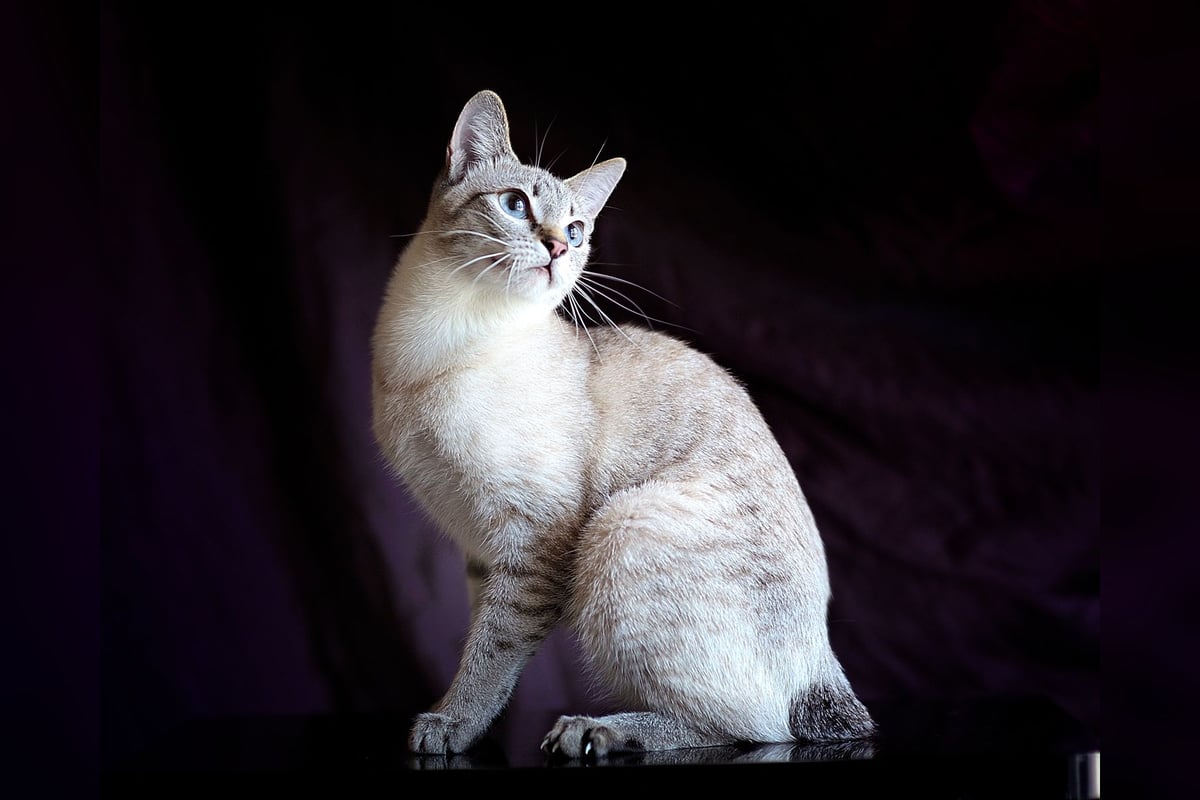
Mekong Bobtail
The Mekong Bobtail (also commonly known as the Thai Bobtail) is a traditional Siamese-type cat with a naturally short tail, formalized by Russian breeders starting in the 1980s from cats native to the kingdom of Siam. Its autosomal dominant mutation is genetically distinct from that of the Manx or the Japanese Bobtail and causes no spinal pathology. A colorpoint coat, mandatory blue eyes and pronounced vocality bring it close to the Siamese.
- Weight
- 2.5 to 5kg
- Height
- 23 to 28cm
- Life expectancy
- 17years
- Monthly cost
- 40 to 80€
Personality profile
Energy 4/5
Independence 2/5
Trainability 4/5
Good with children 4/5
Talkativeness 5/5
Space needed 3/5
Attachment to home 4/5
Good with strangers 2/5
Good with cats 3/5
Good with dogs 3/5
Coat care 2/5
Exercise needs 4/5
Scores given on measured axes, data confidence: low.
Living with a Mekong Bobtail
Description
The body is semi-foreign in type: elongated, muscular without being massive, carried on fine legs with oval paws. The head is a moderate wedge shape, with high cheekbones and large almond-shaped eyes that must be blue, reflecting the colorpoint gene. The coat is short, silky, without notable undercoat, exclusively colorpoint like the Siamese (seal point, blue point, chocolate point, lilac point, red point, tortie point). The tail is the defining feature: it measures 5 to 7 cm, has one or more natural joints, and can form a pompon or a distinct curve depending on the individual.

Temperament
The Mekong Bobtail is an extremely vocal cat: it constantly communicates with those around it through varied vocalizations, a direct legacy of its Siamese ancestry. Deeply attached to the humans in its household, it copes poorly with long periods of solitude and actively seeks company. Its high energy level shows up in sustained play sessions and a permanent curiosity about its surroundings. It can be exclusive, preferring a strong bond with one or two people over diffuse sociability, and sometimes shows wariness toward strangers.
Training
Learning through play works particularly well: its responsiveness and desire for contact make it easy to redirect unwanted behaviors. It responds to positive reinforcement and can learn simple commands or tricks. Two to three intense 10 to 15 minute play sessions a day are enough to channel its energy. Isolation or punishment, on the other hand, quickly damage the relationship and can cause chronic stress in this cat, which is deeply attached to its humans. Early socialization with children, other animals and visitors reduces wariness toward strangers.

Feeding
Its caloric needs match those of an active medium-sized cat, roughly 60 to 70 kcal/kg/day for maintenance. A diet rich in quality animal protein suits its light semi-foreign build. No particular digestive predisposition is documented, but the quality of the ingredients remains key to preserving a well-contrasted colorpoint coat. Rations should be adjusted to the individual's actual activity level to prevent weight gain, which would quickly show on a semi-foreign body.
Affiliate links, no extra cost to you. Legal notice

Living conditions
Native to a warm climate, the Mekong Bobtail tolerates cold poorly and must live indoors in a heated home in winter: its short coat without undercoat does not protect it from low temperatures. It adapts well to an apartment provided the environment is enriched: vertical scratching posts, elevated structures, daily interactive play sessions. Its strong vocality can, however, be an issue in homes with thin walls or close neighbors. Cohabitation with other cats requires a gradual introduction; with calm, non-predatory dogs, it generally works after an adjustment period.

Grooming and coat care
The short coat without undercoat is very easy to maintain: a weekly brushing is enough to remove dead hair and keep its sheen. Shedding is moderate and needs no particular management. Routine care (claws, ears, teeth) follows the standard feline protocol. The jointed tail requires no specific care, but should be handled gently during veterinary visits to avoid awkward movements on the natural joints.

Health
The mutation responsible for the Mekong Bobtail's short tail is autosomal dominant and is associated with no spinal pathology — unlike Manx Syndrome, caused by the M gene in homozygous form. As a precaution, serious breeders nevertheless avoid pairing two bobtail individuals together. Longevity is high (15 to 18 years on average), comparable to traditional Siamese cats and higher than modern extreme-headed Siamese lines. No breed-specific hereditary disease has been documented to date. Sensitivity to anesthetic agents shared with the Siamese family should still be systematically flagged to the veterinarian.
Breed history
Short-tailed cats from the kingdom of Siam are documented in ancient Thai manuscripts, notably the Tamra Maew (14th-18th centuries). These were the animals offered as diplomatic gifts to the royal courts of Europe and Russia. The modern formalization is the work of Russian breeders who, starting in the 1980s, selected breeding cats imported from Thailand to stabilize the standard. The WCF recognized the breed under the name "Mekong Bobtail" in 1994 on a preliminary basis, then granted it championship status in 2004. The name "Mekong Bobtail" refers to the Mekong River, the geographic artery linking Thailand, Laos, Cambodia and Vietnam. The common name "Thai Bobtail" is widely used but remains unofficial. The breed stays rare outside Thailand and Russia.
Getting ready for your Mekong Bobtail
Four essentials to line up before day one.
Affiliate links, no extra cost to you. Legal notice
FAQ: Mekong Bobtail
Sources
- WCF Breed Standard — Mekong Bobtail · World Cat Federation. Mekong Bobtail breed standard. Preliminary recognition 1994, championship status 2004. Accessed May 2026.
- Lyons L.A. — DNA mutations of the cat: the genetic dark matter (Mammalian Genome, 2012) · Lyons L.A. DNA mutations of the cat: the genetic dark matter. Mammalian Genome, 2012; 23(9-10): 547-558. Review of the mutations responsible for tail phenotypes (HES7, T-box, M-gene) in the cat.
- PawPeds — Mekong Bobtail breed database & pedigree records · PawPeds. International pedigree database, Mekong Bobtail breed profile. Accessed May 2026.

