


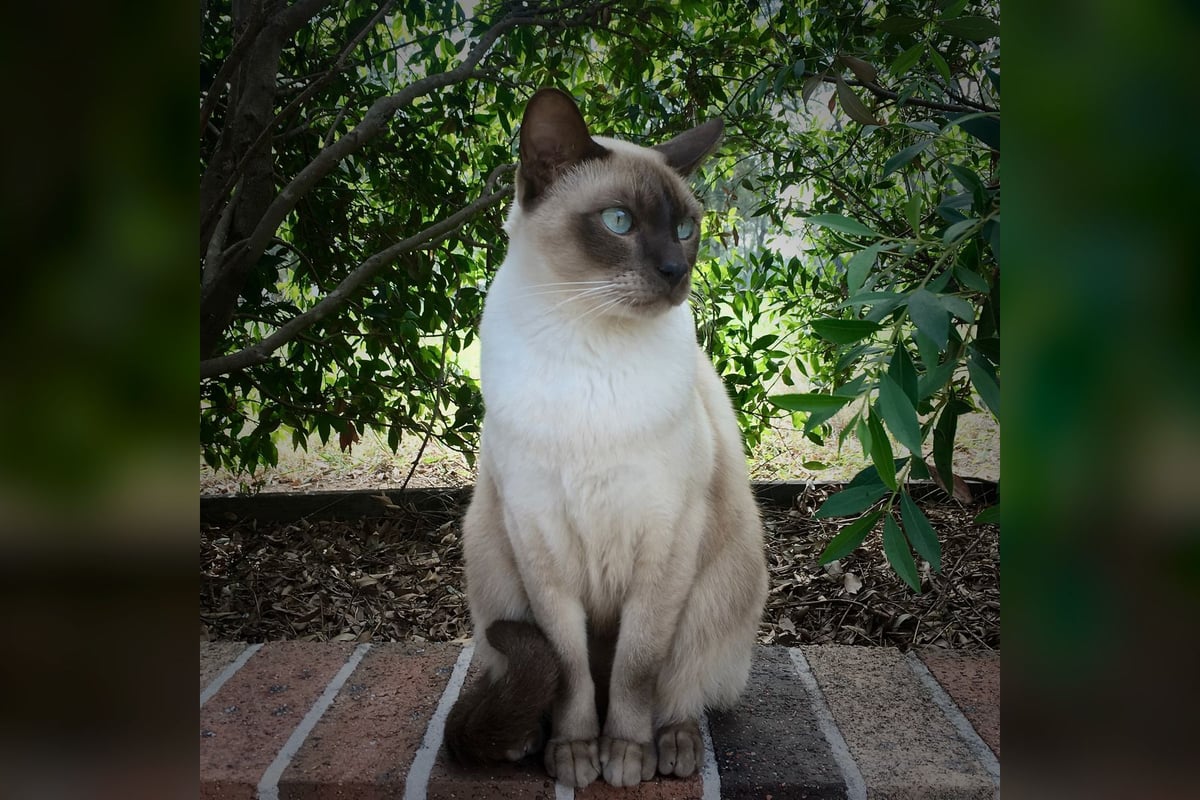
Tonkinese
The Tonkinese is the deliberate result of a cross between the Siamese and the Burmese, two breeds that have been naturally related for centuries in Southeast Asia. Stabilized in North America in the 1960s from the founding female Wong Mau, it is recognized by the CFA and the LOOF. Its "mink" coat — a pattern intermediate between the Siamese colorpoint and the Burmese sepia — and its aqua-turquoise eyes make it an immediately recognizable breed. Temperamentally, it sits right in the middle between its two parent breeds: as affectionate and social as the Burmese, as playful and intelligent as the Siamese, without either the extreme vocal intensity of the one or the possessive exclusivity of the other.
- Weight
- 3.5 to 5.5kg
- Height
- 22 to 30cm
- Life expectancy
- 14years
- Monthly cost
- 60 to 110€
Personality profile
Energy 4/5
Independence 2/5
Trainability 4/5
Good with children 4/5
Talkativeness 3/5
Space needed 3/5
Attachment to home 5/5
Good with strangers 4/5
Good with cats 4/5
Good with dogs 4/5
Coat care 1/5
Exercise needs 3/5
Scores given on measured axes, data confidence: medium.
Living with a Tonkinese
Description
The build is semi-foreign, medium-sized: neither as cobby as the American Burmese, nor as slender as the modern Siamese. The head is a modified wedge with high cheekbones, a distinct muzzle, medium ears tilted slightly forward. The almond-shaped eyes are the breed's most distinctive trait: their aqua-turquoise color — specific to the heterozygous mink genotype (Cs/Cb) — is absent in the purebred parents. The body is dense and muscular, surprisingly heavy for its size when picked up. Males typically weigh 4.5 to 5.5 kg, females 3.5 to 4.5 kg. The coat is short, very silky, soft to the touch, with a subtle undercoat that gives it a velvety look distinct from the Siamese (flatter) and the Burmese (satiny). The mink coat shows an intermediate contrast between the body and the points: less marked than the Siamese colorpoint, more visible than the Burmese sepia. Three genotypes are possible in a litter from two Tonkinese: Cs/Cs (colorpoint, blue eyes, pure Siamese phenotype), Cb/Cb (sepia, green-gold eyes, pure Burmese phenotype), and Cs/Cb (mink, aqua eyes, the only genotype that conforms to the Tonkinese standard). Recognized colors: natural (sable brown/mink), champagne (chocolate/mink), blue, platinum. Life expectancy: 12 to 16 years.

Temperament
It's often described as "the best of both worlds" between the Siamese and the Burmese — a phrase that would be useful if it weren't so overused. More concretely: it's as affectionate and clingy as the Burmese (it seeks physical contact, settles on laps or shoulders), as playful and curious as the Siamese (it investigates every novelty, restarts play sessions, memorizes routines), but without the vocal intensity that characterizes the Siamese or the dog-like exclusivity of the Burmese. Its vocalizing is present and expressive — it comments on its day, asks for attention, answers when spoken to — but in a more moderate register. Its intelligence is notable: it opens drawers, learns its name quickly, adapts to a harness and to clicker training. It handles prolonged isolation poorly — though slightly better than either parent breed — and adopting in pairs remains the optimal solution for very active households. It generally gets along well with children, other cats and properly introduced dogs.
Training
It's one of the most learning-receptive cats among shorthaired breeds. Its sharp intelligence, inherited from the Siamese, and its motivation for human contact, inherited from the Burmese, make it a natural candidate for clicker training. It learns its name quickly, can give a paw, come on command, accept a harness for secure outings, or run small obstacle courses. Short 5- to 10-minute sessions, repeated daily, give the best results — it quickly tires of monotonous exercises. Positive reinforcement through treats and play is the only effective method: no physical restraint. Learning also serves as an essential anti-boredom tool for such a curious breed.

Feeding
An active, muscular, medium-sized breed, it has sustained energy needs. A premium diet rich in animal protein (minimum 35-38%) with a moderate fat level suits it well. Taurine should rank high in the formula for cardiac support. Two split meals a day are preferable to free feeding to regulate appetite — it can ask for food out of boredom or a bid for attention as much as real hunger. For neutered adults, watch for weight gain and adjust the ration: neutering reduces caloric needs without reducing appetite. Favor low-glycemic-index formulas if metabolic history is present in the line (Burmese legacy). For a 4-5 kg adult, plan on 180-240 kcal/day depending on activity level.
Affiliate links, no extra cost to you. Legal notice

Living conditions
It lives well in an apartment, including modest floor spaces, provided the environment is stimulating: cat trees, interactive toys, regular toy rotation to maintain curiosity. A shorthaired breed without a thick undercoat, it is sensitive to cold — avoid unheated rooms in winter. Its trusting, not-very-wary nature makes it vulnerable to outdoor dangers: indoor cat recommended. Regular human presence is non-negotiable for its balance: chronic solitude (beyond 5 to 7 hours a day) generates anxiety and compensatory behaviors. Its tolerance for solitude slightly exceeds that of the Siamese or Burmese taken alone, but the margin is modest. The pairing option — a companion cat, an Oriental, or any sufficiently playful cat — is the most effective answer for regular absences. Finally, plan on 20 to 30 minutes of interactive play a day.

Grooming and coat care
The short, silky coat is among the least demanding to maintain. A weekly pass with a rubber grooming glove or a slightly damp chamois is enough to remove dead hair and keep the coat's velvety look. The molting season is mild and daily shedding stays low. Bathing is only needed on rare occasions. Dental care is the main point of vigilance: the breed shows a predisposition to gingivitis, and regular brushing from a young age is non-negotiable. Clean the ears monthly with a suitable ear solution. Claws should be trimmed every two to three weeks.

Health
The breed benefits from a degree of hybrid vigor from the Siamese × Burmese cross, but also inherits known predispositions from its founding parent breeds. Feline amyloidosis, documented in the Siamese, remains a risk to watch: abnormal amyloid protein deposits can build up in the liver, kidneys or pancreas, with no systematic commercial DNA test available to date — annual blood panels (liver and kidney) are therefore recommended from age 5-6. Chronic gingivitis is the most frequently reported health problem in the breed: dental brushing started at the kitten stage (weekly minimum, daily if possible) is the most effective preventive measure. Hereditary hypokalemia documented in the American Burmese remains a potential risk in lines descending from older crosses — check the breeding cats' test results with the breeder. Feline asthma and anesthesia sensitivity, Siamese legacies, are worth flagging to the veterinarian before any surgical procedure. The breed remains rare in France (fewer than ten recorded breeders): choosing a serious cattery with health traceability on the parents matters all the more.
Breed history
The Tonkinese's history begins, through a genealogical paradox, with the female cat Wong Mau — founder of the modern Burmese, imported from Burma to the United States in 1930 by Dr. Joseph Thompson. Retrospective genetic analyses established that Wong Mau was herself a natural Siamese × Burmese hybrid, carrying the mink genotype (Cs/Cb). Her descendants selected for their darkest color produced the Burmese; those showing the intermediate coat waited several decades before being recognized as a breed in their own right. In the 1960s, Canadian and American breeders — notably Margaret Conroy and Milan Greer — set out to deliberately stabilize this intermediate type, crossing Siamese and Burmese cats and selecting mink individuals (aqua eyes) in each litter. Canada officially recognized the breed in 1965. The CFA accepted it into its registries in 1979 and opened championship status to mink cats in 1984, then to colorpoint and sepia patterns in 2002. In France, the LOOF recognizes the breed, but it remains one of the rarest: fewer than ten active breeders recorded in 2014, with crossbreeding restrictions in place since 2009 (crosses permitted only with Tonkinese, English Burmese or Asian Longhair). The name "Tonkinese" — evoking Tonkin, a historic region of northern Vietnam — is a marketing choice with no genetic link to that region: the breed is purely North American in origin.
Getting ready for your Tonkinese
Four essentials to line up before day one.
Affiliate links, no extra cost to you. Legal notice
FAQ: Tonkinese
Sources
- Wikipedia FR — Tonkinese (cat) · Siamese × Burmese cross stabilized in North America, 1960s. Mink coat (Cs/Cb genotype). Aqua-turquoise eyes. Rare breed in France (fewer than 10 breeders, 2014). LOOF crossbreeding restrictions since 2009.
- CFA — Tonkinese Breed Profile · Founding cat Wong Mau (1930) genetically hybrid. CFA acceptance 1979, mink championship 1984, colorpoint and sepia added 2002. Semi-foreign build, dense and muscular body. Gingivitis documented.
- Royal Canin FR — Tonkinese profile · Active, affectionate, lively, social temperament. Life expectancy 10-16 years. High vocalizing. Strong need for human presence and companionship.
- LOOF — Recognized cat breeds · Tonkinese is among the breeds officially recognized by the Livre Officiel des Origines Félines. Crossbreeding regulated since 2009: Tonkinese × Tonkinese, Tonkinese × English Burmese or Asian Longhair.
Breeds similar to a Tonkinese


See also: Oriental Shorthair