


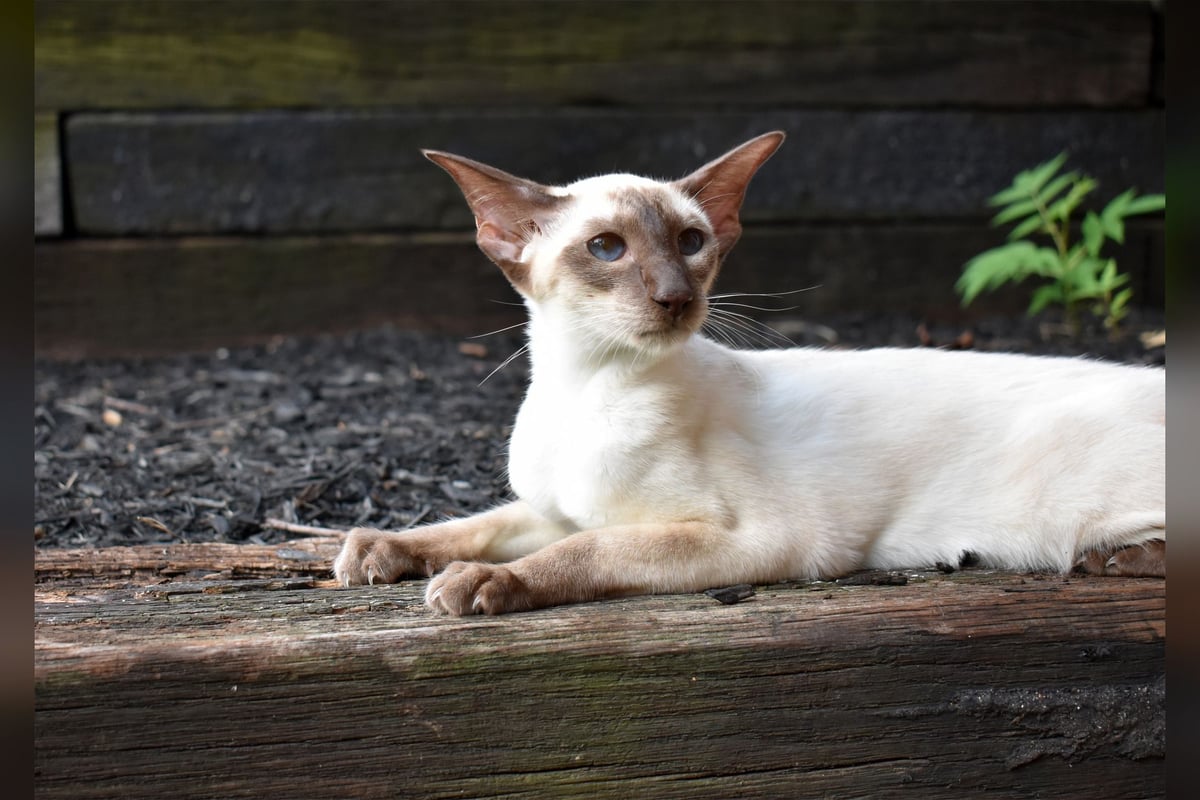
Siamese
The Siamese is one of the oldest and most recognizable cat breeds in the world, native to Siam (present-day Thailand) where it was kept in Buddhist temples and royal palaces. Imported to England in 1884 as a diplomatic gift, it quickly spread across Europe and America. With its short, silky colorpoint coat, its blue almond-shaped eyes and its extremely lively character, the Siamese is often described as the most "dog-like" of cats: hyper-affectionate, hyperactive and endowed with a powerful vocalization that makes it impossible to ignore.
- Weight
- 2.5 to 5kg
- Height
- 25 to 30cm
- Life expectancy
- 15years
- Monthly cost
- 60 to 110€
Personality profile
Energy 5/5
Independence 1/5
Trainability 5/5
Good with children 4/5
Talkativeness 5/5
Space needed 3/5
Attachment to home 5/5
Good with strangers 4/5
Good with cats 4/5
Good with dogs 4/5
Coat care 1/5
Exercise needs 4/5
Scores given on measured axes, data confidence: high.
Living with a Siamese
Description
The silhouette is long, svelte and muscular, characteristic of the oriental type. The head is triangular with a long straight nose, large low-set ears, and almond-shaped eyes of an intense blue — a color genetically linked to the colorpoint coat. The coat is short, fine and very close to the body, with a colorpoint pattern: a light body coat (cream or off-white) contrasting with darker extremities (muzzle, ears, legs, tail) called "points." Point colors recognized by the LOOF notably include seal, blue, chocolate and lilac. Males typically weigh 3.5 to 5 kg, females 2.5 to 4 kg. Two morphological types coexist: the modern Siamese (an extreme type, very fine and angular, recognized in shows) and the traditional Siamese, known as Thai, rounder and more compact — both lines are recognized by the LOOF. Life expectancy: 12 to 20 years.

Temperament
"The most dog-like of cats," as it is often said: it follows its owner everywhere around the apartment, answers to its name, learns simple commands and shows near-canine attachment to its primary human. Its intelligence is comparable to that of the Bengal or the Abyssinian. It is playful, curious, possessive and jealous: it will not appreciate being ignored. Its vocalization is its trademark — loud, raspy, expressive meows with which it comments on its day, demands attention or expresses displeasure. This constant "conversation" is a quality for some, a challenge for others. Its intolerance of prolonged solitude is clear: left alone regularly for more than 4 to 6 hours, it can develop anxiety, destructive behaviors or even depression.
Training
Few breeds are as receptive to training. Its sharp intelligence, its drive to interact with humans and its sensitivity to rewards make it an ideal candidate for clicker training. It can learn to give a paw, sit on command, fetch a light toy or run a small obstacle course. Short sessions (5 to 10 minutes maximum) practiced daily give the best results — it quickly tires if a session becomes repetitive. Positive reinforcement is the only effective method: no physical restraint is accepted, and frustration can translate into intense vocalization or a withdrawal of cooperation. Training is also an excellent anti-boredom tool.

Feeding
The long silhouette should not obscure very real energy needs: hyperactive, it burns through calories and calls for a ration matched to its activity. Favor kibble rich in animal protein (minimum 35-38%) with a moderate fat level. Taurine is a critical nutrient for heart health — check that it features prominently in the composition. Two split meals a day are preferable to free feeding for regulating appetite and maintaining a healthy weight. It sometimes asks for food out of boredom or a bid for attention — learn to distinguish real hunger from a social request. Kittens need a calorie-dense diet up to 12 months to support their rapid growth.
Affiliate links, no extra cost to you. Legal notice

Living conditions
An apartment works, even a modest-sized one, provided the environment is sufficiently stimulating: cat trees, interactive toys, tunnels, food puzzles. It does not need a large space, but it does need human presence. This profile makes it unsuited to households where occupants are routinely absent more than 6 hours a day — such chronic solitude almost systematically leads to behavioral problems. The ideal setup: a family working from home, a multi-person household, or adopting in a pair (ideally with a companion or an Oriental). Interactive stimulation of at least 30 minutes a day — wand toy games, clicker training sessions, obstacle courses — is non-negotiable for its balance. Indoor living is recommended to preserve its health and life expectancy.

Grooming and coat care
Few breeds require as little coat maintenance. The short, close-lying coat does not mat and sheds little. A weekly pass with a rubber grooming glove or a soft brush is enough to remove dead hair and maintain the coat's natural shine. Bathing is rarely necessary. Ear care, on the other hand, deserves attention: at that size, the ears easily accumulate earwax and need regular cleaning with a suitable ear solution. Dental care remains the most important point: weekly brushing (daily if possible) to prevent the tartar and gingivitis to which the breed is predisposed.

Health
Several specific conditions are worth knowing before adopting. Feline amyloidosis is the most serious: abnormal amyloid protein deposits accumulate in the liver, kidneys or pancreas, potentially leading to organ failure in adulthood or as a senior. Unlike the Maine Coon's HCM, no systematic commercial DNA test exists for this condition — clinical monitoring and regular blood panels are therefore essential. Feline asthma strikes more often than the average across all breeds; flare-ups may require bronchodilator treatment. Convergent strabismus is historically linked to the breed's genetic background and remains present in some lines — it does not affect the cat's wellbeing but is a show fault. Dental problems (gingivitis, resorptive lesions) are common and argue for regular dental brushing from a young age. Lastly, the breed is known for its particular sensitivity to general anesthesia — always inform your veterinarian of the breed before any surgical procedure.
Breed history
Few cat breeds are documented from as far back. In Siam (present-day Thailand), it was considered sacred, kept in Buddhist temples and royal palaces as a prestige animal and good-luck charm. Illustrated Thai manuscripts from the 15th century (the "Tamra Maew," or cat treatises) already depict colorpoint cats close to today's Siamese. The first imports to the West date from 1884, when the British consul stationed in Bangkok, Owen Gould, received a pair of Siamese cats as a diplomatic gift from the King of Siam and brought them back to England. The breed was shown as early as 1885 at the Crystal Palace Cat Show in London, where it caused a sensation. It spread rapidly through France and the United States in the years that followed. Over the course of the 20th century, breeders evolved the standard toward an increasingly extreme type — long, angular, a very triangular head — which still sparks debate about the wellbeing of selected specimens. In response, the traditional Siamese type (called Thai) was preserved and recognized separately, allowing both morphologies to coexist today in official registries, including the LOOF.
Getting ready for your Siamese
Four essentials to line up before day one.
Affiliate links, no extra cost to you. Legal notice
FAQ: Siamese
Sources
- Wikipedia FR — Siamese (cat) · Origin in Siam, imported to England in 1884 by consul Owen Gould. Genetic amyloidosis (liver, kidneys, pancreas). Historical convergent strabismus. Modern and traditional (Thai) types coexisting.
- Royal Canin FR — Siamese Profile · Vocal and social temperament, high stimulation needs. Protein-rich diet (38%). Gingivitis and resorptive lesions common. Life expectancy 12-20 years. Documented separation anxiety.

