


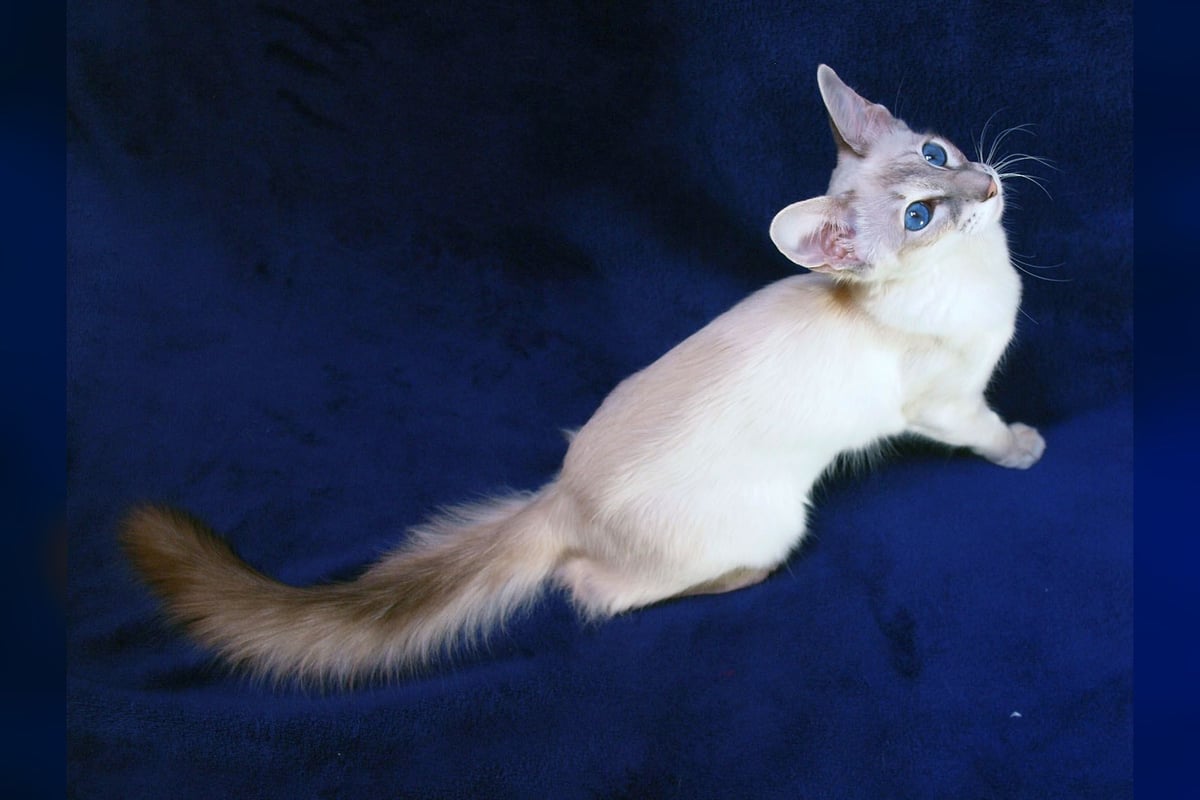
Balinese
The Balinese is the semi-longhair version of the Siamese, born from a spontaneous mutation that appeared in American Siamese litters as early as the start of the 20th century. Long dismissed from breeding programs as a "flaw," it was intentionally selected by two breeders, Helen Smith and Sylvia Holland, who gave it its name in reference to the grace of Balinese dancers. Recognized by the CFA in 1970 and registered today with LOOF, it shares with the Siamese the same tubular oriental morphology and the same hypersocial, vocal temperament — except that its plumed tail and silky, undercoat-free coat give it extra visual elegance for barely more upkeep.
- Weight
- 2.5 to 5kg
- Height
- 25 to 30cm
- Life expectancy
- 16years
- Monthly cost
- 60 to 110€
Personality profile
Energy 5/5
Independence 1/5
Trainability 5/5
Good with children 4/5
Talkativeness 4/5
Space needed 3/5
Attachment to home 5/5
Good with strangers 4/5
Good with cats 4/5
Good with dogs 4/5
Coat care 2/5
Exercise needs 4/5
Scores given on measured axes, data confidence: high.
Living with a Balinese
Description
The silhouette is long, slender and muscular, identical to the modern extreme-oriental-type Siamese. The head is triangular with a long straight nose, large pointed ears set low in line with the head's triangle, and almond-shaped eyes of an intense sapphire blue — a color genetically linked to the colorpoint pattern. The coat is semi-long, fine and silky, free of undercoat: it does not mat and lies flat against the body, lengthening along the flanks and culminating in an abundantly plumed tail, the breed's visual signature. The pattern is colorpoint in all its variants: seal, blue, chocolate, lilac recognized by the CFA; all colorpoint colors accepted by LOOF. Males weigh 3 to 5 kg, females 2.5 to 4 kg. Life expectancy: 15 to 18 years.

Temperament
The Siamese character is inherited in full: hypersocial, hyperdependent on people, incapable of indifference. It follows its owner from room to room, commenting on every action with an abundant vocal vocabulary — slightly less shrill than the pure Siamese's but still present and expressive. It gets bored just as quickly as its ancestor, demands attention with the same insistence, and can develop the same behavioral problems if left alone too long. Playful and clownish, it carries its kitten behaviors well past adulthood. Its strengths: high intelligence, learning ability, responsiveness to its owner's emotions. Its demands: sustained daily human presence and active stimulation — it is not a decoration.
Training
Learning performance matches the Siamese's: the breed is among the cat breeds most receptive to clicker training and intense activity. Its intelligence, its motivation to interact with people and its responsiveness to food rewards make it an ideal candidate for extended training routines — giving a paw, retrieving a toy, running an obstacle course, sustained physical exercise. Sessions should stay short (5 to 10 minutes), daily, and end before it grows tired. Positive reinforcement is the only effective approach: it accepts no physical restraint. Training is also an essential anti-boredom tool for this breed.

Feeding
The metabolic profile is that of the Siamese: hyperactive, it burns through calories and needs a ration matched to its high activity level. Favor kibble rich in animal protein (minimum 35-38%) with a moderate fat level. Taurine is a critical nutrient for heart and eye health — check that it sits high in the ingredient list. Two split meals a day rather than free feeding. Its adult weight is stable, but insistent food-related vocalizing can be mistaken for genuine hunger when it is actually a bid for attention: tell the two apart. Kittens need a calorie-dense diet up to 12 months.
Affiliate links, no extra cost to you. Legal notice

Living conditions
Apartment life goes well provided the environment is stimulating enough: vertical structures, interactive toys, food puzzles. Its compact size lets it adapt to modest spaces, but its hyperactive nature requires interactive play sessions of at least 20 to 30 minutes a day. Prolonged solitude — beyond 4 to 6 hours daily as a routine — is incompatible with its psychological balance. The ideal setup remains a household with someone working from home, or pairing it with another Siamese or Oriental. Indoor living is recommended: its unchecked curiosity and lack of wariness make it vulnerable if allowed to roam freely outdoors.

Grooming and coat care
Despite its semi-long coat, it is one of the easiest longhair cats to maintain, thanks to the total absence of undercoat. Its silky coat does not mat, does not tangle and sheds little. Gentle brushing once or twice a week with a fine comb is enough in steady state to remove dead hair and keep the coat's natural shine. During seasonal molts (spring and fall), step up to two or three brushings a week over three weeks. Caring for the large ears deserves regular attention: clean the canal with an appropriate ear solution every two weeks. Weekly tooth brushing, started in kittenhood, prevents the gingivitis to which oriental breeds are predisposed.

Health
The genetic predispositions are those of the Siamese, from which the breed directly descends. Feline amyloidosis is the most serious: abnormal deposits of amyloid proteins in the liver, kidneys or pancreas, which can progress to sometimes severe organ failure before age five in affected cats. No routine commercial DNA test is available for this condition — monitoring relies on regular blood panels (liver and kidney) from age 2, ahead of the risk window opening. Progressive retinal atrophy (PRA) is documented in oriental lines: an annual ophthalmological screening is advised. Convergent strabismus, linked to the colorpoint genetic background, remains present in certain lines without affecting quality of life. Feline asthma and respiratory sensitivities are reported more often than the feline average. Sensitivity to general anesthetics, common to oriental breeds, means the vet should be informed of the breed before any surgical procedure. The breed is not hypoallergenic, but the absence of undercoat reduces the amount of dead hair shed into the environment, which often makes it better tolerated by people sensitive to feline allergens.
Breed history
Semi-longhair kittens naturally appeared in registered Siamese litters as early as the first decades of the 20th century in the United States, as kittens carrying a recessive gene causing a semi-long coat. Long considered atypical, non-standard individuals, these kittens were systematically excluded from breeding programs. Two American breeders, Helen Smith (New York) and Sylvia Holland (California), were the first to intentionally select these longhaired individuals in the 1940s-1950s. Helen Smith gave them the name "Balinese" in reference to the grace of dancers on the island of Bali — with no genetic or geographic connection to that region. The CFA recognized the breed for championship status in 1970, initially in just four point colors (seal, blue, chocolate, lilac). In 1979, additional colors (lynx points, tortie points) were recognized under the separate name "Javanese." The two divisions merged into a single Balinese standard in 2008. FIFe recognized the breed in 1972; in France, it has been recognized since 1983 and is registered today with LOOF. Today it remains less common than its Siamese ancestor, but is valued for its visual elegance combined with an intact oriental temperament.
Getting ready for your Balinese
Four essentials to line up before day one.
Affiliate links, no extra cost to you. Legal notice
FAQ: Balinese
Sources
- Wikipedia FR — Balinese (cat) · Semi-longhair variety of the Siamese. Recognized: CFA 1970, FIFe 1972, France 1983. Predispositions: amyloidosis (fatal before age 5 in some cats), convergent strabismus. Weight 3-5 kg. No undercoat.
- Royal Canin FR — Balinese profile · Temperament: loyal, affectionate, sociable, talkative, dynamic, intelligent, active, playful. Life expectancy 18-22 years. Minimal upkeep despite the long coat. Thrives best in pairs.
- CFA — Balinese Breed Profile · CFA championship recognition 1970. Balinese/Javanese merger in 2008. Four classic colors (seal, blue, chocolate, lilac) + extended colors. Single-coated, minimal grooming.
- LOOF — Recognized cat breeds · The Balinese is recognized and listed under the semi-longhair category, grouped with the Oriental Longhair. All colorpoint colors accepted.
Breeds similar to a Balinese


See also: Oriental Shorthair