


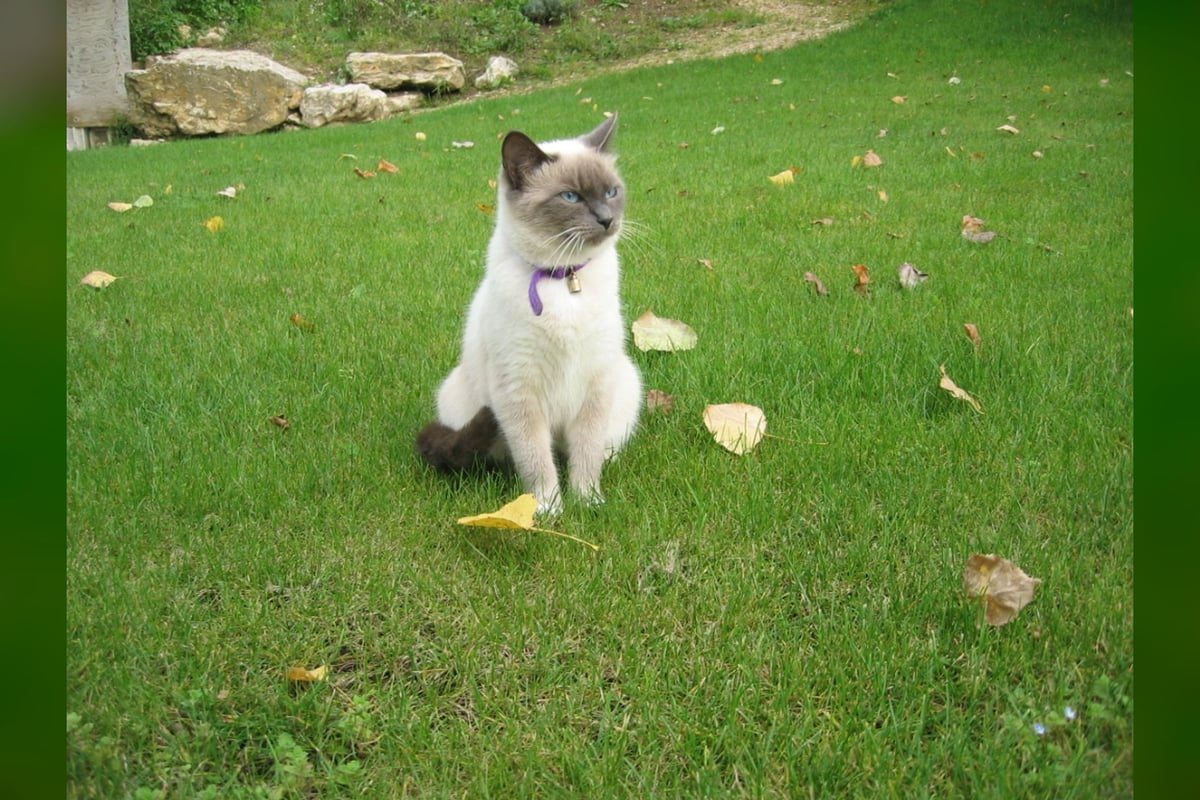
Birman
The Birman, also known as the Sacred Cat of Burma, is a semi-longhaired colorpoint cat recognizable by its four pure white gloves and its deep sapphire eyes. A French breed officially recognized as early as 1925, it holds a steady place near the top of the LOOF's most-registered breeds in France.
- Weight
- 3 to 7kg
- Height
- 25 to 35cm
- Life expectancy
- 14years
- Monthly cost
- 60 to 100€
Personality profile
Energy 2/5
Independence 2/5
Trainability 3/5
Good with children 5/5
Talkativeness 2/5
Space needed 2/5
Attachment to home 5/5
Good with strangers 4/5
Good with cats 5/5
Good with dogs 4/5
Coat care 3/5
Exercise needs 2/5
Scores given on measured axes, data confidence: high.
Living with a Birman
Description
The build is medium and harmonious, with no morphological extremes. The body is substantial without being heavy, the head rounded with a moderately Roman nose, the ears medium-sized and well spaced. The coat is semi-long, silky, with a texture similar to cashmere, and a very sparse undercoat — which sets the breed apart from the Persian and limits matting. Every colorpoint pattern is admitted (seal, blue, chocolate, lilac, red, cream, tortie and tabby) over a body of an off-white shade. The breed's absolute signature remains the white gloves: symmetrically placed on all four paws, with "spurs" running up in a point at the back of the hind legs to the hock. The eyes must always be a deep blue. Males 4-7 kg, females 3-5 kg; body length 30-50 cm. Sexual maturity around 2-3 years.

Temperament
Balanced, neither too independent nor overbearing: this description comes up in every breed profile. It seeks human closeness without imposing a clingy presence: it follows its owners from room to room, settles beside them rather than on top of them, and tolerates long naps alone if the household is secure. Its vocalizing is discreet, soft meows rather than insistent calls. It gets along remarkably well with children, tolerating handling and noise without aggression, and cohabits without difficulty with other cats or dogs properly introduced from kittenhood. Its character is often compared to the Ragdoll's, only more active.
Training
Intelligent, but less eager for active learning than the Maine Coon or the Bengal. It responds well to clicker training for simple routines (coming when called, accepting a harness) but won't actively seek to learn. Motivation works through treats and contact, never coercion. Early kitten socialization to varied sounds, situations and people between 3 and 12 weeks is decisive for its adult stability. Sessions should stay short (5 minutes), positive, and stop before boredom sets in — a Birman that disengages won't spontaneously come back to it for several days.

Feeding
Metabolism is moderate: no extreme caloric intake to plan for, but a real tendency to gain weight after neutering, particularly between ages 3 and 8. A premium diet based on animal protein (>35%) with reduced carbohydrate content works well. For a 5 kg adult, plan on 220-280 kcal/day depending on activity. Splitting into 2-3 meals prevents compulsive snacking. For kittens up to 12 months, favor kitten-specific kibble rich in DHA to support brain development. Adequate taurine intake must be ensured to support heart function, in line with the HCM predisposition.
Affiliate links, no extra cost to you. Legal notice

Living conditions
Apartment life suits it well, even in small spaces (35-50 m²), thanks to a moderate energy level and a contained need for space. An enriched environment (a cat tree, a secured window to watch the outdoors) is enough for its balance. Recommended as an indoor breed: its light coat and trusting temperament make it vulnerable to escapes and urban predators. Its semi-long coat copes well with cold, but it prefers moderate temperatures (18-22 °C); avoid prolonged direct exposure to summer sun. Multi-cat cohabitation is one of its comfort zones, unlike more territorial breeds.

Grooming and coat care
Despite appearances, this is one of the easiest semi-long coats to maintain. A weekly brushing with a soft slicker brush and a fine comb is enough in steady state. During the seasonal molts (spring and fall), step up to 2-3 brushings a week for 3 weeks. No professional grooming is necessary. Check the ears (wax) and eyes (colorpoint breeds secrete more) monthly. The white gloves can yellow from friction against dark surfaces: an occasional gentle shampoo is enough to whiten them.

Health
The breed presents several documented predispositions to watch. Hypertrophic cardiomyopathy (HCM) is reported, with no breed-specific mutation identified as there is in the Maine Coon. Cases of sudden death in young adults, between 1 and 3 years old, linked to cardiac rhythm disorders, have also been described in the literature: this is the window screening needs to cover. A first echocardiographic exam within the first year, followed by an annual check, is therefore worthwhile for breeding cats and companion cats alike — waiting until senior age would miss precisely the at-risk period. The breed also shows increased sensitivity to certain anesthetics: inform the vet before any surgery. Polycystic kidney disease (PKD1), passed down through the Persian lineage and unrelated to skull shape, remains generally rare here but cases exist — a PKD1 DNA test is still worth requesting. Sensitivity to upper respiratory conditions in the first weeks of life in kittens.
Breed history
The origin of the Birman is wrapped in a legend according to which the first kittens were born aboard the ship bringing a pair of sacred temple cats from Lao Tsun (Burma) to France. The historically verifiable version begins in 1919 in Nice, with a queen named Sita belonging to Madame Léotardi. Official recognition came in 1925, under the name "Sacré de Birmanie," from the Fédération Féline Française — the feline authority of the time, with no continuity with the LOOF, created much later. It is one of the oldest breeds officially established in France. World War II bombing raids reduced the population to a single pair, Orloff and Xénia de Kaabaa, from which the entire modern breed descends. The standard was stabilized in the 1950s and the breed spread internationally (CFA in 1967, GCCF in 1966). The LOOF records more than 4 500 registrations a year in France, placing the breed in the national top 5.
Getting ready for your Birman
Four essentials to line up before day one.
Affiliate links, no extra cost to you. Legal notice
FAQ: Birman
Sources
- Wikipedia FR — Sacré de Birmanie · French breed recognized in 1925. Traits: semi-long coat, colorpoint with white gloves, sapphire eyes. Top 5 at the LOOF with more than 4 500 registrations a year.
- LOOF — Recognized cat breeds · The Sacré de Birmanie is among the breeds officially recognized by the Livre Officiel des Origines Félines, semi-longhair category.
- Royal Canin FR — Birman profile · Life expectancy 12-16 years. Temperament described as balanced, sociable, moderately active. Cardiac sensitivity to monitor in the adult.
- FIFé — Birman Breed Standard · FIFé standard: medium build, mandatory white gloves on all four paws, deep blue eyes. Every colorpoint pattern admitted.
Breeds similar to a Birman

