


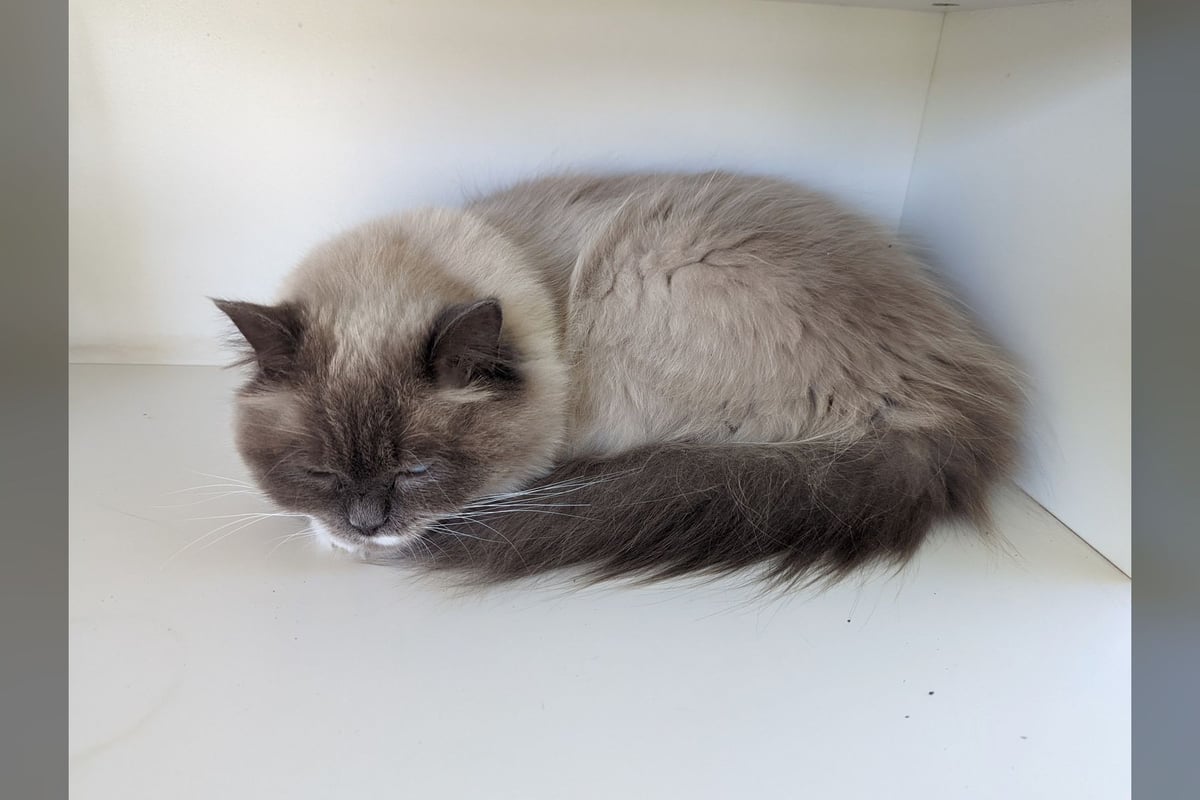
Ragdoll
The Ragdoll is a large semi-longhaired colorpoint cat, developed in the 1960s in California by breeder Ann Baker. Its name — literally "rag doll" — comes from its behavioral quirk: it tends to go completely limp in its owners' arms, becoming as floppy as a plush toy. A popular breed in France with a regular place in the LOOF top 10, it has become one of the default choices for households looking for a calm, gentle, demonstrative cat.
- Weight
- 4 to 9kg
- Height
- 30 to 45cm
- Life expectancy
- 14years
- Monthly cost
- 70 to 110€
Personality profile
Energy 2/5
Independence 1/5
Trainability 3/5
Good with children 5/5
Talkativeness 2/5
Space needed 3/5
Attachment to home 5/5
Good with strangers 5/5
Good with cats 4/5
Good with dogs 5/5
Coat care 3/5
Exercise needs 2/5
Scores given on measured axes, data confidence: high.
Living with a Ragdoll
Description
The body is large, long, sturdy and muscular, on a massive bone structure with a broad chest. Physical maturity is particularly slow: the full adult size is only reached between 3 and 4 years old. The head is triangular with moderate proportions, a slightly convex nose, medium-sized ears rounded at the tip, and large oval eyes that are always a deep, saturated blue — a non-negotiable breed trait. The coat is semi-long, silky and abundant, with a sparse undercoat that considerably limits matting. Three coat patterns are recognized: mitted (with white gloves like the Birman but without the spurs), colorpoint (no white) and bicolor (a white V-shaped mark on the mask). The admitted colors are seal, blue, chocolate, lilac, red, cream, and their tortie/lynx variants. Males 6-9 kg, females 4-6 kg.

Temperament
No cat breed is as universally described as relaxed. Its signature trait — complete muscular relaxation when carried — is observable in the great majority of individuals and gives the cat the appearance of a "rag doll." It actively seeks human contact, follows its owners from room to room, sleeps on them, and accepts children's handling with remarkable patience. Its vocalizing is discreet: it greets with a soft meow and sighs or purrs rather than meowing insistently. Its need for closeness is such that it copes poorly with prolonged solitude — left alone for more than 8 hours a day on a regular basis, it develops visible behavioral melancholy (loss of appetite, over-grooming). It is probably the least independent cat breed in the registry.
Training
Less eager for active learning than the Bengal or the Abyssinian, it remains cooperative and receptive to clicker training all the same. Its motivation comes above all from human contact and treats, never from coercion. Walking on a harness is generally well accepted with gradual training from kittenhood — useful for short outings in a secure garden. Simple routines (coming when called, accepting brushing, standing on a scale) are acquired quickly through positive reinforcement. Its placid nature allows for calm sessions without excessive excitement: 5-10 minutes several times a week. The breed tolerates no physical coercion and remembers negative experiences for a long time — any punishment is counterproductive.

Feeding
Sizeable build and a moderate metabolism: the risk of obesity is real as soon as the ration exceeds its needs. For an active 6 kg adult, plan on 240-300 kcal/day depending on activity level — adjusted downward after neutering and past age 5. Favor premium large-breed kibble with a high animal protein content (≥38%) and taurine to support heart function (HCM prevention). Split into 2 meals a day without leaving food out freely, particularly for neutered cats. For kittens up to 15-18 months, specific large-breed kibble with a balanced calcium/phosphorus ratio. The switch to a senior diet can begin as early as age 7 to anticipate the metabolic slowdown.
Affiliate links, no extra cost to you. Legal notice

Living conditions
Apartment life works, provided human presence is regular. Its moderate energy doesn't call for large floor areas — a 50-60 m² apartment with a medium cat tree is plenty. The breed is recommended strictly indoors: its light coat, unlimited trust in humans and lack of survival instinct make it an easy target for escapes and predators. It tolerates cold well but prefers moderate temperatures (19-22 °C). The limiting factor is never space but the absence of presence: a household where absences regularly exceed 8 hours a day is not advisable, unless it cohabits with another compatible cat.

Grooming and coat care
As with the Birman, the semi-long coat comes with a minimal undercoat, which considerably simplifies upkeep. A weekly 5-10 minute brushing with a fine comb is enough under normal conditions. During the seasonal molts (spring and fall), step up to 2-3 brushings a week for 2-3 weeks. No professional grooming is required. The coat repels moisture and doesn't need regular bathing (1-2 times a year at most). The hind britches and the ruff are the areas to watch for tangling. The breed generally accepts grooming handling well from kittenhood — introducing the comb from 8 weeks makes the routine easier for good.

Health
A genetic heart predisposition dominates the picture: hypertrophic cardiomyopathy (HCM) linked to the MyBPC3 R820W mutation, specific to the breed and different from the Maine Coon mutation. The MyBPC3 DNA test (R820W variant) is essential on both breeding parents — ask for the results before buying. Annual echocardiographic screening from age 2 is recommended even for cats that test negative, since the mutation accounts for only part of the cases. Polycystic kidney disease (PKD1, inherited from old crosses with the Persian) is reported but remains rare; a DNA test is available. The breed also shows a particular sensitivity to feline coronavirus (FCoV), which can develop into FIP (feline infectious peritonitis), although the genetic susceptibility remains debated. Its tendency toward obesity after neutering calls for strict weight monitoring throughout life.
Breed history
The Ragdoll was born in 1963 in Riverside, California, at the initiative of Ann Baker, who crossed a white Angora queen named Josephine with several males. The kittens' unusual traits — large size, very docile temperament, muscular relaxation when carried — led Baker to protect the breed with a trademark ("Ragdoll") and to impose strict breeding conditions through her own association, IRCA. This proprietary approach slowed recognition by independent federations. Recognition finally came from the FIFe in 1992, the CFA in 1993, and then the LOOF shortly after. The trademark's legal status has since expired, and the breed is now freely bred by any breeder who follows the standard. In France, its popularity has grown since the 2000s, with a regular presence in the LOOF top 10 registrations.
Getting ready for your Ragdoll
Four essentials to line up before day one.
Affiliate links, no extra cost to you. Legal notice
FAQ: Ragdoll
Sources
- Wikipedia FR — Ragdoll · Breed created by Ann Baker in the 1960s in Riverside, California. CFA recognition 1993, FIFé 1992. Specific HCM MyBPC3 R820W mutation.
- LOOF — Recognized cat breeds · The Ragdoll is among the breeds officially recognized by the Livre Officiel des Origines Félines, semi-longhair category. Top 10 in France.
- Royal Canin FR — Ragdoll profile · Maturity 3-4 years. Life expectancy 13-16 years. Calm, sociable breed, not very vocal, copes poorly with prolonged solitude.
- CFA — Ragdoll Breed Profile · CFA standard: a large cat with a relaxed pose, mandatory deep blue eyes, three patterns mitted/colorpoint/bicolor. Slow maturation 3-4 years.
Breeds similar to a Ragdoll

