


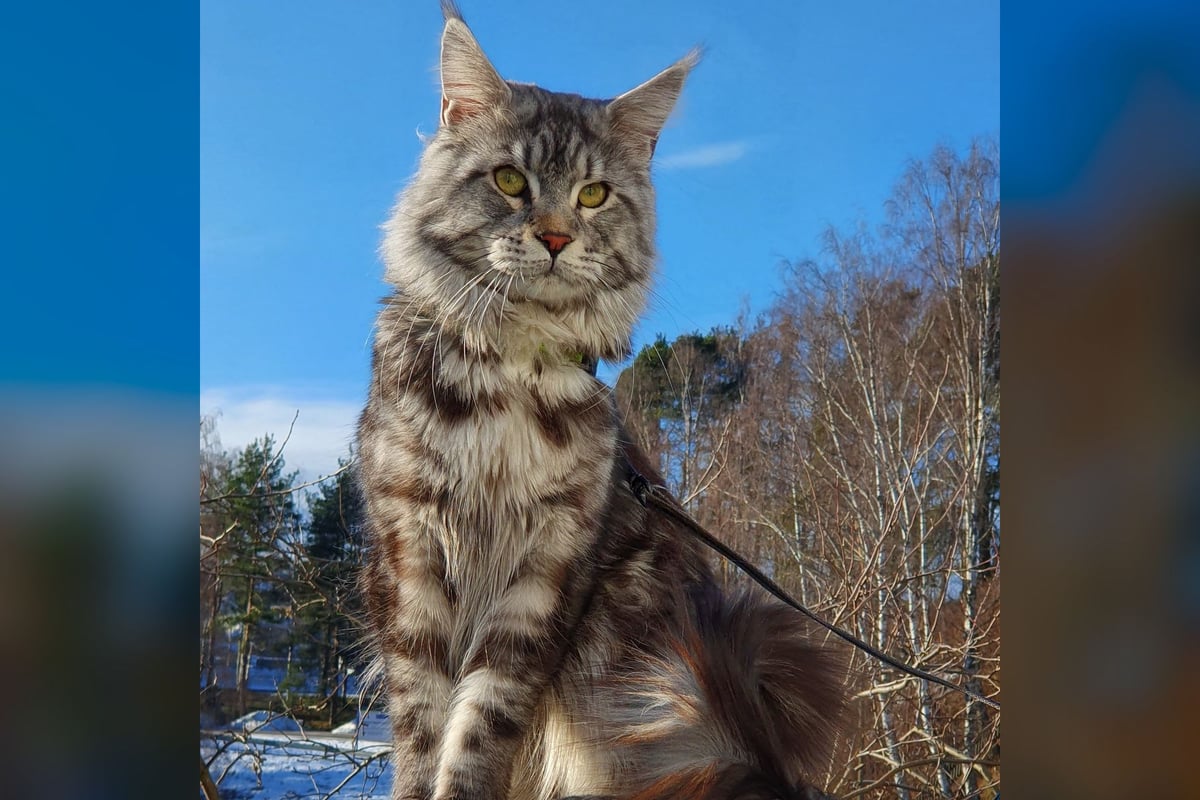
Maine Coon
The Maine Coon is the largest semi-longhaired domestic cat, native to the state of Maine (USA), weighing 5 to 10 kg depending on sex. The number one breed in France at the LOOF since 2012, with more than 26 000 registrations a year, it is nicknamed the "gentle giant" for its calm, sociable temperament despite its imposing frame.
- Weight
- 5 to 10kg
- Height
- 25 to 41cm
- Life expectancy
- 13years
- Monthly cost
- 70 to 120€
Personality profile
Energy 3/5
Independence 3/5
Trainability 4/5
Good with children 5/5
Talkativeness 2/5
Space needed 5/5
Attachment to home 4/5
Good with strangers 4/5
Good with cats 4/5
Good with dogs 4/5
Coat care 4/5
Exercise needs 3/5
Scores given on measured axes, data confidence: high.
Living with a Maine Coon
Description
The silhouette is long and rectangular, with a broad chest, powerful musculature and a semi-long double coat whose length varies: shorter on the shoulders, longer on the flanks, belly and bushy tail. The head is broad with a square muzzle, large high-set ears topped with lynx tips, and large expressive eyes. The coat is accepted in every traditional color except chocolate, lilac, cinnamon and fawn; colorpoint is excluded from the standard. Males reach 7 to 10 kg, females 5 to 7 kg, for a nose-to-tail length of 48 to 100 cm. Maturity is slow: the breed only reaches full adult size between 3 and 5 years old. Life expectancy: 12 to 15 years.

Temperament
Universally described as the "gentle giant" of the cat world, the Maine Coon pairs an impressive frame with a remarkably gentle character. It is sociable, affectionate and curious, and follows its owners from room to room without being intrusive. Its practical intelligence shows in distinctly dog-like behavior: it fetches toys, answers to its name and can learn simple tricks. It lives easily with children, with other cats and even with dogs when introductions are handled properly. Its voice is discreet — trills and chirps rather than loud meows — which contrasts with its stature. It stays playful and curious well beyond kittenhood.
Training
Few cat breeds take to learning this readily. Natural curiosity, plus motivation by play and food rewards, makes it an ideal candidate for clicker training. It can learn to give a paw, fetch a toy, answer to its name or run a small obstacle course. Short sessions (5-10 minutes) repeated daily give the best results. The method must rely purely on positive reinforcement; it does not tolerate physical restraint or punishment, which would break the trust built up.

Feeding
Up to 15 months, use a large-breed kitten food rich in animal protein with balanced calcium and phosphorus, to support the slow growth and bone development. In adulthood the ration must match the frame: an active 8 kg male needs roughly 280-350 kcal a day depending on activity level. Prefer premium food high in taurine (heart-protective, particularly relevant given the HCM predisposition). Avoid overfeeding: the breed tends to gain weight with age, especially in neutered indoor cats. Two split meals a day rather than free feeding.
Affiliate links, no extra cost to you. Legal notice

Living conditions
Apartment life is possible, but a small home is not advisable: its imposing size and active nature argue for a house with a secure garden, or failing that a spacious home of at least 60-70 m² with vertical structures (tall cat trees, wall shelves) and ideally access to a large secure outdoor space (catio, netted balcony). A northern breed, it copes well with cold but is sensitive to intense heat: avoid long exposure during heatwaves. Keeping it indoors is recommended to prevent accidents and infectious disease.

Grooming and coat care
The semi-long coat needs brushing 2 to 3 times a week with a wide-toothed metal comb, to untangle the undercoat without damaging the outer coat. During the seasonal molts (spring and fall), daily brushing for 2 to 3 weeks prevents mats and excessive hair ingestion. The tufts between the toes should be checked and, if needed, trimmed slightly. A quarterly bath is an option for cats that accept it. Clean the ear tufts regularly; too much hair in the ear canal can encourage ear infections.

Health
The breed is predisposed to several genetic conditions that must be monitored. Hypertrophic cardiomyopathy (HCM) is the most critical: linked to a mutation of the MyBPC3 gene (autosomal dominant), it affects a significant share of the breed. The MyBPC3 DNA test is essential on breeding cats — ask for the results before buying. Spinal muscular atrophy (SMA), recessive, causes progressive muscle weakness; it is also detectable by DNA test. Hip dysplasia is common (up to 20% of individuals according to studies, bilateral in 72% of cases) and may require surgery. Pyruvate kinase deficiency (PKDef), which causes hemolytic anemia, is detectable by DNA test. Annual echocardiograms from the age of 2 are recommended even for cats that test negative, since the mutation is not the only cause of HCM.
Breed history
The Maine Coon takes its name from the state of Maine, in the northeastern United States, whose official state cat it is. Its exact origin is still debated: the most widely accepted hypothesis has it descending from crosses between local farm cats and longhaired cats brought over by sailors or European immigrants, adapted over several generations to the harsh New England climate. Popular legends — one of them involving Marie-Antoinette — circulate with no historical basis. The breed appears in cat shows from the 1860s-1880s and won prizes in New York in 1895. In the early 20th century the popularity of Persians imported from Europe pushed it into the background, and the breed nearly disappeared. It was saved in the 1950s-1970s by dedicated Maine breeders, recognized by the CFA in 1976 and quickly adopted in Europe. In France the LOOF has registered it since the 1990s; it has been the most registered breed since 2012.
Getting ready for your Maine Coon
Four essentials to line up before day one.
Affiliate links, no extra cost to you. Legal notice
FAQ: Maine Coon
Sources
- Wikipedia FR — Maine Coon · Number one breed at the LOOF since 2012; 26 661 registrations in 2022. HCM linked to the MyBPC3 mutation, hip dysplasia in up to 20% of individuals.
- LOOF — Recognized cat breeds · The Maine Coon is among the breeds officially recognized by the Livre Officiel des Origines Félines, semi-longhair category.
- Royal Canin FR — Maine Coon profile · Life expectancy 12-15 years. Maturity between 3 and 5 years. Diet matched to the frame, and HCM prevention through taurine intake.
- CFA — Maine Coon Breed Profile · Largest recognized pedigreed cat. Males regularly over 20 lbs. HCM and hip dysplasia testing recommended by the CFA.

