


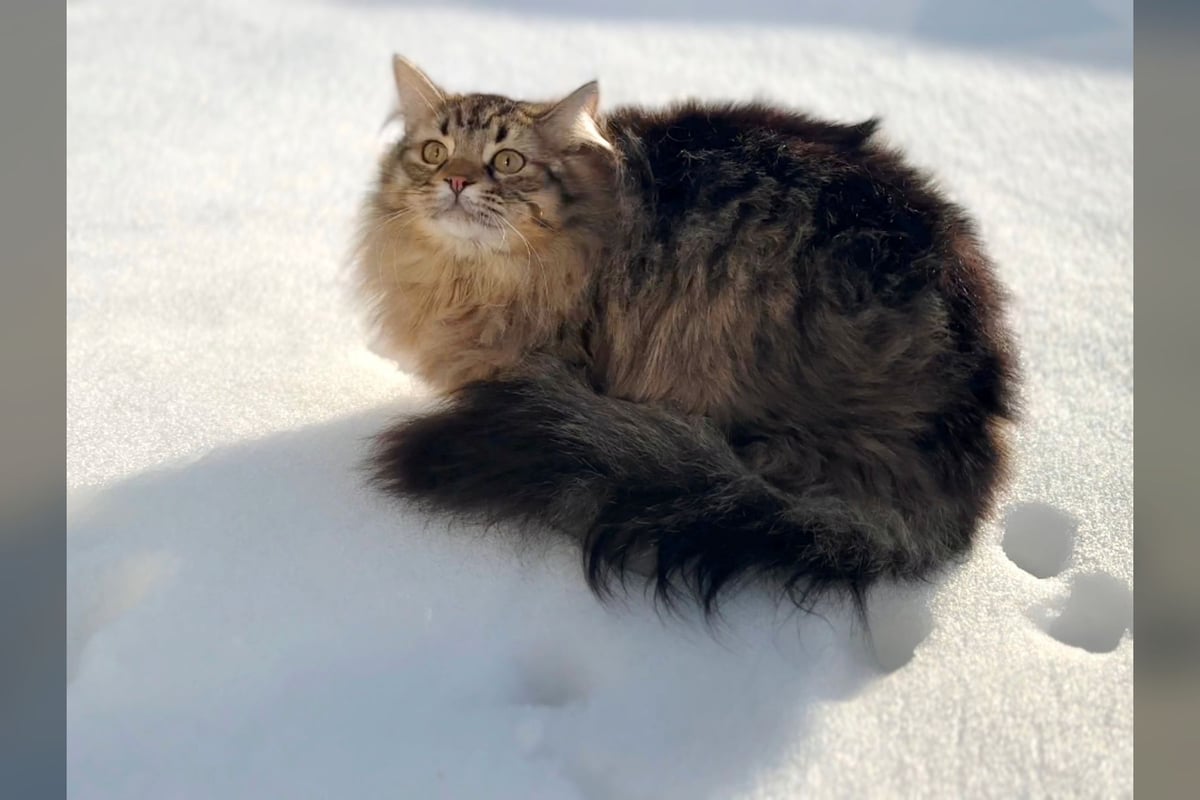
Siberian
The Siberian is a Russian natural breed whose documented history dates back to the year 1000, shaped by millennia of extreme Siberian winters. It stands out for its semi-water-resistant triple coat, its powerful semi-cobby build and, above all, a rare immunological trait: about half of individuals produce Fel d 1 levels — the main feline allergen protein — statistically below average, making it the breed best documented for tolerance among allergy sufferers. Ranked near the top of LOOF registrations in France, recognized by the CFA since 2000 and by FIFe, it remains a large cat (4–9 kg depending on sex) with slow maturity (3–5 years) and a long lifespan.
- Weight
- 4 to 9kg
- Height
- 28 to 33cm
- Life expectancy
- 15years
- Monthly cost
- 65 to 110€
Personality profile
Energy 4/5
Independence 3/5
Trainability 3/5
Good with children 4/5
Talkativeness 3/5
Space needed 4/5
Attachment to home 4/5
Good with strangers 3/5
Good with cats 4/5
Good with dogs 4/5
Coat care 4/5
Exercise needs 4/5
Scores given on measured axes, data confidence: high.
Living with a Siberian
Description
The breed has a semi-cobby silhouette — rounder and more compact than the Norwegian or the Maine Coon — with a barrel-shaped torso, heavy bone structure and dense musculature. The head forms a modified wedge with rounded contours, a broad, slightly domed forehead, a full chin and a medium-length nose without a marked stop. The eyes are almost round, slightly oblique, and accept every color except blue in the absence of colorpoint. The coat is the central feature: a triple layer made up of a dense, woolly undercoat, an intermediate layer (awn hair) and a long, water-resistant outer coat, oily to the touch. An abundant ruff frames the neck in winter, along with pronounced britches and a very bushy tail reaching the shoulder blades when laid forward. Males weigh 5.5–9 kg, females 4–6 kg. The colorpoint variant, with mandatory blue eyes, is recognized under the name Neva Masquerade. All traditional coats are accepted. Full maturity is reached only between 3 and 5 years.

Temperament
A cat of constant presence without being intrusive, it follows its owners around the apartment, observes household activities with curiosity and gets involved in everything happening around it. Its vocalization is moderate — soft trills, intense purring — and mainly serves to initiate contact rather than to demand. Playful well into old age, it enjoys simulated hunting games and structured interactions, and can learn to walk on a leash with a gradual introduction. Its behavior with strangers follows an observe-before-accepting pattern: reserved for the first few minutes, it quickly settles in once reassured by the familiar setting. The breed cohabits well with children able to respect its signals, other cats, and properly introduced dogs. Its practical intelligence lets it solve food puzzles and memorize routines quickly.
Training
The breed is receptive to positive-reinforcement learning — clicker training, treats, play — with decent focus for 5–10 minute sessions. Its practical intelligence and curiosity make it well suited to obstacle courses and search games that channel its high activity needs. Harness and leash are generally well accepted with a gradual introduction starting in kittenhood. Leash walking, a minority practice among pedigree cats, suits it particularly well given its exploratory temperament. Avoid any physical restraint: the breed observes and tests limits rather than submitting, and a bad learning experience is remembered for a long time.

Feeding
For an active 6–7 kg adult, plan 270–340 kcal/day depending on exercise level. Favor large-breed kibble rich in animal protein (≥38%) and taurine for cardiac support, particularly relevant given the HCM predisposition. During the slow growth phase (up to 4–5 years), large-breed kitten kibble provides a calcium/phosphorus ratio suited to gradual bone development. Split into 2–3 meals a day. The breed can put on weight after neutering: reduce intake by 15–20% at the first signs of weight gain and avoid free feeding.
Affiliate links, no extra cost to you. Legal notice

Living conditions
It thrives in an apartment of at least 60–70 m², or ideally a house with a garden, offering vertical climbing structures and physical exercise space: its active nature and daily need for sporting activity make cramped volumes difficult to sustain long term. A cat tree of at least 2 meters, usable wall shelves and daily interactive play sessions (20–30 minutes of hunting games, activity courses, indoor sport) are non-negotiable. Access to a secure outdoor space — a netted balcony, a garden enclosure, a large area — is substantial enrichment for a breed whose ancestors hunted in Siberian forests. Suited to cold and temperate climates, it copes poorly with prolonged heat above 26 °C: ventilation or air conditioning and permanent access to fresh water are necessary during heatwaves. Its water-resistant triple coat naturally protects it against short exposure to rain or cold.

Grooming and coat care
The triple coat needs brushing 2–3 times a week under normal conditions (routine grooming), stepped up to daily brushing during the two major seasonal molts (spring and fall), when the woolly undercoat sheds heavily. Use a wide-toothed metal comb to detangle the outer layer, then a fine-toothed comb to remove dead undercoat without pulling out the guard hairs. The coat's water-resistant, slightly oily structure protects it from excessive matting: it tangles less easily than the Persian or the Angora, but the ruff, britches and tail base deserve particular attention. A bath once or twice a year is enough and stays difficult given the water-resistant nature. Regularly clean the ear and toe tufts.

Health
The breed's main predisposition is hypertrophic cardiomyopathy (HCM), as with most large cat breeds. Serious breeders submit their breeding cats to annual echocardiogram screening from age 2; no mutation specific to the breed has been identified as it has been in the Maine Coon (MYBPC3), which makes DNA testing insufficient — only echocardiography is reliable. Polycystic kidney disease (PKD) is also monitored, with a DNA test available. Demand negative PKD results on both breeding parents at purchase. The breed is generally robust with a long life expectancy (15–18 years) and few breed-specific genetic diseases beyond these two points. Weight gain after neutering remains the common point to watch — dietary control from 18 months.
Breed history
The Siberian is mentioned in Russian texts as early as 1000 AD and appears regularly in accounts of Siberian fairs and markets from the 17th to the 19th centuries, where it was valued for its ability to hunt rodents in warehouses and barns. The breed developed naturally under the selective pressure of one of the harshest environments on the planet, without formal human intervention. A structured breeding program only emerged starting in the 1980s in the USSR, amid the cultural liberalization that finally allowed cat shows. The first official Russian standard was adopted in 1987. The first Siberians reached North America in 1990 via Starpoint cattery, and the CFA accepted them for registration in 2000 before granting championship status in 2007. FIFe recognized it in the 1990s, LOOF after its creation in 1996. The colorpoint variant, the Neva Masquerade, was long debated among federations before being incorporated into the standard as a subtype.
Getting ready for your Siberian
Four essentials to line up before day one.
Affiliate links, no extra cost to you. Legal notice
FAQ: Siberian
Sources
- Wikipedia FR — Siberian (cat) · Russian natural breed attested since the year 1000. LOOF, CFA (2000, champion 2007) and FIFe recognition. Males 5–10 kg, females 3–8 kg. Neva Masquerade = colorpoint variant. Low Fel d 1 production documented in ~50% of individuals.
- LOOF — Recognized cat breeds · The Siberian is among the breeds officially recognized by the Livre Officiel des Origines Félines, semi-longhair category.
- Royal Canin FR — Siberian Profile · Male weight 7–8 kg, female 5.5–6 kg, size 28–33 cm. Water-resistant triple coat. HCM and overweight predispositions. Brushing 2–3 times a week outside molting.
- CFA — Siberian Breed Profile · Accepted for CFA registration in 2000, champion 2007. Males 12–18 lbs, females 8–12 lbs. Maturity around 3 years. HCM, PKD and recessive-condition screening recommended.

