


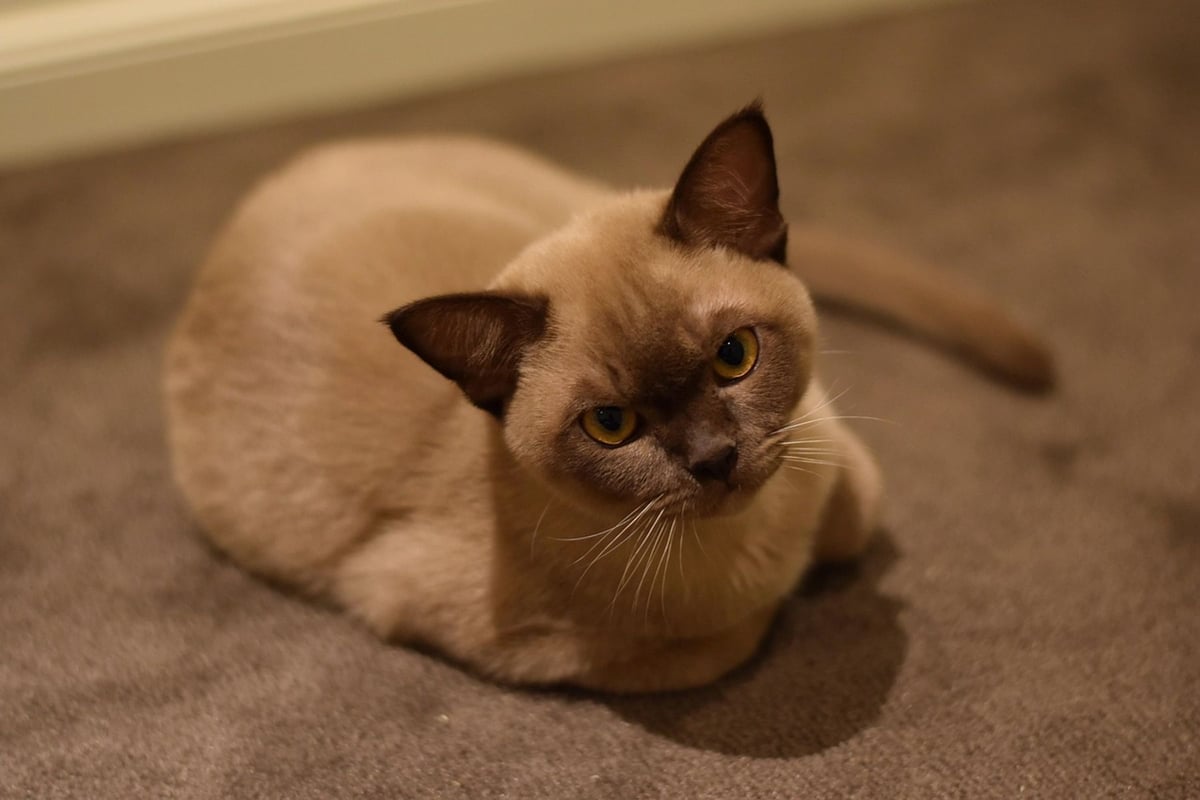
Burmese
The Burmese is a shorthaired breed native to Southeast Asia, founded on a single female cat — Wong Mau — imported to the United States in 1930 by Dr. Joseph Thompson. Note: the Burmese has no connection to the Birman (Sacred Cat of Burma). These are two radically different breeds: the Burmese has a short, satiny brown coat and amber eyes; the Birman has a long colorpoint coat and white gloves. The Burmese today exists in two separately recognized types — American (very round cobby) and European (more moderate semi-foreign) — and in many colors beyond the classic sable brown.
- Weight
- 3.5 to 6kg
- Height
- 22 to 30cm
- Life expectancy
- 14years
- Monthly cost
- 60 to 100€
Personality profile
Energy 4/5
Independence 1/5
Trainability 4/5
Good with children 5/5
Talkativeness 4/5
Space needed 3/5
Attachment to home 5/5
Good with strangers 4/5
Good with cats 4/5
Good with dogs 4/5
Coat care 1/5
Exercise needs 3/5
Scores given on measured axes, data confidence: high.
Living with a Burmese
Description
The silhouette is medium-sized, muscular and compact, heavier than it appears to the hand — a trait often described in the CFA standard. Two morphological types coexist and are recognized separately depending on the federation. The American Burmese (CFA) is of the cobby type: a very round, almost spherical head, with a broad muzzle and high cheekbones, medium ears tilted forward, and round, very large eyes. The European or English Burmese (LOOF, GCCF) is of the semi-foreign type: a rounded wedge-shaped head, a longer, more moderate muzzle, ears wider at the base. In both types, the coat is short, extremely fine, satiny, with almost no undercoat, lying very close to the body — a texture often compared to silk or suede. The eyes range from pale yellow to intense golden amber depending on the line. The classic base color is sable brown. Variants are recognized depending on the federation: blue (warm slate gray), chocolate (called champagne in the US), lilac (called platinum in the US), red, cream, and the corresponding tortie patterns. Males generally weigh 4.5 to 6 kg, females 3.5 to 4.5 kg. Life expectancy: 12 to 16 years.

Temperament
The Burmese is often nicknamed the "velcro cat": it literally sticks to its person, follows them from room to room, settles on laps or against a shoulder, and shows an almost dog-like attachment. It is a deeply social breed, unable to thrive in isolation. Its vocalizing is forthright: it communicates through regular, expressive meows, simply less shrill and less intrusive than the Siamese's — a very present conversation partner, but rarely exhausting. Its energy is sustained: playful and curious well into adulthood, it launches into exploration and interactive play sessions with enthusiasm. It is excellent with children, tolerating handling patiently, and gets along well with other cats or properly introduced dogs. Prolonged solitude is its main weak point: an individual left alone regularly for more than 6-8 hours develops stress and compensatory behaviors. Adopting in pairs is strongly advised for frequently absent households.
Training
Intelligent and motivated by human interaction, this cat is a receptive candidate for clicker training. Its natural curiosity and its attachment to its owner give it a base level of engagement that few shorthaired breeds surpass. It can learn to answer to its name, come on command, accept a harness or perform simple routines (jump onto a stool, offer a paw). Short 5-10 minute sessions, daily and ended before it grows tired, give the best results. Positive reinforcement through treats and contact is the only effective method — no physical restraint. Training also serves as a mental stimulation tool, particularly useful for a cat left alone for a few hours.

Feeding
An active breed with a moderate frame, it burns its calories without excess. A premium diet rich in animal protein (minimum 35-38%) and moderate in carbohydrates suits it well. The predisposition to diabetes mellitus in neutered adults argues for limiting kibble with a high glycemic index (rich in refined grains) and favoring low-starch formulas, or even a portion of wet food. For a 4-5 kg adult, plan on about 200-250 kcal/day depending on activity. Two split meals a day are preferable to free feeding. Taurine should rank prominently in the formula to support heart function. Monitor weight regularly: neutering reduces energy needs without reducing appetite.
Affiliate links, no extra cost to you. Legal notice

Living conditions
Apartment life goes well, even in modest square footage, provided stimulation is on offer. It does not have the Maine Coon's extreme vertical space needs, but it appreciates cat trees, perches and chase games — sustained daily physical activity is essential for this energetic breed. Heat suits it well — a very short-coated breed with no undercoat, it is sensitive to cold and drafts: avoid unheated environments in winter, a mild indoor climate is recommended. Indoor life is recommended: its trusting, not-very-wary temperament makes it vulnerable to outdoor dangers. Regular human presence is non-negotiable for its balance — a cat of this breed in a frequently empty household deteriorates quickly on the behavioral front. Welcoming a second cat (ideally another Burmese or an Oriental) is the best solution for regular absences.

Grooming and coat care
Few breeds are as low-maintenance. Its short, satiny, undercoat-free coat does not mat and sheds very little day to day. A weekly pass with a rubber grooming glove or a damp chamois is enough to remove dead hair and maintain the coat's natural sheen. The shedding season is not very pronounced. Bathing is rarely necessary, except for shows or the occasional mishap. Check the ears monthly (wax) and the eyes — the round-faced American Burmese can have mild eye discharge that needs cleaning. Dental care deserves attention: weekly brushing to prevent tartar. Trim the claws every two to three weeks.

Health
Several genetic predispositions should be known before acquisition. Hereditary hypokalemia (a muscular potassium deficiency) is the most documented in American lines: it causes episodes of muscle weakness, tremors and difficulty holding the head up ("head bobbing"). A DNA test is available and running it on breeding cats is strongly recommended — require the results from the breeder. The skull malformation known as "head fault" (craniosynostosis) exclusively affects certain American lines with an extremely round head: affected kittens are born with a severe craniofacial malformation incompatible with life. This malformation is linked to intensive selection for the cobby type and does not concern the European type. Diabetes mellitus is documented at a higher frequency than the feline average, particularly in neutered males over 8 years old — a low-glycemic-index diet is preventive. Primary open-angle glaucoma has been reported in the breed. In cases of prolonged fasting (illness, anorexia), the risk of hepatic lipidosis exists as in most cats, but vigilance is heightened here given its metabolic predisposition. An annual veterinary check-up including blood glucose is advised from age 6; serum potassium, on the other hand, should be checked at any age at the first sign of muscle weakness, without waiting for the senior years.
Breed history
The history of the modern Burmese begins in 1930, when Dr. Joseph Thompson, an American Navy physician and enthusiast of Oriental cats, brought back from Burma (present-day Myanmar) a small dark-brown female cat named Wong Mau. Convinced he had a distinct breed rather than a brown Siamese, he had her crossed with a seal-point Siamese, then selected the darkest kittens over several generations. Wong Mau turned out to be genetically hybrid — carrying her own coloration mutation — and became the sole founder of the entire Burmese breed. The CFA recognized the Burmese in 1936. In Europe, lines imported from the United States after World War II evolved differently under the influence of British breeders, giving rise to the European Burmese, of the more moderate semi-foreign type, recognized separately by the LOOF and the GCCF. The two types — American and European — are today considered distinct breeds by the CFA but are often grouped under a single standard by European federations. In France, the LOOF registers both variants (American Burmese and English/European Burmese). The breed remains popular and regularly appears in rankings of the most beloved breeds, despite being less well known than the Siamese or the Maine Coon among the general French public.
Getting ready for your Burmese
Four essentials to line up before day one.
Affiliate links, no extra cost to you. Legal notice
FAQ: Burmese
Sources
- Wikipedia FR — Burmese (cat) · Origin: Wong Mau, imported in 1930 by Joseph Thompson. Two types, American (cobby) and European (semi-foreign). CFA recognition 1936. Distinction from the Birman confirmed.
- CFA — Burmese Breed Standard · Cobby standard: round head, compact body. Four recognized colors: sable, champagne, blue, platinum. Velcro-cat temperament documented.
- LOOF — Recognized cat breeds · The LOOF recognizes two distinct entries: English Burmese and American Burmese (with Bombay). Shorthair breeds officially registered.
- Royal Canin FR — Burmese profile · Playful, mischievous and deeply affectionate. Highly dependent on human presence. Short coat, minimal upkeep. Origin: Myanmar.

