


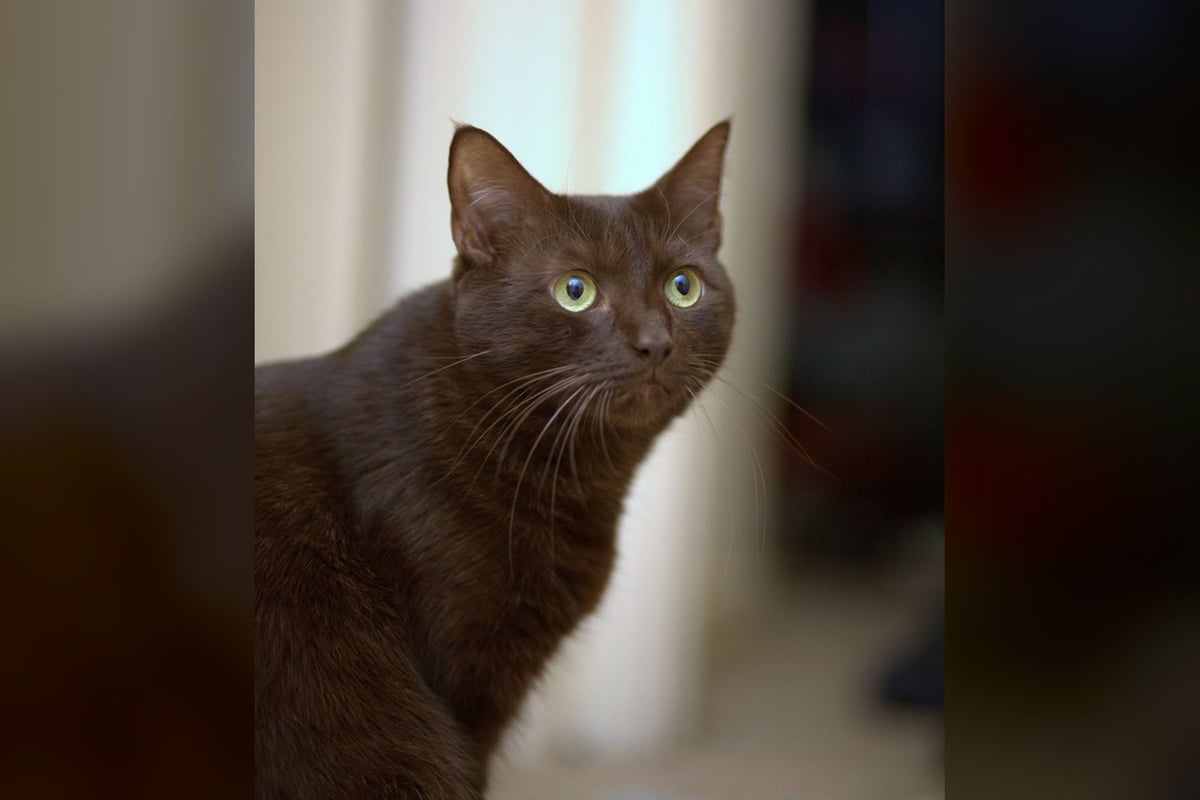
Havana Brown
The Havana Brown is one of the rarest cat breeds in the world: only around fifteen active catteries remain worldwide, twelve of them in North America. Born in the United Kingdom in the 1950s from a deliberate cross between chocolate-point Siamese and black domestic cats, it stands out for its uniformly warm chocolate coat, intense green eyes and — a trait unique in the cat world — brown whiskers. Its temperament recalls the Siamese's, but in a calmer, less insistent register.
- Weight
- 3 to 4.5kg
- Height
- 23 to 30cm
- Life expectancy
- 13years
- Monthly cost
- 60 to 110€
Personality profile
Energy 3/5
Independence 2/5
Trainability 4/5
Good with children 4/5
Talkativeness 3/5
Space needed 3/5
Attachment to home 5/5
Good with strangers 3/5
Good with cats 4/5
Good with dogs 4/5
Coat care 1/5
Exercise needs 3/5
Scores given on measured axes, data confidence: medium.
Living with a Havana Brown
Description
The body is semi-foreign in type, medium and well muscled — neither the extreme slenderness of the modern Siamese nor the cobby compactness of the Persian. The head, longer than it is wide per the CFA standard, narrows toward a rounded muzzle with pronounced whisker breaks, giving the profile a distinctive look known as the "corn cob muzzle" in English-language literature. The eyes are oval, a vivid, even green, set wide. The ears are large and slightly tilted forward. But it is the coat that defines the breed's identity above all: a warm, rich brown with rosy-mahogany highlights, evenly distributed over the whole body, with no tabby markings or lighter patches. The nose leather and paw pads are pinkish-brown with a hint of mauve. And above all: the whiskers are brown — neither white nor black — which to this day makes it a singularity with no equivalent among recognized cat standards. Males generally weigh 3.5 to 4.5 kg, females 3 to 4 kg. The fur is short, smooth, glossy, with no dense undercoat.

Temperament
It inherits the Siamese genetic background but expresses a toned-down version of it: sociable and attached, it lacks the Siamese's constant vocal insistence and its hyperactivity. It happily follows its owner from room to room, seeks physical contact, likes perching on shoulders, and shows unusually tactile behavior — many individuals use a front paw as a tool for exploring and seeking attention, gently grasping a hand or an object that interests them. Curious and playful, it stays active without being exhausting. It copes poorly with long absences and does not thrive in prolonged isolation. Its vocal level is moderate: it communicates, but without the Siamese's constant stream. With children and other pets, it is generally at ease, provided interactions stay respectful.
Training
It is receptive to positive-reinforcement training. Its practical intelligence and tactile curiosity — it readily uses its paws to explore and interact — make it an interesting candidate for clicker training: giving a paw, coming to its name, sitting on command. Short sessions of five to ten minutes, repeated daily, give the best results. Positive reinforcement is the only effective method; it accepts no physical restraint. Training also serves as a mental-enrichment outlet suited to its moderate activity profile.

Feeding
This is a moderately active cat whose ration should reflect that intermediate energy level — neither the high caloric intake of the hyperactive Siamese, nor the strict restriction of a sedentary cat. Kibble rich in animal protein (35% minimum) with a good taurine content — a nutrient critical for heart and retinal health, particularly relevant given the Siamese family's PRA predispositions — forms the appropriate base. Two split meals a day are better than free feeding for maintaining a stable weight. Include a wet-food fraction to support hydration and long-term kidney health.
Affiliate links, no extra cost to you. Legal notice

Living conditions
It suits apartment life, even a modest-sized one, provided environmental enrichment is sufficient: scratching posts, interactive toys, accessible heights. It appreciates regular human presence and does not suit households where absences regularly exceed six to eight hours with no company — adopting as a pair, or alongside another sociable cat, is advisable for very often-absent profiles. Its short coat and lack of a dense undercoat make it more sensitive to cold than thick-coated breeds: keeping a heated home in winter is preferable. An exclusively indoor life is recommended to preserve its health and limit the risk of accidents.

Grooming and coat care
Coat care is minimal. The short, smooth coat with no dense undercoat does not mat and sheds little. A weekly pass with a rubber glove or a small chamois cloth is enough to remove dead hair and maintain the breed's characteristic natural shine. Bathing is rarely needed. Dental care deserves particular attention given the predisposition to gingivitis: weekly brushing (daily if possible) is recommended from a young age. Monthly ear cleaning with a suitable ear solution.

Health
The breed shows no disease genetically specific to it in the available studies. However, through its direct Siamese ancestry, it shares that family's predispositions. Feline amyloidosis — amyloid protein deposits in the liver, kidneys or pancreas — is documented in the Siamese family and represents a risk to monitor in the breed, although no standardized DNA test is available. Annual liver and kidney blood work from 5-6 years of age is therefore recommended. A slightly above-average incidence of gingivitis is observed, likely linked to the Siamese genetic background. Feline asthma and progressive retinal atrophy (PRA, partially testable) are also among the family's risks. But the breed's most serious health risk is systemic, not individual: inbreeding. With roughly twelve to fifteen active catteries worldwide, the breeding pool is catastrophically small. Decades of closed-circuit selection have compressed genetic diversity to a critical level, mechanically raising the risk of deleterious recessives expressing and weakening immune resilience. In response, the CFA allowed controlled rescue outcrosses starting in 2018-2019, with the Oriental Shorthair, seal- or chocolate-point Siamese, and unregistered black or blue domestic cats. Offspring from these crosses can be registered as Havana Brown if they meet the standard. This program is the breed's main conservation strategy.
Breed history
The Havana Brown was born in the United Kingdom in the 1950s from a deliberate program aimed at producing a cat with a uniformly chocolate coat. Mrs. Munro-Smith and other British breeders gathered within the "Havana Group" crossed Siamese carrying the chocolate-point gene with black shorthaired domestic cats, also bringing in Russian Blue breeding cats to refine the morphology. The result, achieved within a few generations, was a semi-foreign-type cat with a uniform warm brown coat, first named the "Chestnut Brown Foreign" in the United Kingdom — a name that emphasized its membership in the foreign-type group of breeds rather than a geographic origin. The name "Havana" — by color analogy with cigar tobacco — gradually took hold, particularly in the United States, where breeders developed their own line. The breed was exported to the United States in the second half of the 1950s. The CFA accepted it for registration in 1959 and granted it championship status in 1964. This is where a divergence begins: American breeders worked in a closed circuit, with no outside crosses, refining a standard slightly different from the British type — a longer head, a rounder muzzle — which became the Havana Brown as the CFA describes it today. In the United Kingdom, the breed evolved in a direction closer to the elongated Siamese type and remains recognized under the name Havana by the GCCF, with a distinct standard. The population decline set in gradually starting in the 1980s, worsening over the following decades. The genetic closure of the CFA registry, combined with breeders' growing lack of interest in a breed that wasn't commercially eye-catching, reduced the breeding pool to a handful of catteries. By the turn of the 2020s, roughly twelve active catteries remained in North America, with a few more in Europe. Faced with this critical situation, the CFA opened a controlled outcross program in 2018-2019, today the only realistic strategy to avoid extinction in the medium term.
Getting ready for your Havana Brown
Four essentials to line up before day one.
Affiliate links, no extra cost to you. Legal notice
FAQ: Havana Brown
Sources
- Wikipedia EN — Havana Brown · UK origins 1950s, Mrs. Munro-Smith and The Havana Group, crosses of chocolate-point Siamese × black domestic cats + Russian Blue. Brown whiskers a distinctive trait. Near-extinct status: ~15 catteries worldwide, 12 in North America (2024). CFA Championship 1964.
- CFA — Havana Brown Breed Profile · CFA standard: head longer than wide, rounded muzzle, oval green eyes, warm mahogany-brown coat, brown whiskers mandatory. CFA registration 1959, Championship 1964. Outcross program active since 2018-2019: Oriental Shorthair, seal/chocolate point Siamese, black/blue domestic cats.
- Wikipedia FR — Havana Brown · Breed originating in the United Kingdom in the 1950s. Reduced gene pool, a few dozen breeding cats worldwide. Two morphological types: UK (triangular head) and USA (compact muzzle). Confirmed rarity, a few breeders in France and Italy.
- LOOF — Recognized breeds · The Havana Brown does not appear in the LOOF registry. Breed not recognized in France under this name.
Breeds similar to a Havana Brown

