


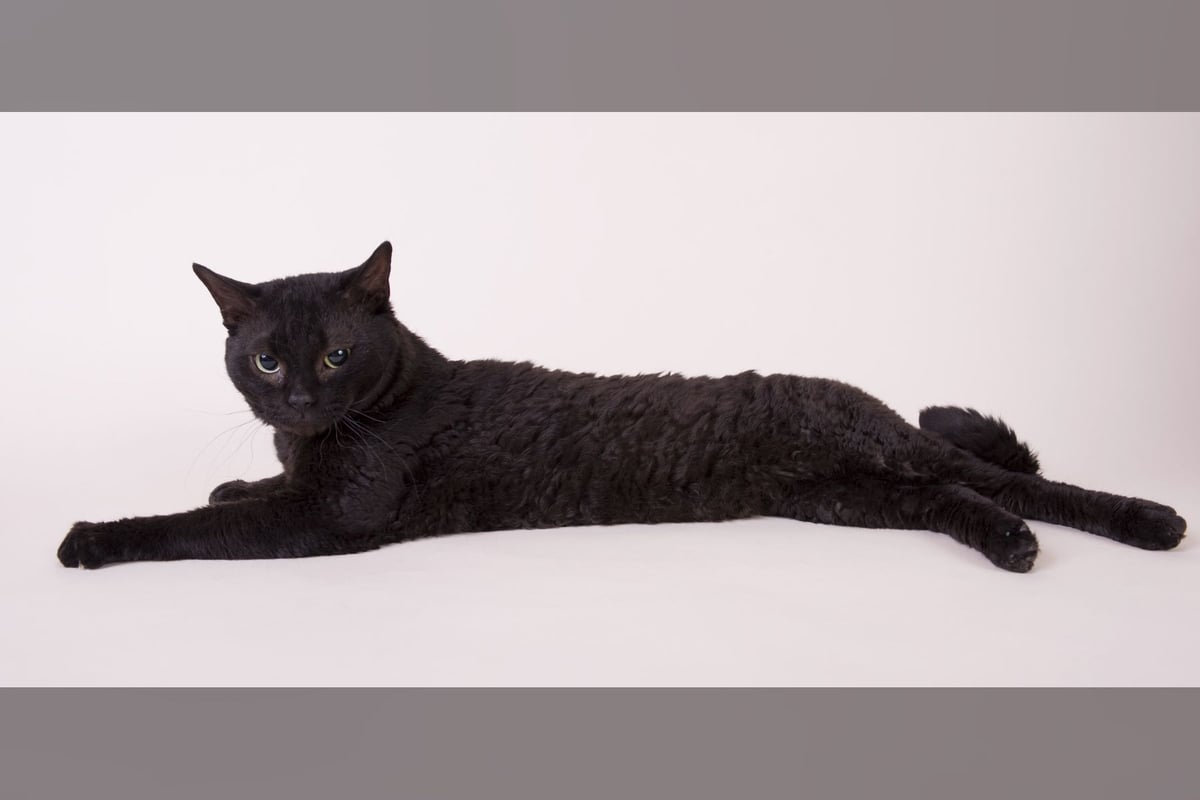
German Rex
The German Rex is the first documented curly-coated breed: a female cat named Lämmchen, spotted in 1947 in the garden of a hospital in Berlin-Buch and studied by Dr. Rose Scheuer-Karpin from 1951 onward, is the origin of every German Rex alive today. Its short, wavy coat with a velvety softness results from a mutation recessive and allelic with the Cornish Rex's — crossing the two breeds consistently produces curly kittens. A balanced semi-cobby body, a round head, a sociable, playful temperament. A breed little known outside Germany, recognized by the FIFe in 1982 and by the LOOF.
- Weight
- 2.5 to 5kg
- Height
- 23 to 30cm
- Life expectancy
- 12years
- Monthly cost
- 55 to 100€
Personality profile
Energy 3/5
Independence 3/5
Trainability 3/5
Good with children 4/5
Talkativeness 2/5
Space needed 3/5
Attachment to home 4/5
Good with strangers 3/5
Good with cats 4/5
Good with dogs 3/5
Coat care 2/5
Exercise needs 3/5
Scores given on measured axes, data confidence: medium.
Living with a German Rex
Description
A medium-sized cat, it has a semi-cobby build: the body is well developed, muscular without excess, with a relatively broad chest and a straight back. The legs are medium length, fairly fine but sturdy, and the tail is medium length, slightly tapered. The head is rounded, longer than it is wide, with well-developed cheeks and a slightly domed forehead. The muzzle is short, the nose straight with no marked stop. The ears are medium-sized, wide at the base, with slightly rounded tips, well set on the skull. The eyes are oval to round, medium-sized, in every color allowed in keeping with the coat. The coat is the breed's defining trait: short, wavy over the whole body, with a texture that evokes velvet to the touch. The FIFe specifies the coat must be short, wavy and very silky, with a density that varies from one individual to another but always with no guard hairs. The whiskers are curly, less tight than the Cornish Rex's. Every coat color is admitted under the LOOF, except chocolate, lilac, cinnamon and fawn. Males generally weigh 3.5 to 5 kg, females 2.5 to 4 kg. Life expectancy: 9 to 14 years.

Temperament
Breeders and the FIFe describe it as a lively, playful, intelligent cat, which bonds quickly with its humans without showing excessive dependency. Its activity level is moderate: it alternates bursts of sustained play with calm moments, which sets it apart from the Cornish Rex or Devon Rex, both noticeably higher-energy. It approaches strangers with initial caution, but the wariness fades fairly quickly. Its vocal level is low — it communicates occasionally, without sonic insistence. It cohabits without friction with other cats, notably other German Rex or European Shorthairs, with which the LOOF allows crossing. Its attachment to its owners is real and steady; it seeks closeness without constantly imposing itself. Its youthful vitality carries on beyond kittenhood, but its overall pace remains that of a balanced cat rather than a frenetic one.
Training
It is receptive to structured interaction thanks to its intelligence and relational motivation. It learns its routines, answers to its name and can progress with simple clicker-training exercises — coming when called, giving a paw, using a cat flap. Short sessions of five to ten minutes repeated regularly give good results. Positive reinforcement is the suitable method: treats, an encouraging voice, play as a reward. Its moderate liveliness makes it more patient than the Cornish Rex with exercises that require repetition, which makes gradual training easier. Early socialization — exposure to handling, visitors, veterinary care — is decisive for raising a confident adult.

Feeding
Nutritional needs are close to those of shorthaired breeds, with no marked metabolic quirk. A premium diet high in animal protein (minimum 35%) with a good essential fatty acid profile is suitable. Taurine should be present in the formula (heart-protective). Two split meals a day are preferable to free feeding to prevent weight gain, particularly in neutered individuals. The wet-food share can make up 30 to 50% of the ration to maintain good hydration and coat quality.
Affiliate links, no extra cost to you. Legal notice

Living conditions
It suits an apartment as well as a house, provided the environment is enriched with play structures and interactive stimulation. Its moderate activity means it does not demand exceptional space, but a very cramped, unstimulating apartment isn't right for it either. Because it has no guard hairs, its thermal protection is lower than a normally coated cat's: a heated home is necessary in winter, though not to the level demanded by the Cornish or Devon Rex. Temperatures below 15-16 °C call for an accessible heat source. It adapts well to an exclusively indoor life. Its sociable nature makes adopting in a pair a serious option for households where daily absences exceed six to seven hours.

Grooming and coat care
Coat care is minimal. The short, wavy coat does not need intensive brushing: a weekly pass with a chamois glove or a very soft, fine-natural-bristle brush is enough to remove dead hair and maintain the waves. Using a stiff-bristled brush should be avoided — it risks damaging the waves and irritating the sensitive skin. Shedding is reduced, comparable to the Cornish Rex's. Ear cleaning is the most regular care to build in: a veterinary ear solution applied every one to two weeks is enough in the absence of any condition. Weekly eye cleaning is advised. Claws should be trimmed every three to four weeks for a cat living exclusively indoors. Bathing is rarely needed; if done, use a gentle hypoallergenic shampoo and dry quickly to avoid chilling.

Health
The breed shows no major breed-specific genetic predispositions documented in the available veterinary literature. Its narrow gene pool — tied to the breed's rarity and to conservation programs that required crosses with the European Shorthair — calls for monitoring the inbreeding coefficient within breeding lines, with no clearly established breed-specific condition. Thermal sensitivity is the most common practical risk: the absence of guard hairs lowers the insulating barrier and exposes individuals to chilling in unsuitable settings. Respiratory conditions can occur after prolonged cold exposure. No breed-specific DNA test is required by the LOOF or the FIFe. Routine care — vaccinations, parasite control, an annual consultation — forms the basis of health monitoring. The ears deserve regular cleaning, with normal wax production to watch. Life expectancy is estimated between 9 and 14 years depending on the source, in line with the average for coat-mutation breeds.
Breed history
The German Rex's history opens on two distinct lines. The first, poorly documented, dates to the early 1930s in East Prussia, where Erna Schneider is said to have observed in Königsberg a curly-coated cat named Kater Munk, likely the result of a Persian × Russian Blue cross. This line disappeared with no formal descendants. The recognized founding line begins in Berlin-Buch: staff at the hospital clinic reported the presence of a wavy-coated female cat in the garden from 1947 onward. In 1951, Dr. Rose Scheuer-Karpin, a doctor at the hospital, identified this animal — a black-and-white female with a short curly coat — and named her Lämmchen, meaning "little lamb" in German, in reference to the texture of her coat. Lämmchen was mated with normal-coated males; her litters included curly kittens, confirming the mutation's recessive nature. She died around 1964-1967 after producing the descendants that founded the breed. The mutation involved is identified as allelic with the Cornish Rex's: the two breeds carry the same recessive rex1 allele at the same genetic locus. Unlike the Cornish Rex (rex1) and the Devon Rex (rex2, non-allelic), a German Rex × Cornish Rex cross consistently produces 100% curly kittens — since the two alleles are identical, the curly phenotype expresses in every individual. The FIFe officially recognized the breed in 1982. The LOOF registers it and allows German Rex × German Rex crosses as well as German Rex × European Shorthair crosses, the latter helping maintain genetic diversity in a breed whose worldwide numbers remain very limited. Since 1999, breeders in Russia, Sweden, Finland and the Netherlands have been actively working to preserve the breed, with programs aiming to widen the gene pool while maintaining its morphological traits.
Getting ready for your German Rex
Four essentials to line up before day one.
Affiliate links, no extra cost to you. Legal notice
FAQ: German Rex
Sources
- Wikipedia FR — German Rex · Lämmchen discovered Berlin-Buch 1947, documented by Dr. Rose Scheuer-Karpin 1951. Mutation allelic with the Cornish Rex's (rex1). FIFé + LOOF. Rare breed, breeders mainly in Russia/Sweden/Finland/Netherlands since 1999.
- Wikipedia EN — German Rex · Lämmchen maternal ancestor of all current German Rex. Coat silky, short, tendency to curl. Whiskers curled. Mutation recessive, same locus as Cornish Rex. FIFé recognised. Temperament: very friendly, lively, playful, intelligent.
- FIFé — German Rex breed standard · Breed recognised by FIFé since 1982. Standard updated 2024. Coat must be short, wavy all over, very silky, feels like soft velvet. Head rounded with well-developed cheeks and medium large ears. Temperament: very friendly, lively, playful and intelligent.
- LOOF — German Rex · Origin Berlin. FIFé recognition 1982, breed listed with the LOOF. Allowed crosses: German Rex × German Rex, German Rex × European Shorthair. Excluded colors: chocolate, lilac, cinnamon, fawn. Breed little known in France.

