


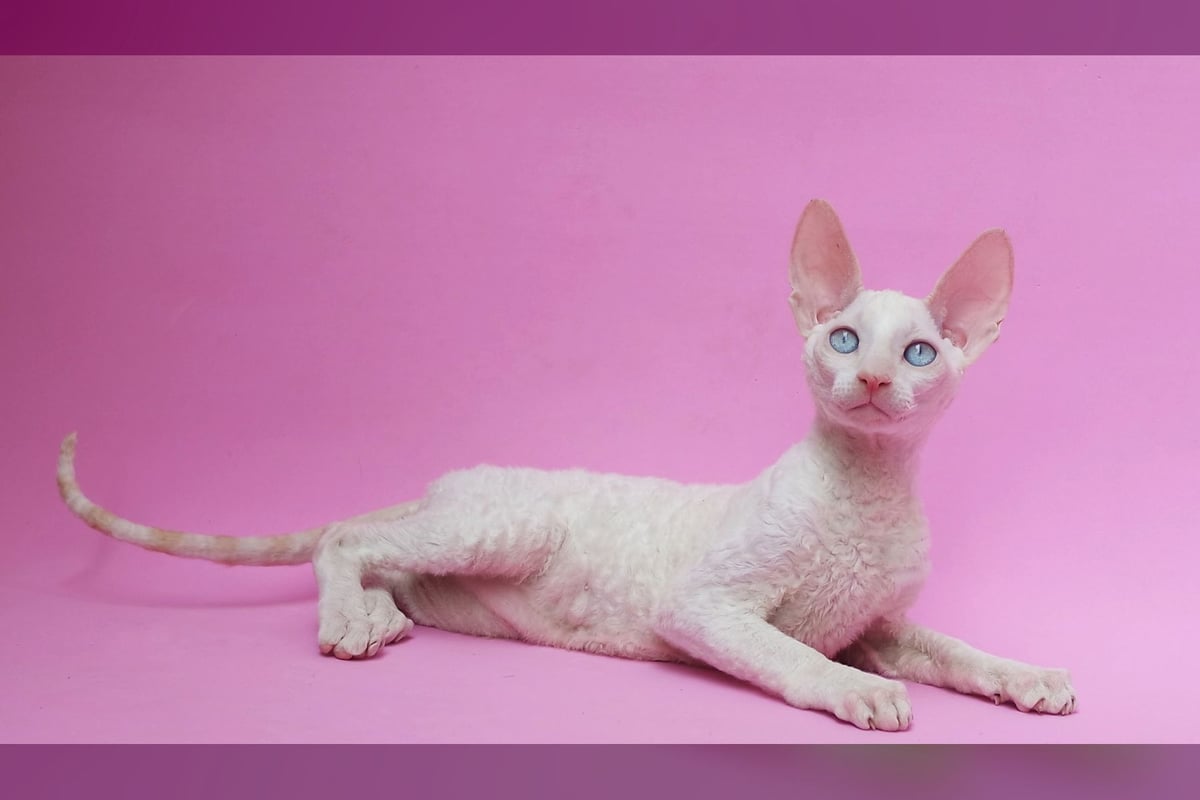
Cornish Rex
The Cornish Rex was born in 1950 in Cornwall, England, from a cream male kitten named Kallibunker, carrying a spontaneous mutation of the rex1 gene that suppresses guard hairs and awn hairs, leaving only a fine, wavy down of velvety softness. Its arched silhouette recalls that of a greyhound: a fine, muscular body, long legs, a Roman-profiled head, disproportionately tall ears. Despite its fragile appearance, it is a robust cat, with overflowing energy well into old age, deeply attached to its humans and with little tolerance for solitude. Its sensitivity to cold — its one real weak point — calls for a permanently heated home.
- Weight
- 2 to 4.5kg
- Height
- 23 to 30cm
- Life expectancy
- 14years
- Monthly cost
- 55 to 100€
Personality profile
Energy 5/5
Independence 2/5
Trainability 4/5
Good with children 4/5
Talkativeness 3/5
Space needed 3/5
Attachment to home 5/5
Good with strangers 4/5
Good with cats 4/5
Good with dogs 4/5
Coat care 1/5
Exercise needs 4/5
Scores given on measured axes, data confidence: high.
Living with a Cornish Rex
Description
The silhouette is long and striking in its elegance, often compared to that of a whippet or a greyhound. The naturally arched back creates a characteristic line: flanks tucked up toward the rear, a deep, muscular chest. The head, egg-shaped, is longer than it is wide; its Roman profile is made up of two convex arcs — from the skull to the nose, then from the nose to the tip of the chin — which clearly sets it apart from the concave-profiled Devon Rex. The ears, very large and wide at the base, are set high on the skull, giving the breed an alert, elfin expression. The eyes, oval and well spaced, can be any color allowed in keeping with the coat. The tail is fine and long, whip-like. The coat is the central genetic trait: the breed has only down hair (the undercoat layer), with no guard or awn hairs at all — unlike the Devon Rex, whose rex2 gene is distinct and non-allelic. This down forms tight, regular waves over the whole body, with a feel compared to velvet or astrakhan. Shedding is almost nonexistent. Males generally weigh 3 to 4.5 kg, females 2 to 3.5 kg, for a shoulder height of 23 to 30 cm. Life expectancy: 12 to 16 years.

Temperament
This is one of the most active, most engaged cats there is: it stays playful and mischievous well beyond kittenhood, climbs everywhere, dashes around the home at full speed and invents its own games when no one is entertaining it. Its nature is deeply social — it follows its owners from room to room and works its way into every moment of daily life. The CFA nicknames it the "Velcro kitty": it physically sticks to people, slips under the covers, settles on shoulders. This need for contact is constant but less obsessive than in the Sphynx — it also knows how to play on its own for a few hours. Its vocal level is moderate: it communicates, but without a Siamese's power. Intelligent and responsive to human cues, it quickly learns its name, household routines, and responds to learning games. It gets along well with children, other cats and dogs introduced properly. Its tolerance for prolonged solitude remains limited: beyond 6 hours alone as a routine, signs of anxiety can appear.
Training
Its sharp intelligence and strong motivation to interact with people make it a receptive candidate for clicker training and intense sport. It quickly learns the basics — giving a paw, coming when called, answering to its name — and can progress to longer obstacle courses or more elaborate tricks if the session stays short and playful. Sessions of 5 to 10 minutes repeated twice a day give the best results. Its overflowing curiosity and energy mean it grows bored quickly if exercises become repetitive: vary the stimuli, introduce food puzzles, and end on a success. Exclusively positive reinforcement (treats, an enthusiastic voice, petting) is the only suitable method. Its velcro nature makes it a cat that also learns by observation and imitation — sustained environmental enrichment matters as much as formal training.

Feeding
Its metabolism runs high in proportion to its size: its low body mass and lack of insulating coat force a permanent energy expenditure to maintain its temperature. Its ration must be rigorously matched to its actual activity level, which is very high. Favor premium kibble rich in animal protein (minimum 35-38%) with a good protein-to-fat ratio to support lean muscle mass without excess weight — the breed can quickly go from lean to chubby if the ration isn't calibrated. Taurine is a nutrient worth checking on the label (heart-protective). Two split meals a day are preferable to free feeding to avoid overeating. Kittens have proportionally high caloric needs up to 12 months, to be met with a calorie-dense diet. Wet food can make up 30 to 50% of the ration to maintain good skin hydration, which benefits the quality of the down.
Affiliate links, no extra cost to you. Legal notice

Living conditions
It is strictly a heated-indoor cat. Its down offers no real thermal barrier: below 18-20 °C, it actively seeks out a heat source. The home must stay at a comfortable temperature at all times; throws, radiators and accessible blankets make up for fluctuations. Direct exposure to summer sun should be limited — the lack of protective hair exposes the skin to UV on depigmented areas, with a risk of sunburn after about twenty minutes. In an apartment it thrives provided the environment is stimulating: cat trees, climbing spaces, interactive toys, secured windows and open runs to dash and leap through. Its high energy expenditure calls for at least 20 to 30 minutes of interactive active play a day to channel its intense need for movement. Adopting in a pair is advisable for households where absences regularly exceed 6 to 8 hours.

Grooming and coat care
This is one of the least demanding breeds when it comes to coat care. The absence of guard hairs and the near-total absence of shedding mean dead hair does not settle onto fabrics and intensive brushing is unnecessary. A weekly pass with a chamois glove or a very soft (natural, fine-bristled) brush is enough to stimulate skin circulation, remove the few dead hairs and preserve the wave of the down. Using a stiff-bristled brush is not advised — it damages the waves and can create bald patches. Ear cleaning deserves particular attention: the breed produces a normal but visible amount of wax, to be cleaned every 1 to 2 weeks with a veterinary ear solution. Weekly eye cleaning removes everyday discharge. Claws should be trimmed every 3 to 4 weeks. Bathing is rarely needed, and should be done with a gentle hypoallergenic shampoo followed by quick drying to avoid chilling.

Health
The breed is broadly robust and shows no major breed-wide documented genetic predispositions, unlike the Maine Coon (HCM MyBPC3) or the Siamese (amyloidosis). A few cases of hypotrichosis — partial or total hairlessness, distinct from the normal rex coat — have been reported in some lines; this is a distinct, rare phenotype, to watch for in kittens from the first few weeks. Patellar luxation is sporadically documented, to watch for in very active individuals. Cases of hypothyroidism have been reported, but with no established prevalence in the breed. Cold sensitivity is the most common practical risk: an individual exposed to temperatures below 15 °C can develop hypothermia or respiratory conditions. It is often better tolerated by allergic people, without being hypoallergenic for that matter: a prior contact test remains essential. An annual vet check-up is enough in the absence of symptoms, with no breed-specific DNA test panel.
Breed history
The Cornish Rex was born by chance on July 21, 1950, on a farm in Bodmin, Cornwall, England. An ordinary domestic cat gave birth to a cream male kitten with a curly coat — Kallibunker — whom his owner, Nina Ennismore, had examined by a vet and a geneticist. The advice was to mate Kallibunker with his own mother to check whether the mutation was heritable; two kittens out of five were born curly, confirming the gene's recessive nature. This gene, named rex1, is distinct from the rex2 gene responsible for the curly coat in the Devon Rex (which appeared in 1960, also in England): the two mutations are not allelic — crossing them produces straight-coated kittens. The first exports to the United States date to 1956, and a pregnant female, Diamond Lil, helped establish the breed across the Atlantic. The CFA recognized it in 1962 and granted it Champion status in 1964. In France, the breed is recognized by the LOOF in the shorthair cat category. It is one of the rare breeds whose founding ancestor — Kallibunker — is precisely dated, named and documented, making it a textbook case for feline genetics.
Getting ready for your Cornish Rex
Four essentials to line up before day one.
Affiliate links, no extra cost to you. Legal notice
FAQ: Cornish Rex
Sources
- Wikipedia FR — Cornish Rex · Spontaneous mutation, Cornwall 1950, kitten Kallibunker. Gene rex1 distinct from the Devon Rex (rex2, non-allelic). Two-curve Roman profile, tall ears, arched slender body. Official recognition in England in 1967.
- Royal Canin FR — Cornish Rex profile · Life expectancy 12-16 years. Very robust despite its fragile appearance. Stays playful into old age. Sociable, active, vocally moderate. Moderate grooming.
- CFA — Cornish Rex Breed Profile · CFA recognition 1962, Champion status 1964. Standard: pure down coat (40/100 pts), tight, even waving. High-set ears, two-curve profile. Arrived in the US in 1956 via Diamond Lil (pregnant female). Nicknamed the Velcro kitty.
- LOOF — Recognized cat breeds · The Cornish Rex is among the breeds officially recognized by the Livre Officiel des Origines Félines, shorthair cat category.
Breeds similar to a Cornish Rex

