


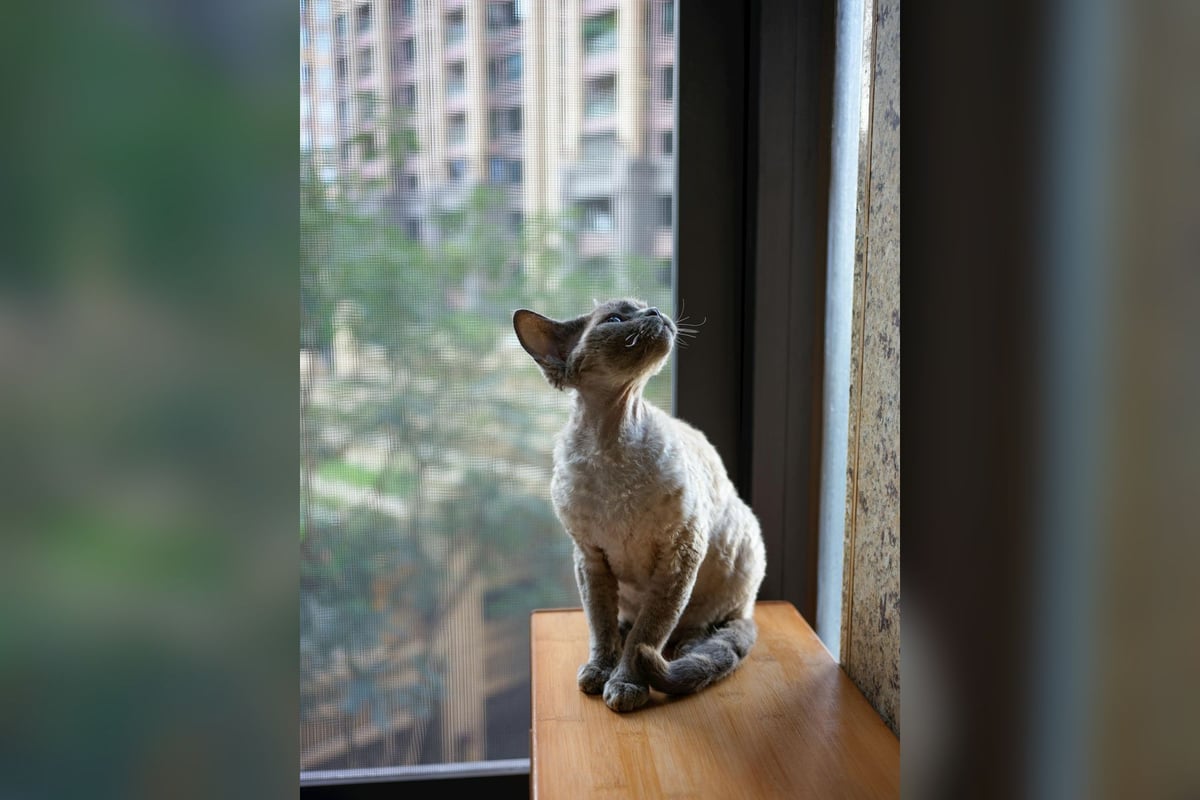
Devon Rex
The Devon Rex is an English cat born from a spontaneous genetic mutation in Devon in 1960: its short, wavy, curly coat results from an anomaly of the rex2 gene, distinct from the Cornish Rex's. Its huge, low-set ears, oversized eyes and short face give it an instantly recognizable, alien-elf look. Behind this unusual physique hides the most velcro of cats: permanently glued to its human, unable to cope with solitude, gifted with an intelligence and energy it keeps all its life. Breeding it calls for serious health vigilance — hereditary myopathy (mandatory DNA test) and seborrheic dermatitis mark the breed.
- Weight
- 2.5 to 4kg
- Height
- 28 to 32cm
- Life expectancy
- 14years
- Monthly cost
- 70 to 130€
Personality profile
Energy 5/5
Independence 1/5
Trainability 5/5
Good with children 4/5
Talkativeness 3/5
Space needed 3/5
Attachment to home 5/5
Good with strangers 4/5
Good with cats 4/5
Good with dogs 4/5
Coat care 2/5
Exercise needs 4/5
Scores given on measured axes, data confidence: high.
Living with a Devon Rex
Description
The build is semi-foreign and medium-sized, with a fine bone structure and surprisingly toned muscle under a light body. The head, small and triangular, is built on three distinct convex curves: ears, cheekbones and whisker pads. The forehead is domed, the nose stop pronounced, the muzzle short. The ears are the most striking feature: disproportionately large, set very low on the skull, wide at the base, slightly rounded at the tip. The eyes are oval, very large, widely spaced, in every shade. The body is long and slender with a broad chest, fine limbs, long toes and a fine tail covered in tight curls. The fur is the breed's signature: short, fine, with no guard hairs, forming natural waves on the back, flanks and tail. The whiskers are short and wavy. Males generally weigh 3 to 4 kg, females 2.5 to 3.5 kg, for a shoulder height of 28 to 32 cm. Every color and pattern is recognized.

Temperament
It is often called a "velcro cat" — a description that is no exaggeration. It doesn't just prefer human company: it demands it continuously. It follows its owners from room to room, systematically occupies shoulders or necks, wedges itself under the covers as soon as evening comes and watches every household activity from a high perch. Its need for physical contact is on par with the Sphynx's — prolonged solitude produces visible distress and anxious behavior. At the same time, its intelligence is extraordinary for a cat: it learns quickly, works door handles, memorizes household routines and can excel at clicker training. Its curiosity is insatiable and its energy level stays high well into old age — at seven or ten years old, it still plays with a kitten's enthusiasm. Its vocalizing is moderate: it communicates, comments, but without a Siamese's sonic insistence. It fits easily into multi-pet households, with children and with visitors, whom it greets warmly.
Training
This is one of the most trainable cats around. Its sharp intelligence, its strong relational motivation and its appetite for anything stimulating combine to make it an ideal candidate for clicker training and intense sport. It learns to give a paw, come when called, weave through obstacles or use puzzle toys with disconcerting speed, and can sustain long training sessions. Sessions should be short — five to ten minutes at most — since it stays very high-energy and can lose interest if the exercise becomes repetitive. Positive reinforcement works perfectly; any physical restraint or sharp tone breaks the trust that is easily built. Training is also an excellent tool for managing its energy and preventing separation anxiety: a cognitively stimulated cat is a calmer cat.

Feeding
Its metabolism runs high despite a modest frame: a fine bone structure and constant high activity translate into caloric needs greater than its weight might suggest. It's not unusual for it to insistently beg for food even after finishing its ration — this behavior can be as much about seeking attention as genuine hunger. Favor premium foods high in animal protein (minimum 35-38%) and rich in taurine, a heart-protective nutrient relevant in a breed predisposed to HCM. The wet-food portion helps maintain skin hydration and can be useful in managing seborrheic dermatitis. Two split meals a day for an adult (three for a growing kitten), with no free feeding, which increases food-begging behavior. Monitor weight regularly: a neutered individual can put on excess weight, which is a problem for its joints.
Affiliate links, no extra cost to you. Legal notice

Living conditions
This is a strictly indoor cat. Its sparse fur strips away any real thermal protection: below 18-19 °C, it actively seeks the body heat of a human or a fellow cat, and the risk of hypothermia is real in an unheated setting. A home kept at a minimum of 20-22 °C is essential, along with thick blankets, a heated bed and access to passive heat sources. The size of the home matters less than how enriched it is: tall cat trees, wall perches and climbing spaces are essential to channel its overflowing energy and its need for intense physical activity. Interactive stimulation and daily exercise are non-negotiable — a minimum of 20-30 minutes of active play a day, ideally two sessions. Because of its intense need for contact, adopting in a pair is strongly recommended for households where the occupants work away from home. Left alone for several hours a day, it quickly develops anxious behavior: vocalizing, destruction, apathy.

Grooming and coat care
Upkeep is minimal for the coat but regular for the skin. The wavy fur is too fine and fragile to be brushed: a brush breaks the curls and can create bald patches. A simple rubber massage glove passed over it weekly is enough to remove dead hair without damaging the texture. The skin, on the other hand, deserves particular attention: the absence of guard hairs lets sebum build up, notably in the folds of the neck, the armpits and the paws. A weekly wipe-down with a gentle, unscented wipe is enough in most cases; if Malassezia dermatitis is confirmed, the vet will prescribe a specific antifungal shampoo. Ear cleaning is weekly: the breed secretes an abundant dark wax, normal but to be removed regularly with a veterinary ear solution. Claws should be checked every two to three weeks — keratin can build up between the toes.

Health
The breed carries two major hereditary conditions every buyer should know about. Devon Rex hereditary myopathy (also called muscular spasticity syndrome) is the most breed-specific: this progressive muscular dystrophy appears between 3 weeks and a few months of age as neck weakness (difficulty holding the head up), tremors on exertion and episodes of spasticity. The causal gene was isolated in 2015; a DNA test is now available and mandatory for any serious breeder on both breeding cats. A kitten from two non-carrier parents cannot develop the disease. Hypertrophic cardiomyopathy (HCM) is documented in the breed, with no causal genetic mutation identified specifically as with the Maine Coon — an annual echocardiogram of breeding cats remains the only reliable monitoring. Malassezia dermatitis is another skin quirk: with no guard hairs to absorb sebum, the skin gets greasy and can develop an overgrowth of this opportunistic yeast, showing up as oily buildup, patches and itching, notably in friction areas (neck, ears, paws). Patellar luxation is also documented in the breed and can require surgery in cases of lameness. Finally, blood type B is significantly prevalent in the breed: a blood incompatibility between a type-A mother and type-B kittens can be fatal without immediate neonatal care — blood typing of breeding cats is therefore required before any breeding program.
Breed history
The Devon Rex's history begins in the summer of 1959 in Devon, England, near the town of Buckfastleigh. Beryl Cox, a local resident, noticed among a colony of stray cats a male with unusually curly fur, living near an abandoned tin mine. In 1960, a domestic female cat belonging to Cox gave birth to a litter that included a male kitten with a wavy coat: named Kirlee, this kitten would become the genetic foundation of the entire breed. Initially convinced they were looking at the same mutation as the Cornish Rex discovered in the 1950s, geneticists quickly found that the two alleles were distinct and non-complementary: one was named rex1 (Cornish), the other rex2 (Devon), confirming that the two breeds are genetically independent despite a superficially similar look. International recognition unfolded over a decade: the GCCF recognized the breed in 1967, the FIFe in 1968, the CFA in the United States in 1979. The LOOF today only allows matings between individuals of the breed. In France, the breed enjoys steady but low-key popularity, far from the numbers of the Maine Coon or the Sphynx, which gives it relative exclusivity.
Getting ready for your Devon Rex
Four essentials to line up before day one.
Affiliate links, no extra cost to you. Legal notice
FAQ: Devon Rex
Sources
- Wikipedia FR — Devon Rex · Spontaneous mutation, Devon 1960, kitten Kirlee. Gene rex2 distinct from the Cornish Rex's rex1. Myasthenia (myopathy) identified in 1974, gene isolated in 2015. GCCF recognition 1967, FIFé 1968, CFA 1979. Life expectancy 12-16 years.
- LOOF — Devon Rex · Breed officially recognized by the LOOF, cats with a distinctive coat category. Standard: semi-cobby, very large low-set ears, short curly coat, every color admitted. Only Devon Rex × Devon Rex breeding allowed.
- Royal Canin FR — Devon Rex profile · Weight 3-5 kg, height 30-31 cm. Life expectancy 10-15 years. High appetite despite its slim build. Patellar luxation documented. Minimal coat care but ears need weekly cleaning. Sensitive to cold.
- CFA — Devon Rex Breed Profile · Morphological standard: modified wedge, very wide low-set ears, large oval eyes. Adult weight 2.7-4.1 kg. High prevalence of blood type B — blood typing mandatory before breeding to prevent neonatal incompatibility.
Breeds similar to a Devon Rex

