


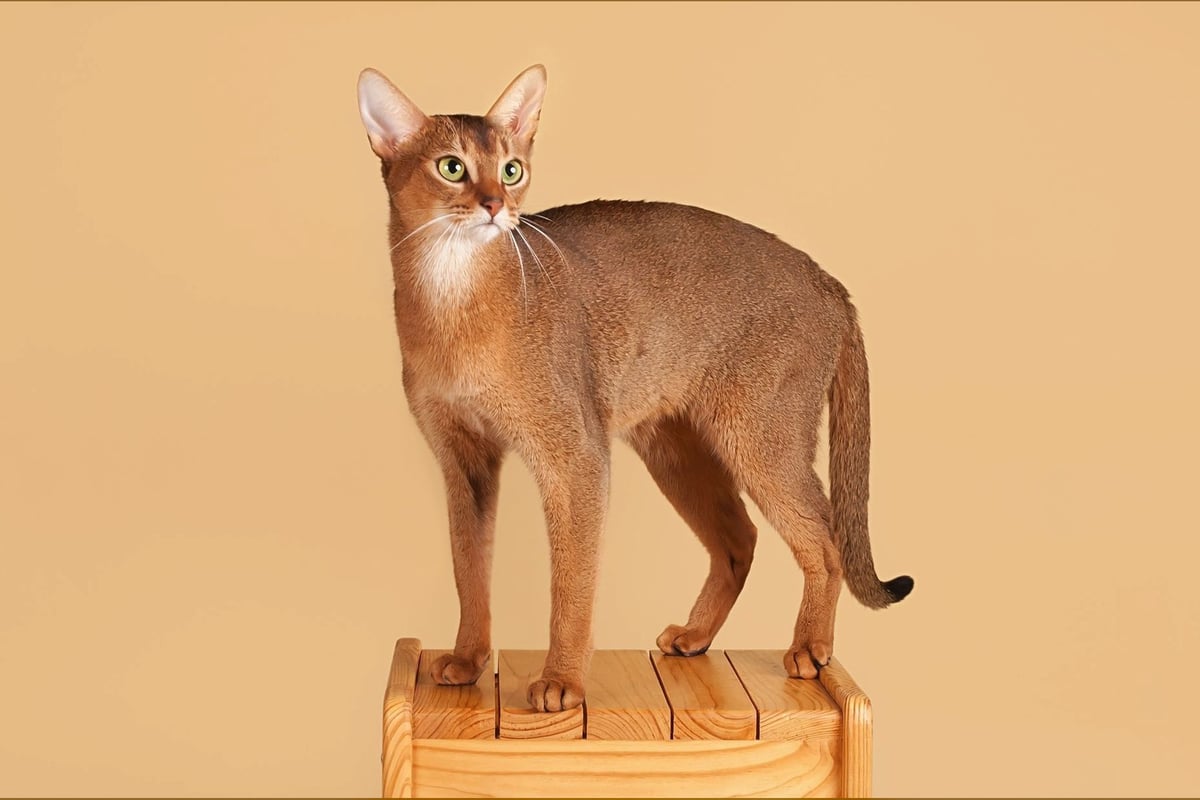
Abyssinian
The Abyssinian is one of the oldest recognized cat breeds, with a slender silhouette and a ticked coat unique in the feline world — each hair carries two to three distinct color bands that give the whole a luminous effect comparable to the coat of wild hares. Uncommon in France but solidly established in LOOF registrations, the Abyssinian appeals to households looking for an athletic, intelligent, exploratory companion — the feline opposite of a couch potato.
- Weight
- 2.5 to 5kg
- Height
- 25 to 30cm
- Life expectancy
- 13years
- Monthly cost
- 55 to 95€
Personality profile
Energy 5/5
Independence 3/5
Trainability 5/5
Good with children 4/5
Talkativeness 3/5
Space needed 4/5
Attachment to home 4/5
Good with strangers 3/5
Good with cats 3/5
Good with dogs 3/5
Coat care 1/5
Exercise needs 5/5
Scores given on measured axes, data confidence: high.
Living with an Abyssinian
Description
The build is medium, slender and athletic, never heavy or stocky. The body is muscular and well-proportioned, with fine, long legs that give it a characteristic airy gait. The head is a slightly rounded triangle with a curved profile, set off by large, attentive, expressive ears — often compared to those of a miniature puma. The eyes are almond-shaped, intense green, yellow or amber depending on the coat. The coat is short, fine, silky and lies close to the body. The breed's absolute signature is ticking: each hair is colored in alternating bands (generally 2 to 3 bands: light at the base, dark in the middle, light at the tip) — the underlying genetic mechanism (the Ta allele) is now carried by several other breeds as well. Four main recognized colors: ruddy (the most iconic), sorrel (coppery red), blue and fawn. Males 4-5 kg, females 2.5-4 kg.

Temperament
Boundless energy and sophisticated intelligence combine here. The cat is constantly on the move, explores its whole environment, opens cupboards, manipulates objects and solves complex food puzzles. Its intelligence is comparable to the Bengal's, but with a calmer, more observant approach — the Abyssinian thinks before acting, where the Bengal experiments. It is affectionate but in its own way: it prefers sharing an activity (play, exploration) over prolonged cuddling. Its vocalizing is moderate but expressive: trills, chirps and soft meows to communicate. It is often reserved with strangers for the first few minutes, then settles in quickly. Cohabitation with other active cats (Bengal, Somali, another Abyssinian) is generally excellent; it can be territorial toward a sedentary cat.
Training
Few cat breeds are as receptive to active learning and intense exercise — the Bengal is the fairest point of comparison. Clicker training gives spectacular results on complex behaviors (retrieving objects, agility, long obstacle courses, opening doors). Motivation comes through play as much as through treats. Harness walking is generally well integrated with progressive training starting at 3-4 months. Sessions should be short (5-10 minutes) but daily to meet the breed's need for mental exercise. The breed does not tolerate any physical coercion and withdraws lastingly after a negative experience. The absence of active training is probably the leading factor in behavioral problems in the breed — cognitive and physical understimulation quickly leads to anxiety or destructiveness.

Feeding
A breed with very high energy expenditure and a fast metabolism, it needs a sustained caloric intake despite its small frame. For an active 4 kg adult, plan on 220-280 kcal/day depending on activity level — significantly more than for a sedentary breed of equivalent weight (the British Shorthair, for example). Favor premium kibble very high in animal protein (≥40%) and limited in carbohydrates. A portion of premium wet food or raw meat as a supplement stimulates the hunting instinct and improves behavioral satisfaction. Split into 3-4 meals a day, ideally via a food puzzle or a delayed-release dispenser. The breed is generally slender by temperament and remains little prone to obesity even after neutering.
Affiliate links, no extra cost to you. Legal notice

Living conditions
Few cats cope as poorly with a small, unadapted apartment. A studio or one-bedroom with no usable height is not advisable for it — its frustration quickly translates into destructive behavior (jumping on high surfaces, moving objects, vocalizing). The ideal: a house with secure outdoor access (catio, garden enclosure) or a large apartment (≥70 m²) with a cat tree ≥ 2 m tall, wall shelves forming an elevated circuit, and widely accessible windows. Harness walking is not only possible but often actively requested by the breed once it gets used to it. Tolerates heat well (likely a warm-climate origin) and copes moderately with cold. Like the Bengal, the breed thrives in an environment of continuous stimulation.

Grooming and coat care
The short, fine coat is among the easiest to maintain of any recognized breed — a weekly 5-minute brushing with a grooming glove is enough to remove dead hair. Shedding is very discreet, with no marked seasonal peak. No professional grooming or regular bathing is needed. The ticked coat keeps its luminous look without any special intervention. Watch the teeth (gingivitis), ears (wax) and claws (trim every 3 weeks given the breed's intense scratching activity). The breed generally accepts grooming handling well from kittenhood if introduced early, but requires little time investment compared with semi-longhair breeds.

Health
Several major genetic predispositions concern the breed, most of them testable. Progressive retinal atrophy (PRA, the rdAc mutation specific to the Abyssinian and the Somali) causes progressive blindness between 18 months and 5 years of age; the rdAc DNA test is essential on both parents. Pyruvate kinase deficiency (PKDef) causes recurrent hemolytic anemia — the DNA test should be required. Familial renal amyloidosis (AA), inherited through a gene with complex transmission, leads to early kidney failure (3-7 years) in certain lines; no reliable DNA test is available, so kidney function should be monitored with an annual blood panel from age 2. Chronic gingivitis is more common than the feline average and calls for regular dental follow-up. The breed is generally slender and not very prone to obesity, unlike sedentary breeds.
Breed history
The Abyssinian owes its name to a female cat imported from Abyssinia (present-day Ethiopia) to England by Captain Barrett-Lennard in 1868, named Zula. But modern genetic studies (notably Lyons et al., 2008) contradict this African origin: the breed shares more markers with cat populations of South Asia and the Indian coastline than with North African cats. The hypothesis favored today places the origin of the ticked allele on the coast of the Indian Ocean, with later spread via maritime trade routes. The breed standard was codified in the United Kingdom as early as the late 19th century, but the population was devastated by the two World Wars and the feline panleukopenia pandemic of the 1960s. The breed was saved by Anglo-American breeders who rebuilt the population in the 1950s-70s. The longhair variant, named the Somali, was officially split off as a distinct breed in 1979. In France, the breed has been present since the 1980s and today accounts for roughly 500-800 LOOF registrations a year — less popular than the large northern cats but with a stable population.
Getting ready for your Abyssinian
Four essentials to line up before day one.
Affiliate links, no extra cost to you. Legal notice
FAQ: Abyssinian
Sources
- Wikipedia FR — Abyssinian · One of the oldest recognized breeds. Ticked coat, Ta allele. Probable genetic origin Southeast Asia, first documented import Zula 1868.
- LOOF — Recognized cat breeds · The Abyssinian is among the breeds officially recognized by the Livre Officiel des Origines Félines, shorthair category.
- Royal Canin FR — Abyssinian profile · Active breed with high energy expenditure, intelligent, athletic. Life expectancy 12-15 years. Susceptibility to PRA and chronic gingivitis.
- TICA — Abyssinian Breed Standard · TICA standard: medium-sized, lithe and graceful, ticked coat, large alert ears. Four colour varieties: ruddy, sorrel, blue, fawn.
Breeds similar to an Abyssinian

