


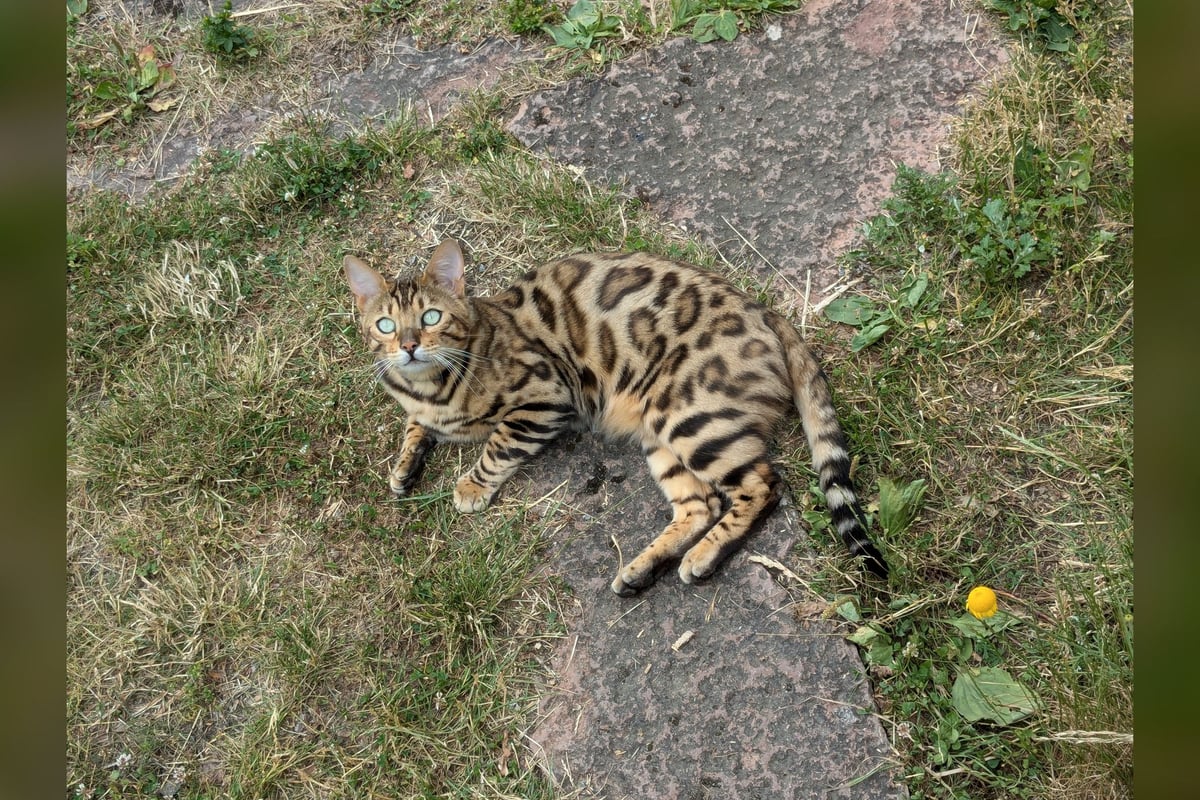
Bengal
The Bengal is a breed resulting from controlled hybridization between the domestic cat and the Asian leopard cat (Prionailurus bengalensis), developed in the 1960s-80s by American geneticist Jean Mill. Recognized as a stable domestic breed from the 4th generation (F4) onward by the major federations, it combines a spectacular spotted or marbled coat with an athletic temperament that demands a significant daily investment.
- Weight
- 3 to 7kg
- Height
- 25 to 35cm
- Life expectancy
- 14years
- Monthly cost
- 70 to 130€
Personality profile
Energy 5/5
Independence 3/5
Trainability 5/5
Good with children 4/5
Talkativeness 4/5
Space needed 5/5
Attachment to home 4/5
Good with strangers 3/5
Good with cats 3/5
Good with dogs 3/5
Coat care 1/5
Exercise needs 5/5
Scores given on measured axes, data confidence: high.
Living with a Bengal
Description
The silhouette is muscular and elongated, both sturdy and feline, a direct heir of its wild ancestor. The body is slightly longer than it is tall, with hind legs longer than the front ones, giving it a characteristic gait. The head is a slightly elongated triangle with a firm chin and short, wide-based ears rounded at the tips. The eyes are almond-shaped and expressive. The coat is short, dense, and exceptionally silky in texture — often described as "pelt-like" — and shows a unique feature: "glitter," a sparkling effect visible in direct light caused by reflective particles at the base of the hair. Two main coat patterns: spotted (open or closed rosettes) and marbled (swirling patterns). Color varieties include brown (the most iconic), snow (lynx, mink, sepia), silver and charcoal. Males 4-7 kg, females 3-5 kg. Maturity reached around age 2.

Temperament
Very high energy, intelligence and vocality: nothing of the couch potato about it. It is curious about everything, handles objects with its paws as if inspecting them, opens doors and solves complex food puzzles. Its vocality covers a varied repertoire: loud meows, trills, chirrups and vocalizations that seem to comment on its surroundings. It is generally affectionate and attached to its owners, but it is not a passive cat: it demands interaction. It plays fetch, accepts a harness and leash, and enjoys water far more than the feline average (showers, baths, running taps). Its intelligence is also its trap: an understimulated Bengal becomes destructive, anxious or hyperactive.
Training
Few cat breeds are as receptive to active learning. Clicker training gives spectacular results on object retrieval, complex behaviors (giving a paw, jumping through a hoop, crossing a tunnel) and feline agility routines. Motivation comes mainly through play and food rewards. Harness walking is not only possible but often actively requested by the breed once it gets used to it. Training sessions should be daily (10-15 minutes), varied, and always end on a success. The breed tolerates no physical coercion and holds onto negative experiences for a long time. The absence of active training is probably the leading factor in behavioral problems in this breed.

Feeding
A breed with very high energy expenditure, it needs a high-quality, high-calorie intake. For an active 5 kg adult, plan on 280-360 kcal/day, raised to 400 kcal/day for a fully active intact male. Favor premium kibble very high in animal protein (≥40%) with limited carbohydrates — the breed's metabolism runs closer to a strict carnivore's than the feline average. A portion of raw meat or premium wet food as a supplement benefits digestive health and behavioral satisfaction. Splitting into 3-4 meals a day, ideally via a food puzzle, stimulates the hunting instinct and curbs compulsive gulping. The breed is less prone to obesity than sedentary breeds, but remains sensitive to IBD if the diet is too processed.
Affiliate links, no extra cost to you. Legal notice

Living conditions
The environment needs to be active and stimulating. A small apartment (under 60 m²) is strongly discouraged unless compensated by 60-90 minutes of daily interactive play and major environmental enrichment. The ideal: a house with access to a secure patio or an outdoor enclosure ("catio"), or a large apartment with a cat tree over 2 meters tall, wall shelves, an elevated circuit, food puzzles and a feline exercise wheel. The breed accepts harness walking with progressive training from kittenhood. Tolerates heat well (a tropical legacy from the ALC), copes moderately with cold. Strictly indoor life in a studio is contraindicated — the cat gets bored quickly there and develops behavioral problems.

Grooming and coat care
The short, silky coat is exceptionally easy to maintain: weekly brushing with a grooming glove is enough under normal conditions. The "pelt-like" texture naturally repels dirt and needs little intervention. The breed sheds moderately, with no marked seasonal peak thanks to indoor living. No regular bathing is needed, even though many cats spontaneously get into water — for play, not for grooming needs. Watch the ears and clean gently with a veterinary product if wax builds up. Claws need regular trimming (every 3 weeks) since the breed actively scratches vertical surfaces.

Health
Several major genetic predispositions concern the breed, most of them testable. Hypertrophic cardiomyopathy (HCM) is reported in the breed; annual echocardiographic screening from age 2 is recommended on breeding cats. Progressive retinal atrophy (PRA-b, a mutation specific to the Bengal) causes progressive blindness between 1 and 2 years of age; the PRA-b DNA test is essential on both parents. Pyruvate kinase deficiency (PKDef) causes recurrent hemolytic anemia — the DNA test should be required. Polycystic kidney disease (PKD1, inherited from old crosses with the Persian) is rare but still testable. Increased sensitivity to anesthetics in some individuals: inform the vet before surgery. The breed tends to develop idiopathic enteritis (IBD) in 5-10% of cats — digestive monitoring is recommended. No particular predisposition to hip dysplasia.
Breed history
The breed comes from a hybridization program launched by American geneticist Jean Mill (formerly Jean Sugden) in the 1960s-1980s, crossing Asian leopard cats (Prionailurus bengalensis, the ALC) with domestic cats to produce a breed with a spectacular coat but a stable temperament. The first generations (F1 to F3) are still considered unstable-behavior hybrids, not permitted as pets in France. It is from the 4th generation (F4) onward that the breed is recognized as stable. TICA accepted the Bengal in 1991; FIFe still refuses its official registration for ethical reasons linked to its wild origin, but French LOOF recognized it in the 2000s. The legal status in France requires at least the 4th generation from the ALC for unrestricted ownership — earlier generations fall under legislation governing non-domestic animals. The breed has grown rapidly in France since 2010, regularly ranking in the top 10 of LOOF registrations.
Getting ready for your Bengal
Four essentials to line up before day one.
Affiliate links, no extra cost to you. Legal notice
FAQ: Bengal
Sources
- Wikipedia FR — Bengal (cat) · Hybridization initiated by Jean Mill in the 1960s-80s. TICA recognition 1991. Legal status: F4 minimum required in France for unrestricted ownership.
- LOOF — Recognized cat breeds · The Bengal is among the breeds officially recognized by the Livre Officiel des Origines Félines, distinctive-coat category. Top 10 in France.
- Royal Canin FR — Bengal profile · Breed with very high energy expenditure. Maturity at 2 years. Life expectancy 12-16 years. Predisposition to PRA-b and HCM to be screened.
- TICA — Bengal Breed Standard · TICA standard: athletic silhouette, sparkling glitter, contrasting rosettes. Pelt-like texture short coat. Origin from Asian Leopard Cat hybridization.
Breeds similar to a Bengal

