


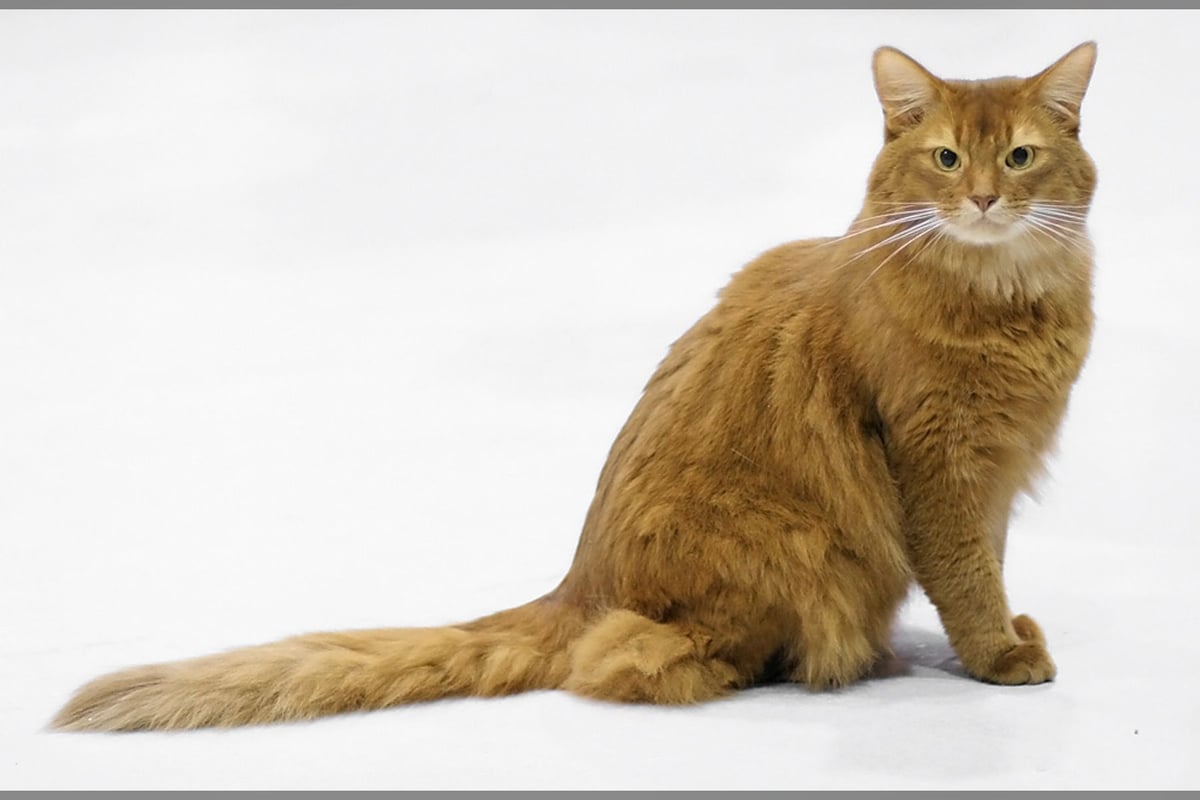
Somali
The Somali is the semi-longhair version of the Abyssinian — a recessive longhair gene mutation that appeared in Abyssinian litters in the 1960s and was developed into a breed in its own right, recognized by the CFA in 1979. It fully carries over its cousin's athletic semi-foreign build and unique ticked agouti coat, adding a silky medium-length coat, a richly plumed tail, a ruff and britches. An obscure breed in France but growing in popularity with the LOOF, it suits households looking for the most active, most curious temperament in the feline world — with the added beauty of a shimmering coat.
- Weight
- 3.5 to 5.5kg
- Height
- 25 to 30cm
- Life expectancy
- 13years
- Monthly cost
- 60 to 100€
Personality profile
Energy 5/5
Independence 2/5
Trainability 5/5
Good with children 4/5
Talkativeness 3/5
Space needed 4/5
Attachment to home 4/5
Good with strangers 3/5
Good with cats 4/5
Good with dogs 4/5
Coat care 3/5
Exercise needs 5/5
Scores given on measured axes, data confidence: high.
Living with a Somali
Description
The build is medium, semi-foreign, svelte and athletic, never massive. The silhouette is muscular and well proportioned, with fine, long legs that give it a characteristic airy gait. The head is a slightly rounded triangle with a curved profile, set with large attentive ears — often tipped with lynx tufts prized by the standards — and almond-shaped eyes, intense green, hazel or amber depending on the coat. Males 4–5.5 kg, females 3.5–4.5 kg. The visual signature is the ticked coat: each hair carries two to three alternating color bands (light at the base, dark in the middle, light at the tip), creating a unique shimmering effect depending on light exposure. Four main recognized colors: ruddy (burnt sienna with black-brown ticking), sorrel (copper red with chocolate ticking), blue (warm beige with slate ticking) and fawn (rosy beige with light cocoa ticking). The coat is the big difference from the Abyssinian: fine, silky and soft, medium length on the body, shorter on the shoulders, markedly fuller on the tail (a bushy plume), the ventral ruff and the hind britches. The dense undercoat gives it extra volume without translating into heaviness.

Temperament
It is the Abyssinian amplified in its social dimension: it keeps the same boundless energy and the same sophisticated intelligence, but tolerates solitude even less and seeks more sustained emotional contact. It is constantly on the move, methodically exploring its environment, handling objects, opening cupboards and solving complex behavioral puzzles. Its operational intelligence is among the highest in the feline world: it anticipates household routines, memorizes the names of its toys and adjusts its strategies based on the responses it gets. Very affectionate, it marks its presence by following its owners from room to room, rubbing its head against their legs or settling on their shoulders. Its vocality is moderate — expressive trills, chirps and soft meows — but it actively communicates through body language. With children and other animals, sociability is excellent provided the energy is shared: faced with a sedentary cat, it can become frustrated and overly insistent. It is slightly reserved with strangers for the first few minutes, then quickly settles into the household atmosphere.
Training
This is one of the cat breeds most receptive to active training — on par with the Abyssinian and the Bengal. Clicker training produces spectacular results from the very first sessions: fetching objects, obstacle-course agility, opening doors, sporting routines. Motivation comes as much from interactive play as from treats. Harness walking integrates well with gradual training from 3–4 months, for walks of several kilometers. Sessions should be short (5–10 minutes) but daily: insufficiently stimulated, it redirects its energy into unwanted behaviors (scratching, breaking objects, sudden jumping), the leading factor in behavioral problems in the breed. Physical coercion is counterproductive and durably breaks trust: positive reinforcement only.

Feeding
A breed with very high energy expenditure and a fast metabolism, it needs sustained caloric intake despite its moderate size. For an active 4.5 kg adult, plan 230–290 kcal/day depending on activity level — significantly more than for a sedentary breed of equivalent weight. Favor premium kibble very high in animal protein (≥40%) and low in carbohydrates. A portion of premium pâté or mixed feeding stimulates the hunting instinct and improves behavioral satiety. Split into 3–4 meals a day, ideally through a food puzzle or a delayed dispenser. The breed remains not very prone to obesity even after neutering, given its naturally high activity level. Hydration: a circulating water fountain is preferable; the breed's interest in running water is documented.
Affiliate links, no extra cost to you. Legal notice

Living conditions
Few breeds tolerate a stimulation-poor environment as badly. An apartment under 50 m² without vertical setup is not advisable for it: its frustration quickly shows up as destructive behavior, anxiety or excessive vocalization. The ideal is a house with access to a catio or a secure outdoor enclosure (a large space), or an apartment (≥70 m²) fitted with a cat tree over 2 meters tall, wall shelves forming an elevated circuit, and accessible windows. Harness walking is not only possible, but often demanded once the habit is set. Its activity level requires at least 20 to 30 minutes of daily physical exertion — wand toys, circuit runs, interactive toys. The breed tolerates heat well (probably a legacy of its Abyssinian origins) and copes moderately with cold. Cohabiting in a pair with a cat of similar energy (Bengal, Abyssinian, another Somali) is strongly recommended for households away more than 6 hours a day: alone, it suffers.

Grooming and coat care
The medium-length coat is clearly less demanding than that of large northern breeds (Maine Coon, Norwegian) since it mats very little thanks to its silky texture and the absence of a thick woolly undercoat. A weekly 10 to 15 minute brushing with a fine comb is enough to remove dead hair and maintain the ruff, britches and tail plume. During seasonal molts (spring, fall), switch to twice a week for 2 to 3 weeks to prevent mats. No regular bathing is needed except for catteries preparing for shows. Watch the teeth (gingivitis/FORL), the ears (earwax, with gentle monthly cleaning) and the claws (trim every 3 weeks given its intense scratching activity). The breed accepts grooming handling well from kittenhood if introduced early.

Health
The breed shares the same major genetic predispositions as its Abyssinian cousin, all documented and testable. Progressive retinal atrophy (PRA, the rdAc mutation specific to the Abyssinian line) causes progressive blindness between 18 months and 5 years; the rdAc DNA test is essential on both breeding parents. Pyruvate kinase deficiency (PKDef) causes recurrent hemolytic anemia, also detectable by DNA test — demand results on both parents. Familial renal amyloidosis (AA), inherited in a complex manner, leads to early kidney failure (3–7 years) in some lines; no reliable DNA test is available, monitor with an annual blood panel from age 2. Chronic gingivitis and odontoclastic resorptive lesions (FORL) are more common than the feline average and call for regular dental follow-up. The breed is svelte and not very prone to obesity. Average life expectancy: 12–15 years for individuals from tested lines.
Breed history
The Somali owes its name to Evelyn Mague, an American breeder who, in the mid-1960s, saw an unusually long-haired kitten born in her Abyssinian litters — named "George." Seeking to understand the origin of this mutation, she realized the recessive longhair gene had been present in the Abyssinian population for decades, probably introduced through crosses with Persians after World War II to rebuild an Abyssinian stock decimated by the conflicts. Mague decided to develop this variant as a breed in its own right and named it "Somali" after Somalia, a country bordering Ethiopia (former Abyssinia), from which the Abyssinian took its name. The CFA began registering the breed in 1976 and granted it championship status in 1979; FIFe followed in the 1980s, LOOF after its creation in 1996. In France, the breed remains obscure compared to the Abyssinian — annual LOOF registrations in the low hundreds — but enjoys growing popularity driven by its spectacular visual appeal and exceptional temperament. Somali × Abyssinian crosses are permitted and practiced to maintain the stock's genetic diversity.
Getting ready for your Somali
Four essentials to line up before day one.
Affiliate links, no extra cost to you. Legal notice
FAQ: Somali
Sources
- Wikipedia FR — Somali (cat) · Longhair gene mutation in Abyssinian litters in the 1960s, developed by Evelyn Mague. Ticked coat, semi-foreign build. Same health predispositions as the Abyssinian (PRA rdAc, PKDef, renal amyloidosis).
- LOOF — Recognized cat breeds — Somali · The Somali is among the breeds officially recognized by the Livre Officiel des Origines Félines, semi-longhair category. Somali × Abyssinian crosses permitted.
- Royal Canin FR — Somali Profile · A dynamic, lively breed that requires plenty of exercise. Moderate grooming for a semi-long coat. Very intelligent, affectionate.
- CFA — Somali Breed Profile · CFA championship status 1979. Four colors: ruddy, cinnamon, blue, fawn. Temperament busy/active/affectionate. Heritable renal amyloidosis; PKDef and PRA DNA tests used by responsible breeders.
Breeds similar to a Somali

