


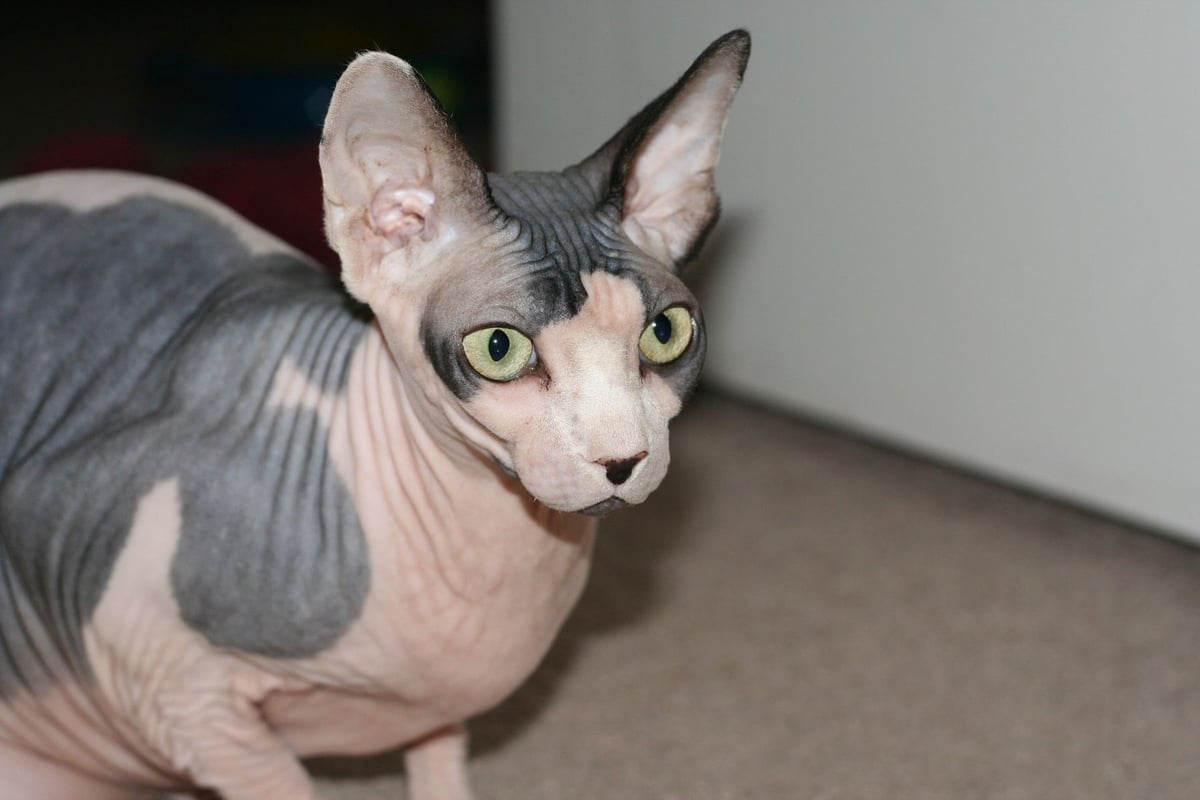
Sphynx
The Sphynx is the best-known hairless cat breed in the world, born from a spontaneous genetic mutation in Toronto in 1966. Permanently glued to its owners, unable to bear solitude, it is the opposite of the independent cat: a true affectionate hot-water bottle that slides under the covers and climbs onto shoulders. Its bare skin requires regular care and its life is spent exclusively indoors in a heated home.
- Weight
- 3.5 to 6kg
- Height
- 20 to 25cm
- Life expectancy
- 13years
- Monthly cost
- 90 to 150€
Personality profile
Energy 4/5
Independence 1/5
Trainability 4/5
Good with children 5/5
Talkativeness 3/5
Space needed 3/5
Attachment to home 5/5
Good with strangers 5/5
Good with cats 5/5
Good with dogs 4/5
Coat care 3/5
Exercise needs 4/5
Scores given on measured axes, data confidence: high.
Living with a Sphynx
Description
A medium-sized cat with a semi-cobby build: firm musculature, a broad, open chest like a bulldog's, fine legs with elongated extremities and thick paw pads. Its triangular head with prominent cheekbones carries oversized ears (7 to 10 cm), very open, low-set, and deeply expressive almond-shaped eyes. Its most striking feature is the near-total absence of hair: the skin, whose texture recalls a peach, shows pronounced wrinkles — very marked in kittens, they persist without excess in adulthood per the standard. Every color and pattern is accepted, visible directly on the pigmented skin. Males typically weigh 4 to 6 kg, females 3.5 to 4.5 kg, for a height at the withers of 20 to 25 cm.

Temperament
Often described as the "golden retriever of cats," it is extremely sociable and seeks human contact in an almost obsessive way. It does not just tolerate cuddles — it demands them. An under-the-covers sleeper from day one, a shoulder climber, a hallway follower, it cannot bear being ignored or alone for hours. Its sharp intelligence makes it receptive to training: it can learn tricks, respond to its name and engage with food puzzles. Its vocalization is moderate — it communicates but is not as talkative as a Siamese. It gets along remarkably well with children, other cats and even dogs, making it an ideal choice for busy households. Note: its need for company is such that adopting in a pair (two individuals, or a sociable companion of another breed) is strongly advised for owners who work.
Training
Its intelligence and strong relational drive make it one of the most trainable cats. Its curious nature and intense need for interaction mean it gets bored quickly if its environment lacks stimulation. Clicker training works very well: it can learn to give a paw, come on recall, run an obstacle course or use a puzzle food dispenser. Sessions of 5 to 10 minutes, repeated twice a day, give fast results. Positive reinforcement (treats, petting, an enthusiastic voice) is the only suitable method — any sign of punishment breaks the trust it gives easily but regains with difficulty.

Feeding
Its metabolism is clearly higher than that of classic-furred breeds: without fur, it regulates its body temperature by burning more calories, and its daily ration must account for that. A 4 kg adult consumes about 20 to 30% more calories than a shorthair cat of the same weight. Favor premium foods rich in animal protein (minimum 35%) and taurine (an essential cardiac protector). Wet food (pâté) can be mixed with kibble to maintain good skin hydration. Avoid cheap kibble high in cereals. Split the ration into 3 meals a day for kittens (high metabolic rate) and 2 meals for adults. Weight should be tracked monthly: too thin, it loses body heat faster; overweight, it is more exposed to HCM.
Affiliate links, no extra cost to you. Legal notice

Living conditions
This is strictly an indoor cat, no exceptions. The lack of fur deprives it of all protection against UV rays (risk of sunburn and skin tumors), cold, and injuries from vegetation or asphalt. The home's temperature should be kept around 20-22 °C at all times; below 18-19 °C, it will actively seek out a heat source or show visible thermal discomfort. Cat clothing (thin sweaters, onesies) can be used on cool days. Provide warm blankets, radiators it can access safely, and a heated bed. In an apartment, floor area matters less than the richness of the environment and its daily activity level: cat trees, interactive toys, play sessions to channel its energy, and human presence are enough to satisfy it. Regular physical exercise — toy hunting, wand toys, small obstacle courses — is necessary for its balance. Direct sun exposure through a window should be limited, or the UV rays filtered.

Grooming and coat care
Paradoxically, a hairless cat requires more care than many longhair breeds. Without fur, the sebum produced by the skin builds up without being absorbed, forming a visible greasy film on the skin and leaving marks on fabrics. A weekly bath with a mild, hydrating shampoo (cat formula, SLS-free) is essential to prevent clogged pores and skin infections. After the bath, dry thoroughly with a warm towel — wet, it cools down very fast. Ear cleaning should be done twice a week: the breed secretes a significant amount of brown-black earwax, normal but potentially pathogenic if left to build up. Use a veterinary ear lotion and lint-free pads. The claws grow normally, but keratin builds up between the toes for lack of wear on scratching posts; trimming every 2 to 3 weeks is necessary. Weekly eye cleaning (pronounced discharge in some individuals) rounds out the routine.

Health
The breed is predisposed to several conditions, two of them critical. Hypertrophic cardiomyopathy (HCM) is the most serious and most common: the mutation involved differs from the one identified in the Maine Coon, and existing DNA tests cover only part of the cases. This is why an annual cardiac ultrasound from 6 months of age is considered mandatory, even for individuals genetically identified as non-carriers. Dermatitis and skin conditions are common: hairless skin accumulates sebum, attracts dust and can react to certain soaps or fabrics; daily skin care with a hypoallergenic lotion is necessary. Dental problems appear early in the breed (a legacy of the Devon Rex crosses): dental brushing or regular veterinary care are recommended. Hip dysplasia has also been documented in the breed. Because of its faster metabolism (maintaining body temperature without fur), it consumes more calories and should be monitored for hypoglycemia in case of a diet change.
Breed history
The Sphynx's story begins on January 31, 1966, in Toronto (Canada), when an ordinary domestic cat gave birth to a hairless kitten named "Prune." Her owner, suspecting a genetic mutation, had Prune bred back to her mother to reproduce the phenomenon. A second hairless kitten was born, named "Epidermis." These two animals were the first attempt at developing a hairless breed. In the 1970s-1980s, hairless cats reappeared spontaneously in litters in the Netherlands and France. Dr. Hugo Hernandez (Netherlands) crossed two females imported from Canada with Devon Rex cats to stabilize the build. France went on to play a decisive role: the first breed standard was drawn up from a cat named "Aménophis Clone," born in 1985. TICA officially recognized the breed in 1985. Crosses with the Devon Rex — permitted and documented — brought the bone solidity and health resilience that make the modern Sphynx a far sturdier breed than the first Canadian lines. In France, the LOOF registers it in the distinctive-coat category; the breed has enjoyed growing popularity since the 2000s, driven by its iconic look and media appearances.
Getting ready for your Sphynx
Four essentials to line up before day one.
Affiliate links, no extra cost to you. Legal notice
FAQ: Sphynx
Sources
- Wikipedia FR — Sphynx (cat) · Spontaneous genetic mutation, Toronto 1966, kitten Prune. Development via the Devon Rex (Netherlands, France). Standard established on Aménophis Clone (1985). TICA recognition 1985.
- LOOF — Sphynx · Breed officially recognized by the LOOF, distinctive-coat category. Standard: semi-cobby, very large ears (7-10 cm), all colors admitted. Weekly skin care mandatory.
- Royal Canin FR — Sphynx Profile · High metabolism, above-average caloric needs. HCM a major predisposition. Weekly bath with hydrating shampoo. Male weight 4-7 kg, female 3-4 kg.

