


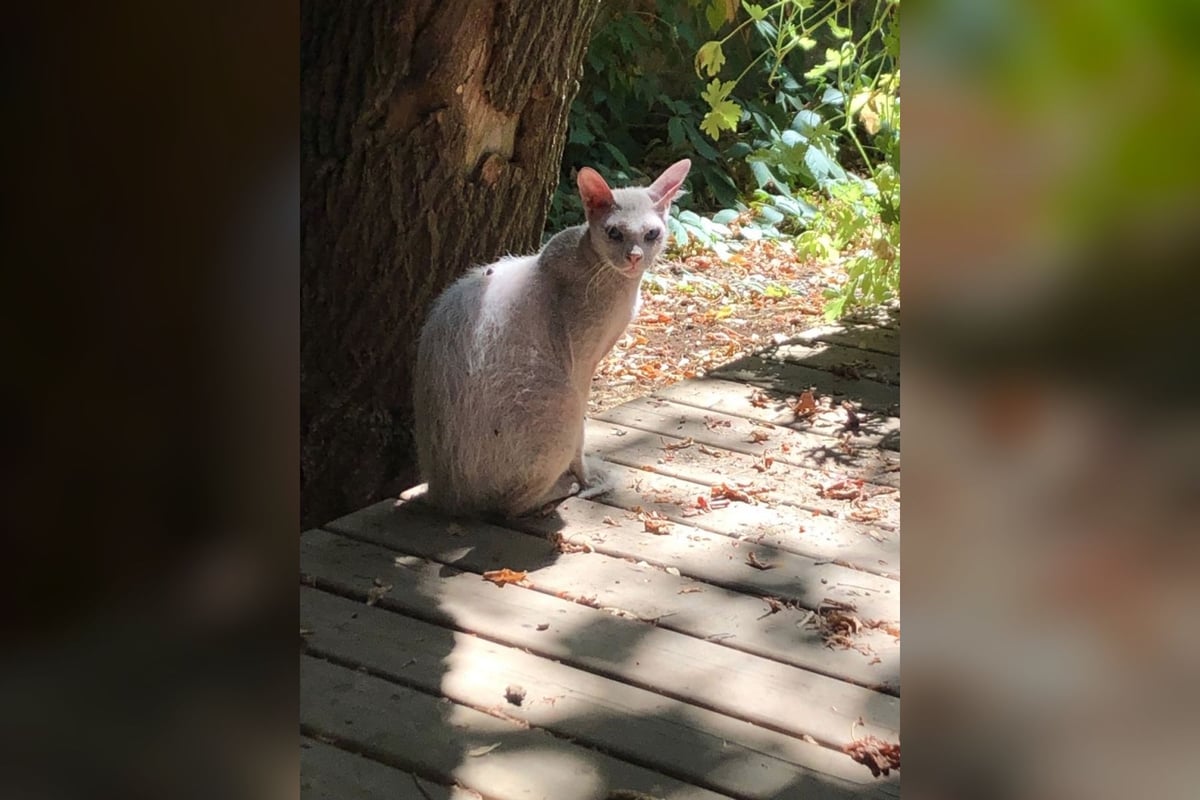
Peterbald
The Peterbald is a Russian breed born in 1994 in Saint Petersburg, the result of an experimental cross between a Donskoy and an Oriental Shorthair carried out by breeder Olga Mironova. Unlike the Canadian Sphynx, whose hairless gene is recessive, the Peterbald carries a dominant Hr gene inherited from the Donskoy: a single copy of the gene is enough to produce a hairless cat. Its build is that of a pure Oriental — a slender tubular silhouette, triangular head, huge ears — carried across four coat variants ranging from completely bald to a normal coat. As clingy with its owners as the Sphynx, and even more restless than the Oriental, it suits only households ready for a demanding, noisy cat that cannot bear to be left alone.
- Weight
- 3 to 5kg
- Height
- 22 to 30cm
- Life expectancy
- 13years
- Monthly cost
- 85 to 145€
Personality profile
Energy 5/5
Independence 2/5
Trainability 5/5
Good with children 4/5
Talkativeness 4/5
Space needed 3/5
Attachment to home 5/5
Good with strangers 4/5
Good with cats 4/5
Good with dogs 4/5
Coat care 2/5
Exercise needs 4/5
Scores given on measured axes, data confidence: high.
Living with a Peterbald
Description
The silhouette follows the Oriental breeds: a long, tubular body, firm muscle over a fine bone structure, long legs with oval paws, a thin tail tapering like a whip. The head forms an elongated triangle with prominent cheekbones, with a straight profile from skull to nose tip. The ears are very large, wide at the base and open, set so as to naturally extend the sides of the facial triangle — even more developed than in the Oriental. The almond-shaped eyes, set obliquely, can be blue, green or another color depending on the coat. The tail is long and slender. Adult weight generally falls between 3 and 5 kg, with a height at the withers of 22 to 30 cm. The breed's most distinctive trait is its coat, which comes in four variants: fully bald (warm, elastic skin with no hair at all, called ultra-bald or bald), velour (a very fine downy layer resembling suede, which can disappear with age), brush (short, wavy coat, sometimes sparse, with a hard texture to the touch), and straight (a normal coat, not recognized in championship classes since it shows no expression of the Hr gene). Only the first three variants are admitted in shows.

Temperament
The emotional intensity of the Sphynx and the hyperactivity of the Oriental combine here in a single cat. Rated a "velcro cat" by breeders, it follows its owners into every room, insistently demands physical contact and settles without ceremony on shoulders, laps or under blankets. Its vocalizing is sustained — less shrill than a purebred Siamese, but constant and varied — and it spontaneously comments on the household's comings and goings. Its energy level is high: it plays with gusto, climbs, explores and seeks interaction throughout the day. It finds prolonged solitude hard to bear; left alone for more than five hours as a routine, it can develop anxiety or destructive behavior. Its sharp intelligence makes it very receptive to learning and mentally stimulating games. With respectful children, other cats and sociable dogs, it lives together without tension, provided its needs for movement and contact are met.
Training
Two inherited traits make it one of the most trainable cats: the Oriental's operational intelligence and the Sphynx's extreme relational motivation. It quickly learns to answer to its name, give a paw, come when called and run small obstacle courses. Clicker training works particularly well, since it turns interaction into structured play — exactly what it's looking for. Sessions of 5 to 10 minutes, twice a day, give fast results. Exclusively positive reinforcement (treats, petting, an enthusiastic voice) is the only suitable method: sensitive to frustration, it shuts down cooperation the moment physical restraint is applied.

Feeding
Its metabolism runs slightly higher than that of fully coated breeds: maintaining body temperature without an insulating coat draws on extra energy reserves. Its ration should be rich in animal protein (minimum 35-38%) and contain a good dose of taurine, a nutrient that protects the heart and retina, particularly relevant given the predispositions inherited from its Oriental genetic background. Premium kibble or a mixed diet (kibble plus wet food) with adequate water intake is recommended to support kidney health. Two split meals a day are better than free feeding for controlling intake and catching drops in appetite that could signal a health problem. Weight should be tracked monthly: too thin, it loses body heat faster; overweight, it puts its fine bone structure at risk of joint complications.
Affiliate links, no extra cost to you. Legal notice

Living conditions
This is strictly an indoor cat, with no exceptions. The Hr gene deprives it of the thermal and UV protection a normal coat provides: exposed directly to the sun, a hairless cat can get sunburned in under twenty minutes, and repeated exposure raises the risk of skin tumors. Below 18-19 °C it actively seeks out a heat source; the home should ideally be kept at 22 °C or above. Warm blankets, a heated bed and, if needed, a thin cat sweater help make up for cold days. The size of the home matters less than how rich it is in stimulation: cat trees, rotating interactive toys, climbing courses and daily play sessions are non-negotiable for its well-being. Given its intense need for companionship, adopting in pairs — two littermates, or a cat from the Oriental or Siamese family — is strongly advised for households with regular absences.

Grooming and coat care
Skin care is more demanding than for most shorthair breeds: with no coat to absorb it, sebum builds up on the surface in bald and velour cats, visible in the skin folds and around the paw pads. A weekly bath with a gentle cat shampoo — hypoallergenic formula, SLS-free — followed by careful drying with a warm towel is recommended. Watch for rapid chilling after the bath: avoid drafts. Brush and straight cats, by contrast, need only a quick pass with a grooming glove once or twice a week. Ear cleaning matters for all variants: the large ear flaps accumulate wax and dust; a weekly cleaning with a veterinary ear lotion is enough. Nail trimming (every 2 to 3 weeks) and weekly tooth brushing round out the routine.

Health
Several points call for breed-specific vigilance. The bare skin of bald and velour cats secretes sebum without absorbing it, which requires regular skin care to prevent clogged pores and contact dermatitis; cosmetic products or fabrics containing irritants are not recommended. Oligodontia — the congenital absence of some permanent teeth — is documented in several lines, likely linked to the pleiotropic effects of the Hr gene inherited from the Donskoy. A dental radiograph of breeding cats and monitoring from the kitten's first months allow early detection. Like the Oriental it descends from, it can be prone to feline amyloidosis (protein deposits in the liver or kidneys), progressive retinal atrophy (PRA), and it metabolizes certain anesthetic agents differently — the vet should be informed of the breed before any procedure under general anesthesia. Life expectancy is 12 to 15 years for cats that are well cared for.
Breed history
The Peterbald was born in 1994 in Saint Petersburg, Russia, at the initiative of breeder Olga Mironova. The goal was to combine the slender build of the Oriental Shorthair with the dominant hairless gene of the Donskoy — a Russian breed recognized since 1989, born of a natural mutation in the Don region. The first experimental cross produced two kittens, Mandarin iz Murino and Nocturne iz Murino, who became the breed's founders. The Cat Federation of Russia officially recognized the breed in 1996. TICA granted recognition in 1997. The FIFe and the LOOF followed, placing the breed in the category of cats with a distinctive coat. Approved outcrosses with Orientals and Siamese help maintain genetic diversity and refine the build. In France, the reference club is the AFAS (Association Féline des Amis du Siamois), which also manages the breeds of the Oriental family.
Getting ready for your Peterbald
Four essentials to line up before day one.
Affiliate links, no extra cost to you. Legal notice
FAQ: Peterbald
Sources
- Wikipedia FR — Peterbald · Origin: Saint Petersburg 1994, Donskoy × Oriental Shorthair cross by Olga Mironova. Dominant hairless gene inherited from the Donskoy. 4 coat types: bald, velour, brush, straight. Recognized by the Russian federation in 1996, TICA in 1997. Weight 3-7 kg.
- LOOF — Peterbald · Breed recognized by the LOOF, category cats with a distinctive coat. Reference club: AFAS (Association Féline des Amis du Siamois). Standard: tubular Oriental body, triangular head, large ears extending the facial triangle, oblique almond-shaped eyes. Approved outcrosses: Peterbald × Peterbald, Siamese, Oriental.
- Wikipedia EN — Peterbald · First official recognition by the Russian cat federation in 1996. Breed founders: Mandarin iz Murino and Nocturne iz Murino, born from the initial 1994 experimental cross. Oligodontia documented as a pleiotropic effect of the Hr gene.

