


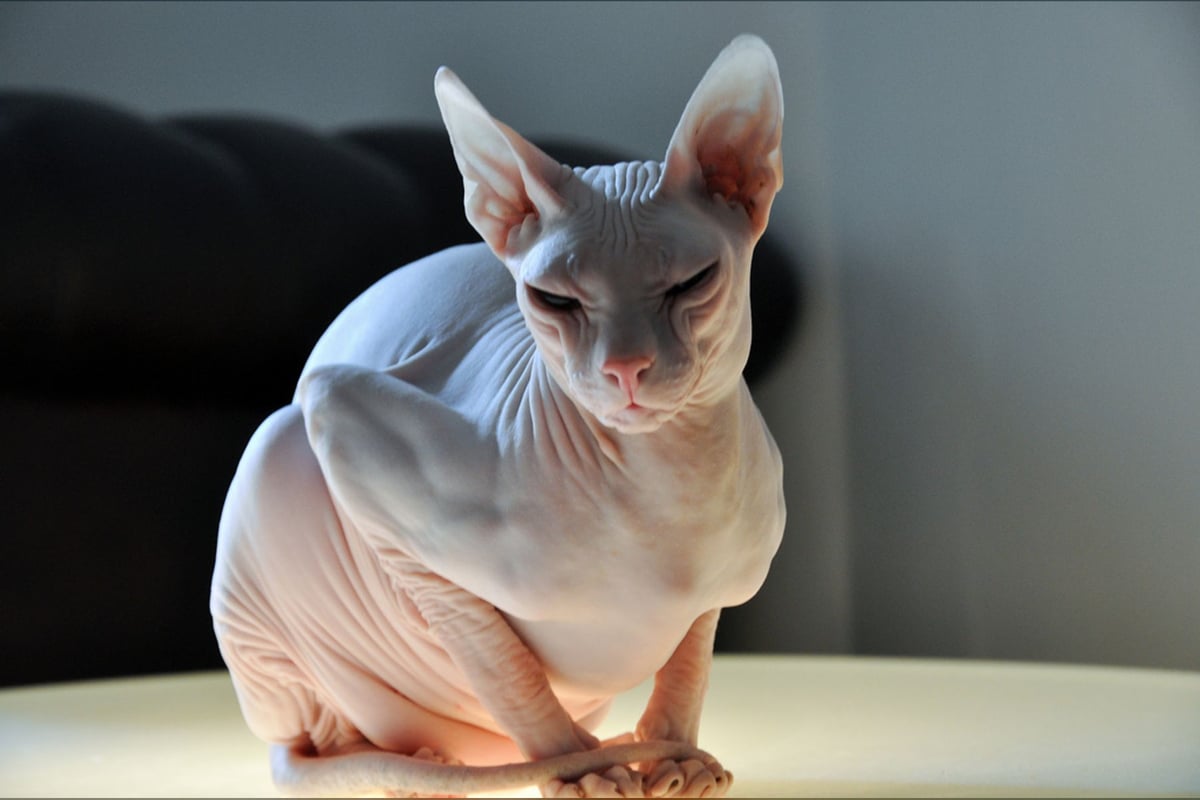
Donskoy
The Donskoy is a hairless Russian cat born from a dominant genetic mutation discovered in 1987 in Rostov-on-Don — a gene distinct from the Canadian Sphynx's, which makes it a breed in its own right rather than a derivative. Its wrinkled skin, large flared ears and almond eyes give it the look of an ancient creature, while its temperament is that of an ultra-affectionate, tactile cat, unable to cope with solitude. The direct ancestor of the Peterbald, it comes in four coat variants ranging from fully hairless to a curly brush coat, and requires rigorous weekly skin care.
- Weight
- 3.5 to 5.5kg
- Height
- 20 to 28cm
- Life expectancy
- 13years
- Monthly cost
- 90 to 160€
Personality profile
Energy 4/5
Independence 2/5
Trainability 4/5
Good with children 4/5
Talkativeness 3/5
Space needed 3/5
Attachment to home 5/5
Good with strangers 5/5
Good with cats 4/5
Good with dogs 4/5
Coat care 3/5
Exercise needs 3/5
Scores given on measured axes, data confidence: medium.
Living with a Donskoy
Description
A medium-sized cat, it has a semi-foreign build: firm, well-developed muscle, a broad torso with an open chest, a slightly rounded abdomen, a wide rump. Its wedge-shaped head has high, prominent cheekbones, a characteristically wrinkled forehead and an almost straight profile. The ears are very large, set high and slightly flared, with rounded tips — noticeably wider at the base than the Sphynx's. The almond eyes, deeply expressive, can be blue, green, amber, orange, yellow or brown. The skin is elastic, with pronounced folds on the face, neck, armpits, belly and base of the tail — a direct legacy of the dominant Hr gene. The breed comes in four coat variants — the LOOF officially recognizing only three: fully hairless (rubber bald), born nude and staying nude for life; flock, covered in a peach-fuzz down imperceptible to the eye; velour, whose very short down evokes chamois and is generally lost before one year of age; and brush, whose short, coarse, curly hair can show permanent bald patches. Every color and pattern is admitted. Males generally weigh 4 to 5.5 kg, females 3.5 to 4.5 kg, for a shoulder height of 20 to 28 cm.

Temperament
Breeders describe it as a cat of extreme sociability, unable to bear prolonged solitude. It seeks physical contact constantly — not intermittently like many cats, but almost continuously: it clings to its owners, slips under the covers, seeks skin-to-skin contact, and follows every member of the household from room to room. Its practical intelligence is sharp: it quickly adapts to routines, methodically explores its surroundings and responds to stimulation with sustained curiosity. Its vocalizing is moderate — it expresses itself without being intrusive. It shows no defensive aggression: even faced with strangers, it displays frank openness rather than territorial wariness. This lack of instinctive reserve means it gets along easily with children, other cats and dogs introduced gradually. The direct trade-off of this need for bonding is its intolerance of isolation: left alone for eight hours a day, it quickly develops visible distress (vocalizing, repetitive behavior). Adopting in a pair is strongly advised for active households.
Training
The combination of sharp practical intelligence and strong relational motivation makes it a cat particularly receptive to positive-reinforcement training. It can learn to give a paw, come when called, use puzzle food dispensers and run small obstacle courses. Clicker training suits the breed very well: the sound-signal → behavior → reward sequence matches how it processes information. Short sessions of five to ten minutes, twice a day, give quick results without overloading its attention. Motivation by treats is strong, but physical contact — petting, being held — is also an effective reward for this very tactile breed.

Feeding
Its metabolism runs slightly higher than that of furred breeds, owing to active skin thermoregulation. Its ration should be adjusted accordingly: an active 4 kg adult needs roughly 200 to 260 kcal/day, with a preference for high-quality animal protein (minimum 35% of dry matter). Wet food is recommended as the priority to maintain good skin hydration — skin that is well hydrated from within shows less dryness and cracking. Premium kibble high in omega-3 and omega-6 supports the quality of the skin film and reduces excess sebum. For individuals with oligodontia, favor finely-cut wet food or an all-wet diet. Split into two meals a day for adults, three for kittens. Monitor weight monthly.
Affiliate links, no extra cost to you. Legal notice

Living conditions
It is strictly an indoor cat. The absence of fur leaves it with no protection against ultraviolet light — direct sun exposure of under thirty minutes can cause sunburn, and repeated exposure raises the risk of skin tumors. Below 15 °C, it quickly becomes thermally uncomfortable; below 10 °C, the risk of hypothermia is real. The home's temperature must stay between 20 and 24 °C. Cat clothing (thin sweaters, bodysuits) can add thermal protection on cool days. In an apartment, floor area matters less than how enriched the environment is: cat trees with high platforms, warm resting spots (accessible radiator, throw, heated bed), and regular human presence are the essential conditions. A secure balcony with netting and protection from direct sun can give it fresh air safely. Daily exercise through interactive play is essential to channel its energy and prevent boredom.

Grooming and coat care
Grooming is counterintuitive: being hairless — often perceived as hypoallergenic — it needs more skin care than a shorthaired cat. The skin continuously produces sebum with nothing to absorb it, which creates a visible oily film and brown marks on fabrics. A weekly bath is essential — with a gentle, hydrating shampoo formulated for cats, free of SLS and alcohol. The good news: most individuals tolerate this ritual well, and some genuinely enjoy warm water. After the bath, dry quickly with a warm towel and keep the cat in a warm setting (above 22 °C) until fully dry. The large ears should be cleaned once or twice a week with a veterinary ear solution. Claws grow normally; trimming every two to three weeks prevents injuries. Weekly eye cleaning rounds out the routine.

Health
The breed's genetic peculiarity — a dominant Hr gene — creates a specific risk in the homozygous state: individuals carrying two copies of the gene present ectodermal dysplasia, which can lead to oligodontia (a reduced number of permanent teeth) or partial anodontia, as well as a reduced ability to sweat and produce milk. Among serious breeders, matings never pair two carriers of the gene, which rules out the birth of homozygotes. Bare skin is the second area to watch: with no hair to absorb sebum, it accumulates oily residue and can develop fungal or bacterial infections if bathing is irregular. Susceptibility to respiratory infections is slightly above the feline average, likely linked to the absence of a fur barrier. Oligodontia, when it occurs, calls for twice-yearly veterinary dental checks and a suitable diet (wet food prioritized). No predisposition to hypertrophic cardiomyopathy (HCM) is documented specifically for the breed to date. Life expectancy: 12 to 15 years.
Breed history
The Donskoy's history begins in 1987, when Elena Kovaleva, a teacher in Rostov-on-Don, picked up a small stray female cat off the street and named her Varvara. Around four months old, the cat began progressively losing her fur — a phenomenon first attributed to illness, with no conclusive diagnosis. When Varvara had litters, some kittens were born hairless or lost their coat the same way, revealing the trait's hereditary nature. Breeder Irina Nemikina took in one of Varvara's daughters, named Chita, and systematically developed the breed through crosses with European Shorthair, Persian and Siberian cats. The breed was recognized by the WCF (World Cat Federation) in 1997 under the name Don Sphynx, then by TICA in 2005 under the name Donskoy. In France, the LOOF has listed it among its recognized breeds, though it remains little known: only 34 pedigrees were issued in 2019, making it one of the rarest cat breeds in the country. It is also the direct ancestor of the Peterbald: created in 1994 in Saint Petersburg by crossing a male Donskoy with a female Oriental, the Peterbald inherits the Hr gene while showing the fine build of the Orientals. Since 2000, matings between Donskoy and Peterbald have been banned by the registries to prevent confusion between the two breeds.
Getting ready for your Donskoy
Four essentials to line up before day one.
Affiliate links, no extra cost to you. Legal notice
FAQ: Donskoy
Sources
- Wikipedia EN — Donskoy cat · Discovered 1987 by Elena Kovaleva, Rostov-on-Don, cat Varvara. Dominant gene (Hr mutation) vs. Sphynx's recessive one. Four coat variants: rubber bald, flock, velour, brush. Homozygous ectodermal dysplasia. WCF 1997, TICA 2005.
- Wikipedia FR — Donskoy (cat) · Breed founded by Irina Nemikina from Chita (Varvara's daughter). Crosses with European Shorthair, Persian, Siberian cats. WCF 1997, TICA 2005. Life expectancy up to 15 years. 34 LOOF pedigrees in 2019.
- LOOF — Donskoy · Official standard: semi-foreign, wedge-shaped head, high cheekbones, large ears. Three LOOF-recognized variants: nude, velvet, brush. Weekly bathing mandatory. Only Donskoy × Donskoy breeding allowed.

