


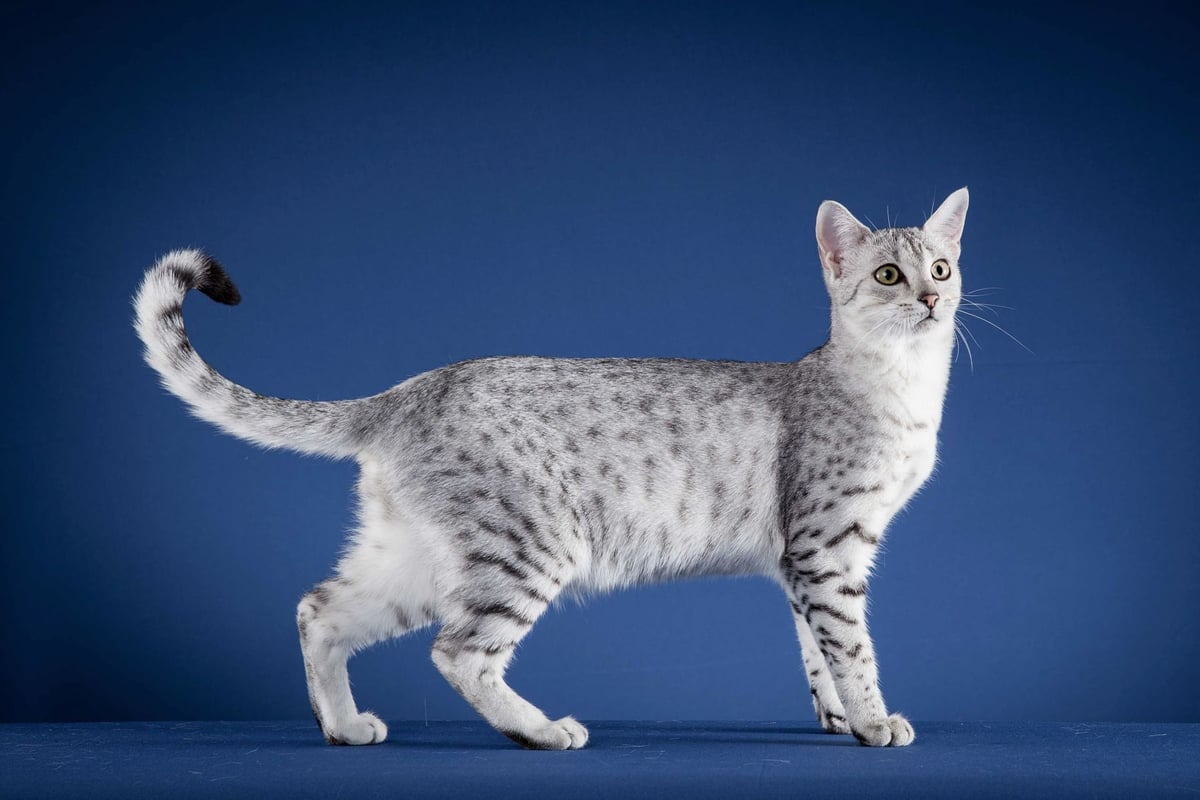
Egyptian Mau
The Egyptian Mau is the only domestic cat breed whose spots are entirely natural — not the result of hybridization with a wild felid nor of cross-genetic selection, but arising randomly in a cat population probably descended from the sacred cats of ancient Egypt. An athletic medium-sized breed capable of reaching 48 km/h, it was founded in 1956 by Russian princess Natalie Troubetskoy from three cats imported from Egypt. Its temperament has two faces: absolutely loyal to its adoptive household, it remains wary of strangers and not very adaptable to changes in environment.
- Weight
- 2.5 to 5kg
- Height
- 20 to 30cm
- Life expectancy
- 13years
- Monthly cost
- 55 to 100€
Personality profile
Energy 5/5
Independence 2/5
Trainability 4/5
Good with children 3/5
Talkativeness 3/5
Space needed 4/5
Attachment to home 4/5
Good with strangers 2/5
Good with cats 3/5
Good with dogs 3/5
Coat care 1/5
Exercise needs 5/5
Scores given on measured axes, data confidence: medium.
Living with an Egyptian Mau
Description
The morphology is semi-foreign, medium in size, balanced between the European and oriental types without leaning toward either. The body is muscled, elongated and athletic, with a rare anatomical feature: a loose abdominal fold (a "flank flap") between the abdomen and hind legs that gives it an exceptional stride length. The hind legs are slightly longer than the front. The head is a rounded triangle with a slightly convex profile. The ears are large, moderately pointed. The eyes are almond-shaped, the color known as "gooseberry green" — a characteristic light green shade required by the standard, whose full development occurs only at 18 months. Three coat colors are recognized in the international standard: silver (light background, dark grey spots), bronze (warm fawn background, dark brown spots) and black smoke (silvery-white background under the smoke overcoat, black spots). The breed's signature is its scarab-shaped forehead marking, forming the characteristic letter "M", completed by mascara lines on the cheeks. The coat is short, dense, with a silky texture and a slightly glossy effect. Males 3.5-5 kg, females 2.5-4 kg.

Temperament
The temperament reads in two registers: with a rarely-matched intensity of bond to its household, it can attach to a single person almost exclusively, revealing a loyalty that recalls a dog's more than an ordinary cat's. It expresses this affection through trills, chirps (vocal sounds specific to the breed, distinct from the classic meow) and expressive tail movements. Around strangers, the behavior reverses radically: marked wariness, withdrawal, sometimes flight. This is not passing shyness — it is a structural trait of the breed. It is not suited to households with a high turnover of visitors or unpredictable social environments. Change is just as poorly tolerated: a move, a major rearrangement of the space, or a change of owner are significant stress factors. Its high energy makes it a born hunter: it is constantly on alert, loves prey-style games, can fetch a toy and shows notable practical intelligence.
Training
Intelligent and a keen hunter, the breed responds well to learning through interactive play. Clicker training gives good results for recall, object retrieval and simple behaviors. Its main motivation remains the hunt: prey-style games (wand toys, moving toys) are the most effective teaching vehicle, and it is these — not formal sessions — that can go on for a long time without tiring the cat. The breed is, however, more selective than the Bengal or the Abyssinian in its interactions with humans: it chooses its moments and is not performative on demand. Actual learning sessions should stay short (5-8 minutes), initiated by the cat as much as possible, and always positive — a coercive or anxiety-inducing experience can durably break trust. Never force interaction, particularly in the first months after adoption.

Feeding
Very active with a fast metabolism, the breed requires sustained energy intake despite its medium build. For an active 3.5 kg adult, plan for 200-260 kcal/day in premium kibble with a high animal protein content (≥ 40%). The predisposition to urolithiasis makes food choice strategic: favor formulas low in magnesium and phosphorus, promoting a slightly acidic urinary pH (6-6.5), and ensure sufficient hydration — a running water fountain is a worthwhile investment for this breed. Supplementing with wet food or raw meat increases natural fluid intake and reduces the risk of urinary crystals. Avoid low-end kibble heavy in cereal filler. Split into 2-3 meals a day; the breed is not very prone to obesity thanks to its high activity level.
Affiliate links, no extra cost to you. Legal notice

Living conditions
Apartment life is possible provided the space is stimulating and sources of outside disturbance are limited. Its high sensitivity to change argues for a stable environment: the same furniture, the same routines, few strangers passing through. It appreciates high perches — its hunting instinct drives it to watch over its territory from above. A cramped apartment is not advisable for a breed with 5/5 energy: plan for at least 50 m² with vertical enrichment (cat tree ≥ 1.8 m, access to windows) or ideally a house with a secure garden to meet its need for intense exercise. The breed tolerates heat well (Egypt/Mediterranean origin) and is moderately cold-tolerant. It is not recommended for households with very active young children or homes with a constant flow of strangers — chronic disturbance generates lasting stress in this breed.

Grooming and coat care
The short, dense coat is among the easiest to maintain. A weekly brushing with a fine comb is enough to remove dead hair and preserve the coat's shine — the breed sheds moderately, with no marked seasonal peak. No regular bathing is necessary. Unlike long- or semi-longhaired breeds, the risk of matting is nonexistent. Watch the ears (gentle cleaning if wax accumulates) and the claws (regular trimming every 3 weeks). Grooming handling is well accepted when introduced young and paired with positive experiences — its sensitivity to stress makes early conditioning particularly important.

Health
No major hereditary disease is specific to the breed, but its historically very narrow gene pool (founded on only three individuals in 1956) required outside blood introductions in the 1980s-2000s, from India and Egypt, to reduce inbreeding — the average inbreeding coefficient remains documented at 4.92%. Two predispositions are documented by the CFA: pyruvate kinase deficiency (PKDef), responsible for hemolytic anemia, testable by DNA; and a tendency toward urinary stones (urolithiasis), particularly in males, requiring dietary monitoring and sufficient fluid intake. Isolated cases of hypertrophic cardiomyopathy (HCM) have been reported in certain traditional lines, with no documented breed-wide prevalence. Hereditary umbilical hernias and isolated patellar luxations are reported by breeders. Life expectancy: 12-15 years.
Breed history
Spotted cats of Egypt are depicted in frescoes dating to 1550 BC, associated with the cult of the goddess Bastet, whose hieroglyphic name shares a root with the ancient Egyptian word "mau", simply meaning "cat". While the ancestry of modern domestic cats certainly traces back to the cats of the ancient Near East (Felis lybica), a direct genetic link between these pharaonic cats and the modern breed remains a plausible but unproven hypothesis. The modern Egyptian Mau line begins in the 1950s: Russian princess Natalie Troubetskoy, who had emigrated to Italy and then the United States, noticed spotted kittens in Rome and recognized their striking resemblance to the cats of ancient Egyptian depictions. She developed a breeding program and imported three founding individuals to the United States in 1956: Baba (silver female), Jojo (bronze male) and Liza (silver female). The initial genetic base was therefore extremely narrow. The CFA accepted the breed for registration in 1968 and granted it championship status in 1977. The FIFe recognized it in 1992. Facing the risk of inbreeding, outside blood introductions were carried out in the 1980s-2000s with cats imported from India and Egypt, significantly reducing the average inbreeding coefficient. The breed remains scarce in France, where the LOOF recognizes it, but it draws growing interest among fans of breeds with a well-documented history and a spectacular phenotype.
Getting ready for your Egyptian Mau
Four essentials to line up before day one.
Affiliate links, no extra cost to you. Legal notice
FAQ: Egyptian Mau
Sources
- Wikipedia — Egyptian Mau · Only naturally spotted breed. Founded 1956 by Princess Troubetskoy (3 founding individuals: Baba, Jojo, Liza). CFA 1968 (registration) / 1977 (championship). FIFé 1992. Inbreeding coefficient 4.92%. HCM reported in traditional lines.
- CFA — Egyptian Mau Breed Profile · Official standard: gooseberry green eyes, scarab forehead marking, abdominal fold (flank flap). Predispositions: PKDef and urolithiasis. Exceptional athletic speed documented. CFA championship status 1977.
- Royal Canin — Egyptian Mau Profile · Medium-sized breed, short coat, life expectancy 13-16 years. Active, sensitive, intelligent temperament. Reserved with strangers. Easily startled (sensitive to noise and movement).
- LOOF — Recognized cat breeds · The Egyptian Mau is among the breeds officially recognized by the Livre Officiel des Origines Félines.

