


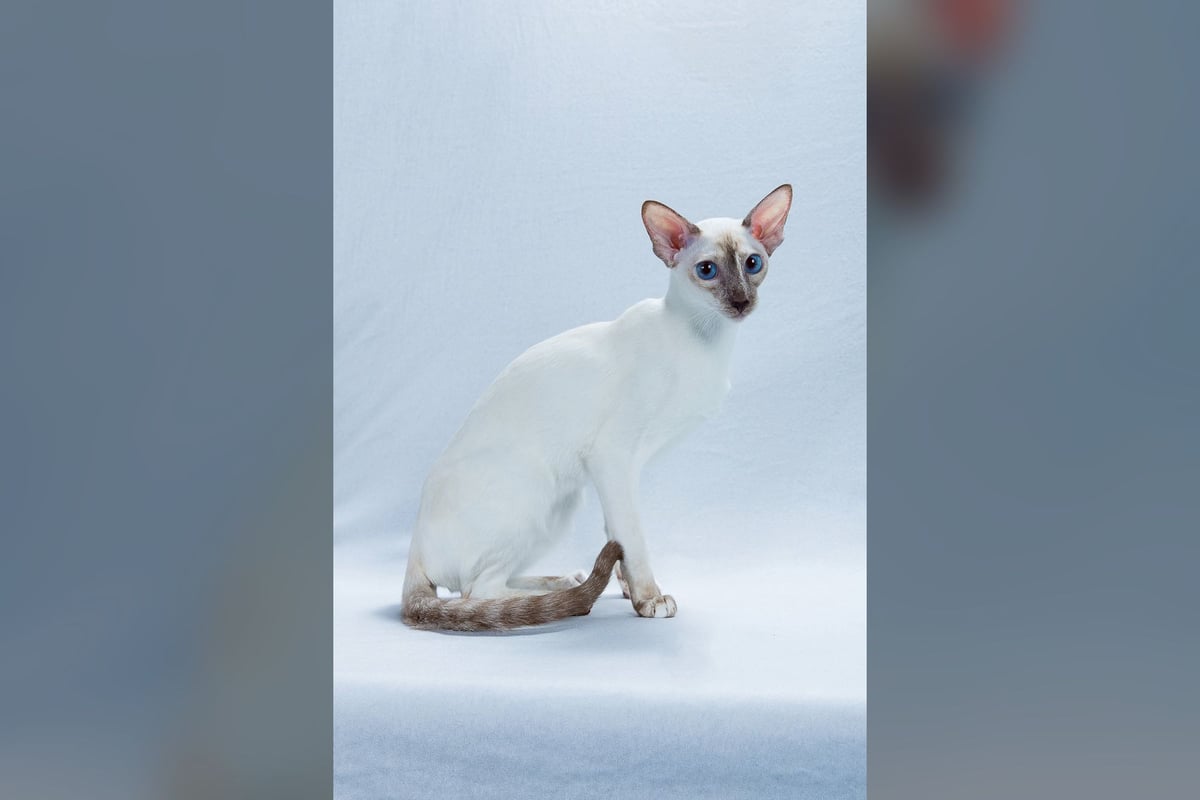
Colorpoint Shorthair
Genetically and morphologically, the Colorpoint Shorthair is a Siamese with non-traditional colorpoints: red point, cream point, lynx point (tabby point) and tortie point, among others. Born in the 1940s-1950s from crosses between Siamese and domestic cats with red or tabby coats, it has been recognized as a distinct breed by the CFA since 1964, whereas European registries — including the LOOF and the FIFe — simply treat it as a color variety of the Siamese. This ambiguous status, somewhere between "breed in its own right" and "variant," sits at the heart of its identity. In practice, owners find a cat identical in every respect to the Siamese: a long, oriental silhouette, intense blue eyes, a powerful voice and a visceral need for human company.
- Weight
- 2.5 to 5kg
- Height
- 25 to 30cm
- Life expectancy
- 15years
- Monthly cost
- 60 to 110€
Personality profile
Energy 5/5
Independence 1/5
Trainability 5/5
Good with children 4/5
Talkativeness 5/5
Space needed 3/5
Attachment to home 5/5
Good with strangers 4/5
Good with cats 4/5
Good with dogs 4/5
Coat care 1/5
Exercise needs 4/5
Scores given on measured axes, data confidence: high.
Living with a Colorpoint Shorthair
Description
The morphology is entirely that of the modern Siamese. The silhouette is long, svelte and muscular, typical of the oriental build: a triangular head with clean lines, a long straight nose, large wide-based ears set in line with the cheeks, almond-shaped eyes of a deep sapphire blue. The coat is short, very fine, lying close to the body, with almost no undercoat. The colorpoint pattern — a light body contrasting with colored extremities — is its defining trait, but where the classic Siamese comes in seal, blue, chocolate and lilac, this breed explores a wider palette: red point (fiery red), cream point (delicate cream), lynx point (tabby overlaid on the points, also called tabby point), tortie point (tortoiseshell mottling combining the base color and red on the points), and every combination of the two (cream lynx point, seal tortie lynx point...). Males reach 3.5 to 5 kg, females 2.5 to 4 kg. Life expectancy is around fifteen years.

Temperament
It inherits the Siamese character unfiltered, in its full intensity. It is a hyper-affectionate cat that follows its owner from room to room, comments on every event of the day in a raspy, carrying voice, and demands to be the center of attention. Its intelligence is sharp: it solves problems, opens doors, works its way into drawers and turns its environment upside down for entertainment. Playful and curious well into old age, it never seems to slow down. Its sociability is real — it readily welcomes strangers and lives well with other cats or well-socialized dogs — but its main attachment goes to its chosen human, toward whom it shows an almost exclusive devotion. Solitude is painful for it: more than four to six hours alone as a routine is enough to trigger anxiety, compulsive vocalizing and destructive behavior.
Training
This is one of the most trainable cats there is. Its intelligence, its motivation to interact with people and its responsiveness to rewards make it a top candidate for clicker training. It can learn to answer to its name, give a paw, sit on command, retrieve a light object or run a mini obstacle course. Short sessions — five to ten minutes a day — give the best results; beyond that, it grows bored and disengages. Positive reinforcement (treats, play, cuddles) is the only effective method: any physical restraint or punishment triggers an immediate withdrawal, or even an indignant vocal reaction. Training also serves as an essential anti-boredom outlet for this intellectually demanding cat. Its need for intense exercise is high: plan at least two long active-play sessions a day (15-20 minutes each) to channel its overflowing energy.

Feeding
Despite its slender silhouette, this is an energetic cat that burns through calories and needs a diet matched to its activity level. Kibble or wet food rich in animal protein (minimum 35 to 38%) is the ideal base. Taurine, an amino acid critical for heart and eye health, should be explicitly listed in the ingredients. Two split meals a day are preferable to free feeding, which encourages emotional snacking — because, like its Siamese cousin, it can beg for food out of boredom or attention-seeking rather than genuine hunger. Kittens need a calorie-dense diet up to twelve months to support their rapid growth. Monitor weight regularly: unusual weight gain in this naturally lean cat can signal a metabolic imbalance.
Affiliate links, no extra cost to you. Legal notice

Living conditions
It adapts perfectly to an apartment, even a modest one, provided the environment is enriched and human presence is guaranteed. Cat trees, tunnels, interactive toys in rotation, food puzzles: cognitive stimulation matters as much as physical space. It is not suited to households where the occupants are routinely away for long hours — such chronic solitude almost inevitably leads to behavioral problems. The ideal setup remains a work-from-home household, a multi-person family, or adoption alongside another Oriental or Siamese. An interactive play session of at least thirty minutes a day — wand toy, clicker training, obstacle course — is essential to its mental balance. Like all Orientals, it is recommended to keep it indoors to protect its health and maximize its life expectancy.

Grooming and coat care
Upkeep is minimal, making this one of the easiest cats to care for on this front. The short, close-lying coat does not mat, sheds little and keeps its satin look with minimal effort. A weekly pass with a rubber grooming glove or a chamois cloth is enough to remove dead hair and stimulate skin circulation. Bathing is only rarely needed. Attention should instead go to the ears — large and open, they can accumulate wax; cleaning twice a month with a suitable ear solution prevents infection. Dental care is the real point of vigilance: weekly brushing (ideally daily) from kittenhood limits the tartar buildup and gingivitis the breed is prone to. Claws should be trimmed every two to three weeks.

Health
The breed shares the Siamese's genetic makeup and, with it, its health predispositions. Feline amyloidosis is the most serious risk: amyloid protein deposits gradually build up in the liver, kidneys or pancreas, potentially leading to organ failure in adulthood or old age. No standardized commercial DNA test is available for this condition — monitoring relies on regular blood work (liver and kidney) from five years of age. Feline asthma is also overrepresented in oriental breeds: any episode of recurrent dry coughing or labored breathing should raise concern. Progressive retinal atrophy (PRA) is another documented predisposition in Siamese and Oriental lines, which can lead to progressive blindness; some serious breeders have their breeding cats' eyes checked. Convergent strabismus, a historical genetic remnant, can occur without harming wellbeing. Dental problems (gingivitis, resorptive lesions) call for early, regular dental care. Finally, like the Siamese, the breed is known for a particular sensitivity to general anesthesia — it is essential to flag this to any vet before surgery.
Breed history
The history of the Colorpoint Shorthair begins in the 1940s, on both sides of the Atlantic, when American and British breeders sought to introduce new colorpoints into the Siamese. To obtain red point — a color absent from the classic Siamese — they crossed Siamese with domestic cats with red or tabby coats, then backcrossed over several generations to reintroduce the oriental type. The CFA recognized it as a distinct breed in 1964, drawing a precise line: the CFA Siamese is reserved for the four historical colorpoints (seal, blue, chocolate, lilac), with any other colorpoint constituting a Colorpoint Shorthair. This split remains a North American specificity. In Europe, the FIFe and the LOOF have never made this distinction: all Siamese cats, whatever their colorpoint, are registered under the Siamese breed, with the newer colors simply classed as varieties. This dual status — a standalone breed in the United States, a color variety in Europe — persists today and explains why the breed remains little known under this name outside American show circles.
Getting ready for your Colorpoint Shorthair
Four essentials to line up before day one.
Affiliate links, no extra cost to you. Legal notice
FAQ: Colorpoint Shorthair
Sources
- Wikipedia FR — Colorpoint Shorthair · Breed recognized by the CFA in 1964 as distinct from the Siamese. In Europe (FIFé, LOOF), considered a color variety of the Siamese. Originated from Siamese × red/tabby cat crosses in the 1940s-1950s.
- CFA — Colorpoint Shorthair Breed Standard · 16 recognized color combinations. Official distinction from the Siamese since 1964: Siamese = 4 historical colorpoints (seal, blue, chocolate, lilac); Colorpoint Shorthair = every other colorpoint.
- Wikipedia EN — Colorpoint Shorthair · History of the breed's creation, CFA split 1964, variety status of the Siamese in Europe. PRA and predispositions shared with the Siamese (amyloidosis, asthma).

