


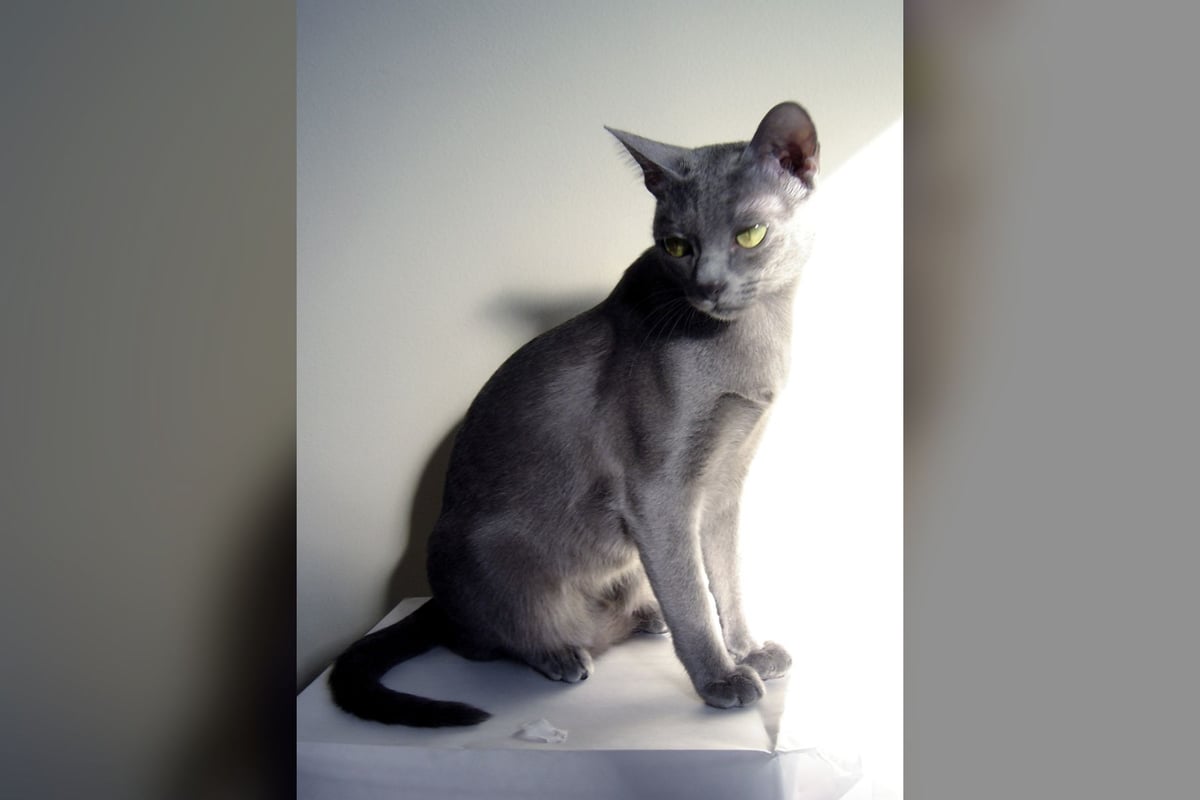
Korat
The Korat is one of the oldest documented cat breeds, originating from the Khorat Plateau in Nakhon Ratchasima province, Thailand. Mentioned in the Tamra Maew (an illustrated Thai manuscript from the 14th-18th centuries) as a symbol of luck and prosperity, it was traditionally given in pairs to newlyweds. Its silver-blue coat with silver-tipped hairs — unique and inimitable — and its intensely green adult eyes make it an instantly recognizable breed. Imported to the United States in 1959 by Jean Johnson, admitted to CFA championship in 1966 and recognized by FIFe in 1981, it remains rare and sought after, with a deeply devoted and territorial temperament. Major health point to watch: GM1/GM2 gangliosidosis, a hereditary neurological disease that is fatal in kittens — a DNA test on breeding cats is mandatory before any acquisition.
- Weight
- 2.5 to 4.5kg
- Height
- 23 to 30cm
- Life expectancy
- 15years
- Monthly cost
- 50 to 90€
Personality profile
Energy 3/5
Independence 3/5
Trainability 4/5
Good with children 3/5
Talkativeness 3/5
Space needed 2/5
Attachment to home 4/5
Good with strangers 2/5
Good with cats 2/5
Good with dogs 3/5
Coat care 2/5
Exercise needs 3/5
Scores given on measured axes, data confidence: high.
Living with a Korat
Description
The silhouette is semi-cobby, surprisingly dense: compact and muscular, heavier than it first appears, with a solid bone structure and firm muscle under a close-lying coat. The head is its morphological signature: a perfect heart shape, with high, prominent cheekbones that form the side curves, a slightly domed forehead, and well-defined brow ridges that trace the top edge of that heart. The muzzle is short, with a well-defined stop, and the whole head gives an expression of concentrated gentleness. The ears are large, wide at the base with a slightly rounded tip, set high, with fine, almost translucent inner skin. The eyes are its most striking feature: large, round and luminous, an intense peridot green in adulthood — a color that can take two to four years to fully stabilize. In kittens and young adults, an amber-green shade is tolerated up to two years; fully amber eyes are a show fault in an adult. The tail is medium length, thick at the base, tapering toward the tip. The coat is the only recognized color: a uniform blue over the whole body, each hair tipped with silver that produces a characteristic "silver halo" effect in the light, the result of combining the dilute gene (d/d) with silver tipping. The absence of undercoat gives the coat a silky, glossy texture that lies flat against the body. Males: 3.5 to 4.5 kg; females: 2.5 to 3.5 kg. Full maturity around 3 years. Life expectancy: 14 to 18 years.

Temperament
This is a cat of extreme loyalty, deeply attached to the people it knows best and to its territory. That loyalty has a flip side: it is territorial, sometimes dominant with other cats, and cohabitation with an unfamiliar cat must be managed carefully and gradually. It follows its owners, seeks physical contact and tolerates prolonged solitude or sudden changes of environment poorly. Its intelligence is marked — it quickly learns simple tricks, memorizes routines and responds to its name — but it gets bored if stimulation is lacking. Unlike the chattiest Asian breeds, its vocalizing is moderate: melodious, varied, expressive sounds rather than continuous communication. What it cannot tolerate is noise: loud voices, noisy household appliances or a chaotic environment unsettle it deeply. This is not a cat that adapts to every setting — it is a cat of deep bonds, giving everything to those it chooses.
Training
Sharp and with an excellent memory for routines, it is very receptive to positive-reinforcement learning. It can learn to come on recall, use a designated scratching post, accept a harness if socialized early, and perform simple clicker tricks. Sessions should be short (5 to 8 minutes), calm, and conducted without raised voices — noise breaks its concentration and erodes trust. Its dominant nature means it cooperates by choice, not by submission: physical coercion is counterproductive. Socializing the kitten before 12 weeks (handling, varied sounds, vet visits) is decisive for tempering the breed's natural reserve and noise sensitivity in adulthood.

Feeding
The ration should be matched to a compact, muscular build, without excess: a 4 kg adult with moderate activity needs roughly 180 to 220 kcal/day. Two measured daily meals are preferable to free feeding. Favor premium kibble high in animal protein (minimum 35%), low in carbohydrates, with adequate taurine for heart function. The absence of undercoat makes any coat-targeted supplementation unnecessary. Kittens up to 12 months need dedicated kitten food, rich in DHA for neurological development. It is not especially greedy, but weight monitoring after neutering is still advisable. Avoid abrupt diet changes: this is a breed sensitive to changes in routine.
Affiliate links, no extra cost to you. Legal notice

Living conditions
Apartment life suits it perfectly: its compact size, moderate energy level and strong attachment to its territory make it an indoor cat at heart. A quiet home with stable routines and few strangers passing through matches its needs. It appreciates high perches to survey its domain, and a few refuge spaces where it can withdraw if the atmosphere becomes too lively. Cohabitation with young children is possible if the environment stays calm, but this is not a cat for a large, noisy family — it prefers households with a measured pace. Introducing a second cat should be done with a great deal of patience: its dominant nature can make cohabitation conflictual if introductions are rushed. It tolerates a range of temperatures moderately well but is sensitive to sudden shifts in humidity and drafts, particularly regarding respiratory illness — avoid environments that are too cold or damp.

Grooming and coat care
Coat care is among the simplest in the cat world. The total absence of undercoat removes the risk of matting and significantly reduces shedding. Brushing twice a week with a rubber grooming glove or a soft, fine-bristled brush is enough to remove dead hair and maintain the coat's natural shine. Shedding is minimal: textiles are barely affected, and no daily brushing is needed even during the molt, which stays discreet. Clean the ears once or twice a month with a suitable ear solution. Trim the claws every three to four weeks. A bath is rare — the short, close-lying coat dries quickly if needed.

Health
The health point to watch is major and non-negotiable before any acquisition: GM1 and GM2 gangliosidosis, two hereditary lysosomal storage diseases with autosomal recessive transmission. These serious neurological conditions cause lipids to build up in neurons, leading to progressive neurological disorders — head tremors from 6 to 8 weeks of age, then ataxia, loss of mobility — and are fatal before 8 to 9 months. A DNA test on a gum-tissue sample that identifies carriers has existed since 1998. Every serious breeder should be able to provide the results of both parents (clear/carrier/affected) — a kitten from two carrier parents should never be sold for breeding. Aside from this predisposition, this is a natural breed considered robust. Two other points to watch: respiratory sensitivity (a predisposition to feline asthma and respiratory infections when exposed to cold, humidity or drafts) and general sensitivity to anesthesia and antiparasitic treatments — always inform the vet of the breed. Gangliosidosis screening happens upstream, in the breeding cats: once a kitten is born to untested parents, no exam can undo the risk. For the rest, an annual visit from adulthood onward, including a respiratory exam, is enough for good preventive follow-up.
Breed history
The Korat takes its name from the Khorat Plateau in Nakhon Ratchasima province, in northeastern Thailand, the region it has come from for centuries. It is one of the earliest documented breeds: the Tamra Maew ("Cat Poems"), an illustrated Thai manuscript written between the 14th and 18th centuries, already depicts and describes it as a symbol of luck and prosperity. According to tradition, giving Korats in pairs to newlyweds guarantees them happiness and fertility. During the Hae Nang Maeo rain ceremony, Korats were carried in procession in baskets and sprinkled with water, their blue-gray coat evoking the beneficial rain clouds. The breed remained almost exclusively Thai until the mid-20th century. In 1959, Jean Johnson imported the first pair to the United States from the Mahajaya cattery in Bangkok — Nara and Dara, the founders of the American line. The Korat Cat Fanciers' Association was founded in 1965; the CFA recognized the breed in 1965 and opened championship status to it in March 1966. France received its first Korats in 1979; FIFe granted it official recognition in November 1981. The breed remains one of the rarest in Europe today, with limited breeding numbers and a small but rigorous community of enthusiasts committed to genetic testing.
Getting ready for your Korat
Four essentials to line up before day one.
Affiliate links, no extra cost to you. Legal notice
FAQ: Korat
Sources
- Wikipedia FR — Korat · Origin: Khorat Plateau, Nakhon Ratchasima. Tamra Maew 14th-18th c. US import 1959 (Nara and Dara). CFA 1965-1966. FIFe November 1981. France 1979. GM1/GM2 gangliosidosis autosomal recessive, DNA test since 1998, fatal before 8 months. Respiratory sensitivity and asthma. Silver-blue coat, adult peridot green eyes.
- CFA — Korat Breed Profile · Jean Johnson import 1959. Semi-cobby body. Heart-shaped head. Large round peridot green eyes, amber tolerated up to age 2. Silver-blue coat, silver halo effect. Robust natural breed. CFA championship recognition March 1966.
- Royal Canin FR — Korat profile · Life expectancy 15-20 years. Energetic, intelligent, affectionate and exclusive temperament. Soft, melodious voice. Sharp senses (hearing, sight, smell). Minimal upkeep. Should not be left alone often.
- LOOF — Recognized cat breeds · The Korat is among the breeds officially recognized by the Livre Officiel des Origines Félines.

