


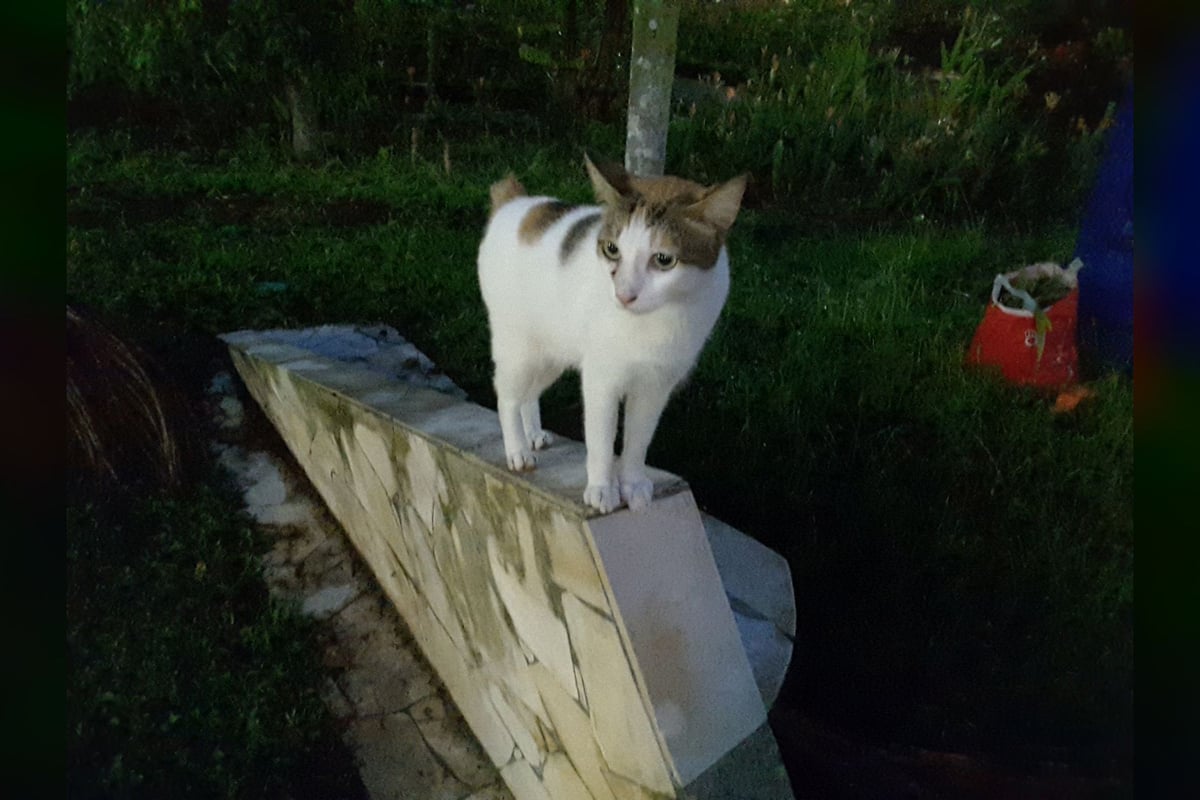
Japanese Bobtail
The Japanese Bobtail is an ancient breed, present on the Japanese archipelago since at least the 6th century, symbolized by the Maneki-neko — the tricolor figurine with a raised paw that decorates shop windows across Asia. Its pom-pom tail, short and unique to each individual, results from a dominant genetic mutation distinct from the Manx's: no vertebral problems, no associated syndrome. A slender semi-foreign body, active, a hunter, social: this cat follows its owner around, plays with intensity and vocalizes melodiously without filling the room with noise.
- Weight
- 2.5 to 4.5kg
- Height
- 25 to 33cm
- Life expectancy
- 13years
- Monthly cost
- 55 to 95€
Personality profile
Energy 4/5
Independence 3/5
Trainability 4/5
Good with children 4/5
Talkativeness 3/5
Space needed 3/5
Attachment to home 4/5
Good with strangers 3/5
Good with cats 4/5
Good with dogs 3/5
Coat care 2/5
Exercise needs 4/5
Scores given on measured axes, data confidence: medium.
Living with a Japanese Bobtail
Description
The build is semi-foreign: a slender, muscular silhouette, long fine legs, a light bone structure, a torso of moderate length. The hind legs are slightly longer than the front legs, giving the breed a characteristic posture, slightly arched when standing. The head is triangular, with high, wide cheekbones, a moderately short muzzle, and large, well-spaced, upright ears. The eyes are oval, slightly slanted, in all colors — odd eyes (heterochromia) are common in tricolor individuals and highly prized. The breed's absolute signature is its tail: short, no more than 7.6 cm (3 inches) unfolded per the CFA standard, made up of a reduced number of partially fused vertebrae, covered in hair that fans out — the visual effect resembles a pom-pom or a chrysanthemum flower. Each individual has a tail whose bone structure is unique. The coat is short, silky, not very dense, with no significant undercoat. Shedding is moderate. The Mi-ke (三毛) coat — white, red and black in large patches — is the most culturally emblematic, but every coat is accepted except colorpoint, chocolate and cinnamon. There is a semi-longhair variant (Longhair Japanese Bobtail), recognized separately by the CFA since 1993. Males: 3.5 to 4.5 kg, females: 2.5 to 3.5 kg.

Temperament
An active, curious cat, strongly oriented toward human interaction. It follows its owner from room to room, takes an interest in every household activity and copes poorly with prolonged indifference. Its voice is melodious and modulated — it "converses," producing trills and soft sounds rather than repetitive, shrill meows. This vocal level is expressive without being intrusive, a world away from a show-line Siamese or a Bengal. Its intelligence is practical: it memorizes routines, quickly spots interactive toys and solves moderately difficult food puzzles. Its temperament is often described as dog-like — it can retrieve thrown objects, take to leash walking and develop an asymmetric, strongly attached bond with one member of the household while remaining approachable to others. With respectful children, cohabitation is generally easy. Its tolerance of strangers is average — a period of observation before social investment is typical of the breed. Its hunting instinct remains sharp.
Training
Receptiveness to active learning is good. Its practical intelligence and strong orientation toward people make it a good candidate for clicker training: retrieving objects, simple tricks, leash walking. Mental sport sessions (food puzzles, search games) suit this cat particularly well, since intelligence exercises help keep it behaviorally balanced. Harness walking is achievable with gradual training from 3–4 months. Sessions should stay short (5–10 minutes) but regular: it is this daily physical and cognitive activity that prevents the compensatory behaviors linked to understimulation. Positive reinforcement is the only effective method; any physical restraint breaks the trust built up.

Feeding
An active cat, with a metabolism that runs high for its size. A premium diet high in animal protein (≥38%) suits its needs. For a 4 kg adult with moderate to high activity, plan on 200–250 kcal/day, split into two meals. The breed has no particular kidney or heart predispositions that would call for a specialized diet. After neutering, adjust the ration to prevent weight gain, since the breed stays active but its basal metabolism drops. A circulating water fountain is preferable to a static bowl to ensure adequate hydration.
Affiliate links, no extra cost to you. Legal notice

Living conditions
Apartment or house both work, provided its activity level is met. An enriched environment — vertical structures, interactive toys, toy rotation — is non-negotiable for a cat whose energy sits at 4/5: without stimulation, compensatory behaviors (rummaging, climbing surfaces, vocalizing) appear quickly. Secure access to the outdoors or a netted balcony is a plus for individuals with a strong hunting instinct, without being essential if the indoor space is well set up. Daily active play sessions (20 to 30 minutes) provide the physical activity equivalent needed to keep it balanced. The breed tolerates living with a feline companion well — it generally cohabits without friction with other active cats, provided the introduction is gradual. Its tolerance of cold and heat is moderate.

Grooming and coat care
The short, silky coat is among the easiest to maintain. The lack of a dense undercoat cuts matting to almost zero. Weekly brushing with a grooming glove or a soft brush is enough to remove dead hair and keep the coat's glossy look. During seasonal shedding — spring and fall — step up to two sessions a week for two to three weeks. No regular bathing is needed, as the breed grooms itself effectively. The pom-pom tail deserves occasional attention: the long hairs that make it up can trap debris if not checked regularly. Check the ears monthly and clean with a suitable veterinary product if wax builds up. Trim the claws every three to four weeks for cats living exclusively indoors.

Health
This is one of the genetically healthiest recognized breeds. Its tail mutation — a missense variant of the HES7 gene, identified in 2016 — is a dominant mutation that reduces the number of caudal vertebrae and causes their partial fusion without affecting the spinal column, the nervous system or adjacent organs. Unlike the Manx, whose dominant M gene is lethal in the homozygous state (MM = non-viable embryo) and is associated with severe spinal malformations (Manx syndrome: spina bifida, megacolon, hindquarter paralysis), the Japanese Bobtail gene generates no documented vertebral pathology. The two mutations are genetically distinct, with no molecular relationship. The breed shows high genetic diversity for a pedigree cat — a finding established in several feline population studies — which translates into the absence of major documented hereditary predispositions. No specific DNA test is required on breeding cats. Litters are generally small, but kittens are proportionally large at birth and develop quickly. Life expectancy: 9 to 15 years. Routine care (vaccinations, parasite control, annual check-ups) is sufficient.
Breed history
The breed has been present on the Japanese archipelago since at least the 6th century, when cats are believed to have arrived from continental Asia — most likely via Korea, in the wake of Buddhism and diplomatic exchanges with China. The earliest iconographic records that unambiguously depict short-tailed cats in Japan date back to the medieval period: scrolls, ukiyo-e prints and sculptures attest to it. The breed is inseparable from the Maneki-neko (招き猫, "beckoning cat"), the lucky-charm figurine whose prototype is traditionally a tricolor Mi-ke Bobtail, paw raised to "beckon fortune." This symbol, ubiquitous in Japanese shops since the Edo period (17th–19th century), has helped link the Mi-ke coat with prosperity. Historically, owning cats was reserved for the nobility until 1602, when an imperial decree freed them to control the rodents threatening silkworm farms. From then on the breed lived in Japanese streets and countryside, naturally selected over centuries. Its introduction to the West is the work of Elizabeth Freret, the first documented person to import Japanese Bobtails to the United States from Japan in 1968. The CFA recognized the shorthair variety for championship in 1976, then the longhair variety in 1993. In Europe, its introduction came notably through a French breeder, Hélène Choisnard, who acquired a tricolor female in Thailand in 1980. The genetic mutation responsible for the short tail was confirmed as distinct from the Manx's in molecular studies during the 1990s–2000s, definitively lifting any ambiguity about vertebral risk. In 2016, a study precisely identified the HES7 gene missense mutation as responsible for the Japanese Bobtail phenotype — a dominant gene with no deleterious effect, unrelated to the Manx's M gene. The breed remains rare in France but benefits from an active community of breeders, mainly linked to the FIFe and CFA networks.
Getting ready for your Japanese Bobtail
Four essentials to line up before day one.
Affiliate links, no extra cost to you. Legal notice
FAQ: Japanese Bobtail
Sources
- Wikipedia FR — Japanese Bobtail · Breed present in Japan since the 6th century (continental import). Short tail, fused vertebrae, chrysanthemum appearance. Semi-foreign body. Emblematic tricolor Mi-ke coat. Introduced to Europe via French breeder Hélène Choisnard (tricolor female, Thailand, 1980).
- Wikipedia EN — Japanese Bobtail · Tail mutation: dominant HES7 gene (missense, 2016), distinct from the Manx — no associated vertebral disorder. Elizabeth Freret, first US import 1968. CFA championship shorthair 1976, longhair 1993. Among the most genetically diverse of the pedigree breeds. Mi-ke = tricolor white/red/black, culturally auspicious.
- CFA — Japanese Bobtail breed standard · CFA standard: tail ≤ 7.6 cm (3 inches) from the body, fanned pom-pom of fur unique to each individual. Semi-foreign body, long slender legs, medium torso. Dominant gene distinct from Manx syndrome. No known anomaly associated with the mutation. Mi-ke traditional coloring.

