


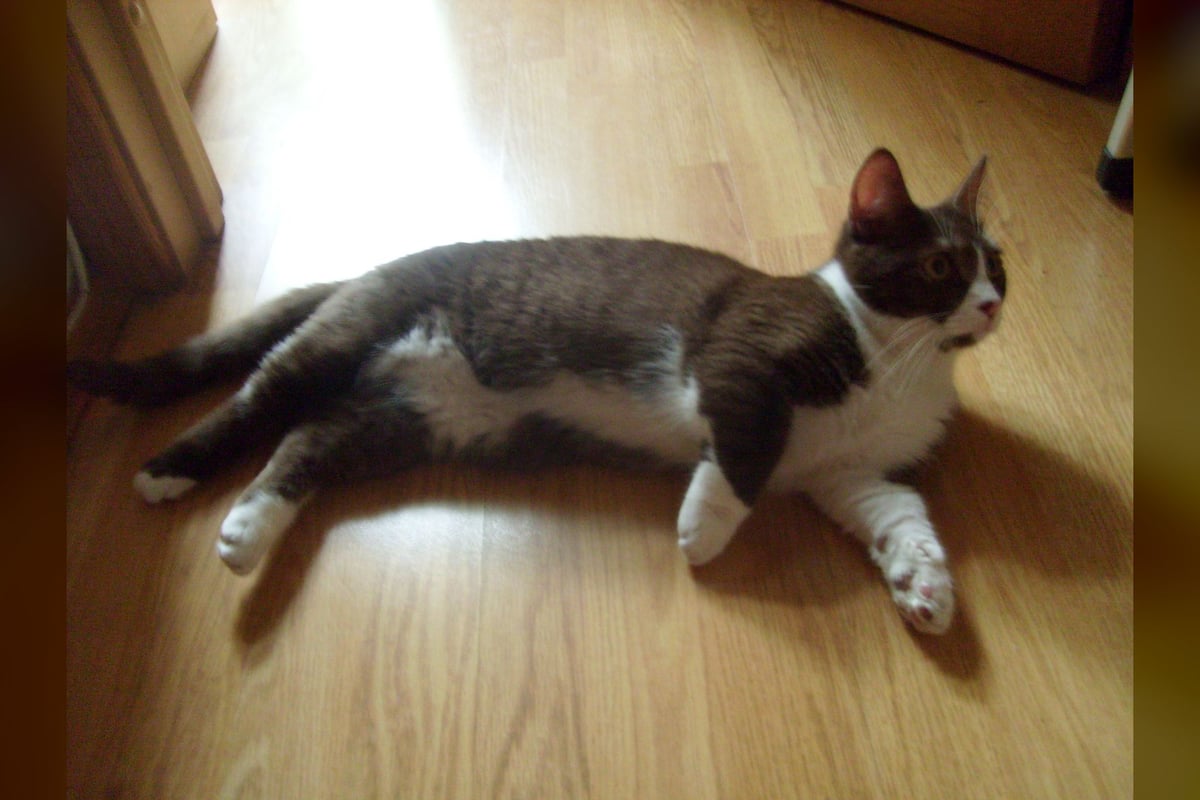
Munchkin
The Munchkin is an American breed born from a spontaneous mutation discovered in Louisiana in 1983, which shortens the long bones of the limbs without affecting the trunk or head. Recognized in championship by TICA since 2003 and by the LOOF under special oversight, refused by the FIFe, the GCCF and the CFA, it is at the center of a persistent veterinary debate: the gene responsible is lethal in the homozygous state, and the long-term skeletal risks remain insufficiently documented. Its temperament, by contrast, is lively and playful, at odds with its compact silhouette.
- Weight
- 2 to 4.5kg
- Height
- 13 to 18cm
- Life expectancy
- 13years
- Monthly cost
- 60 to 110€
Personality profile
Energy 3/5
Independence 3/5
Trainability 3/5
Good with children 4/5
Talkativeness 3/5
Space needed 2/5
Attachment to home 4/5
Good with strangers 3/5
Good with cats 4/5
Good with dogs 4/5
Coat care 2/5
Exercise needs 2/5
Scores given on measured axes, data confidence: medium.
Living with a Munchkin
Description
The build is semi-foreign, medium-sized, with a long torso, firm musculature and a characteristic low stance due to the shortening of the long bones of the limbs. The head is a moderate wedge, with high cheekbones, a clear chin, a medium-length muzzle and large, expressive oval eyes whose color varies with the coat. The ears are medium to large, well spaced and slightly rounded at the tip. The breed's defining trait is the extreme shortness of the legs — the forelegs in particular, slightly shorter than the hind legs — giving it a low-slung silhouette and a ferret-like gait. The limbs remain straight, muscled and well-proportioned; the paws are round and compact. The breed comes in two official variants: the Munchkin Shorthair (short, dense coat with a slightly springy texture) and the Munchkin Longhair (semi-long, silky coat with a ruff and a plumed tail). All coat colors and patterns are accepted. Despite its short legs, it retains surprising mobility and agility on the ground, even though it is naturally limited in its ability to jump to height. Weight: 2 to 4.5 kg for females, 3 to 4.5 kg for males. Life expectancy: 12 to 15 years.

Temperament
Lively, playful and social, it has a temperament that runs counter to its low-slung build. It keeps a mischievous, curious streak well beyond kittenhood, dashes at full speed close to the ground, and frequently stands up on its hind legs to survey its surroundings — a characteristic posture that sometimes earns it comparisons to a meerkat. Its sociability is marked: it enjoys its owners' presence, tolerates children well and cohabits without tension with other cats or properly introduced dogs. It is not particularly vocal, but it regularly speaks up to signal its needs or ask for play. Its attachment to people is real without being excessive: it follows its owners with interest but accepts moments of independence. The breed is known for collecting small shiny objects — a behavior breeders readily describe as magpie-like. Its curiosity and energy translate into a need for daily mental and physical stimulation, even though the reach of its jumps stays limited by its short legs.
Training
Curious, it responds well to structured interaction. Its energy level and natural sociability make it a good candidate for directed play sessions and a few simple lessons through positive reinforcement: answering to its name, accepting the carrier, tolerating brushing and handling without resistance. Sessions should be short (3 to 5 minutes), regular and based exclusively on food rewards or a soft voice — never on physical restraint. Since its jumping ability is limited, exercises involving significant heights should be avoided. Ground-level courses, tunnels, food puzzles and rolling toys, on the other hand, suit its build perfectly and stimulate its intelligence without straining its limbs asymmetrically. Early socialization to veterinary handling is particularly recommended: the regular orthopedic follow-up implied by the uncertainty over long-term skeletal risks requires a cat that calmly accepts examinations.

Feeding
Feeding must meet one central requirement: preventing excess weight. An overweight cat subjects its short legs to increased mechanical stress — and these legs are already in an atypical biomechanical situation because of the mutation. Weight monitoring is therefore stricter than for a standard breed. Favor food rich in quality animal protein, moderate in fat and low in unnecessary carbohydrates. Two measured, split meals a day, never free-feeding — particularly for sedentary neutered individuals. An intake of omega-3 fatty acids (EPA and DHA), with anti-inflammatory properties, is a reasonable plus for preventive joint support. Kibble containing glucosamine and chondroitin can provide extra cartilage support in aging individuals. Monthly weight checks are recommended: every extra kilogram mechanically amplifies pressure on the distal joints and lumbar spine. After 7-8 years, switch to a senior formula with moderate caloric density.
Affiliate links, no extra cost to you. Legal notice

Living conditions
Apartment life suits it well: its compact build and limited jumping ability make it a naturally less destructive climber at height than standard breeds. A ground-level enriched environment — tunnels, rolling toys, food puzzles, low structures to explore — suits its build better than very tall cat trees. That said, perches should not be removed altogether: it finds its own routes to reach heights, climbing in stages. A few climbing structures with closely spaced steps let it exercise this natural curiosity. Life in a house with a garden is possible, with the usual precautions for an indoor cat. Weight monitoring is important: an overweight cat mechanically increases the load on legs that are already short. Noisy or unstable environments do not suit it well; it prefers a stable, predictable setting.

Grooming and coat care
The short coat of the Munchkin Shorthair is low-maintenance: a weekly brushing with a fine metal comb or grooming glove is enough to remove dead hair and maintain the coat's shine. During seasonal shedding (spring and fall), step up to twice a week. The Munchkin Longhair needs more sustained care: 2 to 3 weekly brushings with a wide-toothed comb to detangle the outer coat and prevent mats, particularly in friction zones (armpits, groin, behind the ears). A practical quirk: the shortness of the limbs partly limits self-grooming, particularly in the dorsal and tail areas, which it reaches with more difficulty than a standard cat. Regular checks on the cleanliness of these areas and, if needed, a light quarterly bath are advised. Ears and eyes follow the usual protocol: weekly cleaning with suitable products, checking for discharge.

Health
The breed is at the center of an ethical and veterinary debate tied to its very definition: the breed's characteristic legs result from an autosomal dominant mutation in the UGDH gene (UDP-glucose 6-dehydrogenase), precisely identified in recent research. This mutation produces a shortening of the long bones through dysregulation of proteoglycan metabolism in cartilage — a mechanism distinct from classic achondroplasia but with comparable morphological effects. The first genetic issue is structural: the Mk gene is homozygous lethal. Embryos carrying two copies of the mutation (Mk/Mk genotype) are not viable and die in utero. Every Munchkin × Munchkin cross therefore statistically produces 25% embryonic loss, and responsible breeders cross exclusively Munchkin × non-Munchkin (Mk/mk). Crosses between two Munchkins are condemned by veterinary organizations for this reason. Clinically, the picture is nuanced. Historical concerns centered on lordosis (abnormal lumbar spinal curvature), pectus excavatum (sternal deformity) and early arthritis linked to the atypical biomechanical stresses on short limbs. Studies published to date have not documented systematic lordosis or pectus excavatum in the populations studied, and conclude that mobility is broadly preserved. However, two major limitations temper these conclusions: study sample sizes are modest, and long-term follow-up of aging individuals remains very insufficient. The risks of early arthritis and disc herniation linked to the particular biomechanical stresses of very short limbs cannot be ruled out on the basis of current data alone. The FIFe, the GCCF and the CFA refuse to recognize the breed, citing precisely these uncertainties and the principle of not selecting for a genetic anomaly. TICA and the LOOF recognize the breed under oversight, requiring Mk × mk crosses exclusively. Clinical points of vigilance: monitor lumbar posture and spinal flexibility (an early sign of lordosis), detect any gait asymmetry, control weight rigorously (excess weight worsens joint stress). An early orthopedic assessment is recommended, and regular veterinary follow-up including attention to the limbs and spine remains prudent throughout life.
Breed history
The Munchkin's history begins in 1983 in Louisiana, when Sandra Hochenedel took in two adult female cats with abnormally short legs found under a truck. One of them, named Blackberry, was pregnant; part of her litter showed the same shortened limbs, revealing the hereditary nature of the mutation. The descendants were entrusted to Kay LaFrance, who let the cats develop semi-free; the entire modern founding population comes from these two lines. The breed stayed under the radar for several years before a paper by researcher Solveig Pflueger drew TICA's attention in 1991. Presented publicly at a TICA show in New York on May 1, 1991, the breed immediately sparked heated controversy among the breeders and veterinarians present — some judging the spread of a deleterious mutation irresponsible, others pointing out that the mobility of the cats shown appeared to be preserved. TICA accepted the breed into its development program in September 1994, then granted it championship status in May 2003. Recent genetic research has identified the UGDH gene as carrying the causal mutation — a scientific advance that clarifies the mechanism but does not settle the ethical debate over intentionally breeding a morphology arising from a dominant genetic anomaly. The FIFe, the GCCF and the CFA maintain their refusal to recognize the breed. In France, the LOOF recognizes the Munchkin under oversight, requiring Munchkin × non-Munchkin crosses exclusively and organizing specific breeding meetings to monitor the breed's health over time.
Getting ready for your Munchkin
Four essentials to line up before day one.
Affiliate links, no extra cost to you. Legal notice
FAQ: Munchkin
Sources
- Wikipedia — Munchkin (cat) · Origin: Sandra Hochenedel, Louisiana, 1983. Autosomal dominant mutation, homozygous lethal (25% embryonic loss per Mk×Mk cross). TICA championship recognition May 2003 (development status September 1994). Refused by the FIFé, GCCF, CFA. LOOF: recognized under oversight.
- TICA — Munchkin Breed (list of recognized breeds) · Munchkin and Munchkin Longhair listed among the 73 breeds recognized by TICA in championship.
- Royal Canin — Munchkin Profile · Weight males 3-5 kg, females 2-4 kg. Height 12.7-17.8 cm. Life expectancy up to 15 years. Risks flagged: lordosis and pectus excavatum. Life-stage-appropriate diet. Weekly brushing (shorthair) or several times a week (longhair).
- LOOF — Recognized cat breeds · The Munchkin is recognized by the Livre Officiel des Origines Félines under specific breeding oversight. Munchkin × non-Munchkin crosses exclusively; breeding meetings organized to monitor the breed's health.

