


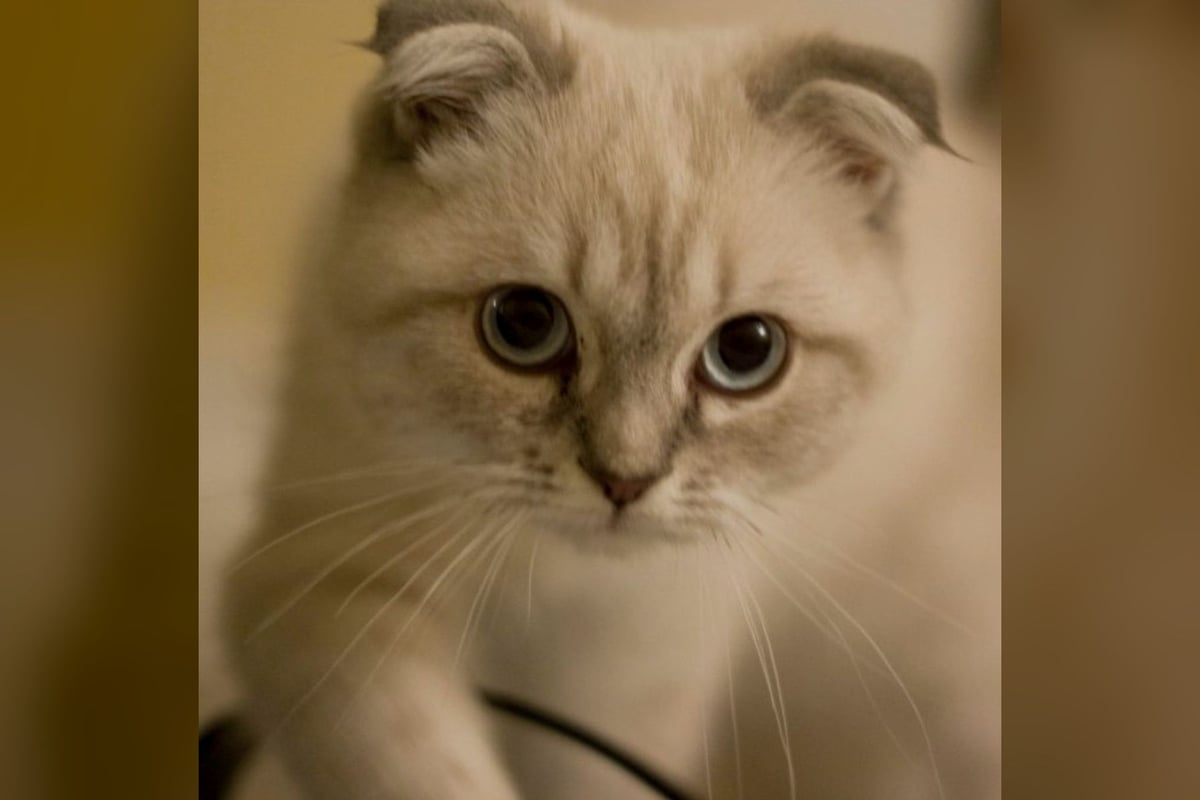
Scottish Fold
The Scottish Fold was born in 1961 from a spontaneous mutation discovered in Scotland: a queen named Susie had ears that naturally folded forward, giving the breed its spherical silhouette and immediately recognizable owlish expression. Recognized by the LOOF, the CFA and TICA, but refused by the FIFe on ethical grounds, it crystallizes a major veterinary debate: the gene responsible for its folded ears causes an incurable bone and cartilage disease in every carrier.
- Weight
- 3 to 6kg
- Height
- 28 to 35cm
- Life expectancy
- 13years
- Monthly cost
- 70 to 130€
Personality profile
Energy 2/5
Independence 3/5
Trainability 3/5
Good with children 4/5
Talkativeness 2/5
Space needed 2/5
Attachment to home 4/5
Good with strangers 3/5
Good with cats 3/5
Good with dogs 3/5
Coat care 2/5
Exercise needs 2/5
Scores given on measured axes, data confidence: high.
Living with a Scottish Fold
Description
The build is cobby, compact and rounded in almost every contour. The head is round and broad, with full cheeks, a domed forehead, a short muzzle and a well-defined chin — a morphology closely resembling the British Shorthair's, a breed it shares a close genetic kinship with. The eyes are round, large and highly expressive, their color varying with the coat. The breed-defining trait is the ears: folded forward and down by a dominant mutation of the Fd gene, they create that unique, permanent "owl" expression. The ears come in three degrees depending on the level of folding: degree 1 (single fold, tip slightly tilted), degree 2 (double fold, flap semi-flattened), degree 3 (triple fold, ear fully flattened against the skull — the most sought-after in shows). The coat is short, dense and slightly springy. Every color and coat is accepted. The semi-longhaired variant is called the Highland Fold (or Scottish Fold Longhair). The body is small to medium, with short legs and a compact stance. The tail must be flexible — a stiff or short tail is a clinical sign of severe OCD involvement. Weight: 3 to 6 kg depending on sex. Life expectancy: 12 to 15 years in well-monitored cats.

Temperament
Few cats are as placid. The temperament is calm, gentle and devoted without being possessive: it follows its owners discreetly, settles nearby, but doesn't demand constant attention. Not very vocal — it expresses itself with light, infrequent meows — it observes its surroundings with quiet curiosity. Its tolerance for handling is excellent, making it a cat popular with families with children. It cohabits without tension with other cats and with properly introduced dogs. It accepts strangers after a short observation period. Its composed nature can sometimes be mistaken for depression or chronic pain — a non-trivial diagnostic issue in a breed prone to OCD, which suffers in silence without radically changing its behavior. It remains playful and curious into advanced age, but its bursts of activity are short and low-intensity.
Training
This isn't a breed built for spectacular learning, but its gentle intelligence and attachment to its owners make it receptive to structured interactions. It can learn to answer to its name, accept veterinary care (transport, handling of the paws and ears — crucial for OCD monitoring), and submit to brushing and ear cleaning without resistance if the routine is established early. Sessions should be very short (3 to 5 minutes), based exclusively on positive reinforcement (treats or a soft voice), and never physically coercive. Coercion is counterproductive and, in a cat in pain, can trigger unusual defensive reactions. Early socialization to veterinary handling matters particularly for this breed: orthopedic consultations will be frequent, and a cat that accepts the exam makes diagnosis and monitoring easier.

Feeding
Two imperatives govern the diet, both linked to bone health: preventing overweight (an aggravating factor for joints already weakened by OCD) and supporting cartilage and joint tissue. Favor a diet rich in animal protein, moderate in carbohydrates, and enriched with omega-3 fatty acids (EPA and DHA), whose anti-inflammatory properties are documented. Foods containing glucosamine and chondroitin can provide preventive cartilage support, particularly in cats where OCD involvement is confirmed or radiographically suspected. Two split daily meals with measured portions — never free feeding, particularly in sedentary neutered cats. Monthly weight checks are advised: every kilogram of excess weight mechanically increases pressure on already compromised distal joints. After 7-8 years, switch to a senior formula with moderate caloric density.
Affiliate links, no extra cost to you. Legal notice

Living conditions
Apartment life suits it very well: a moderate energy level, its vocal discretion and compact build make it an unobtrusive roommate even in a small space. It doesn't need large floor areas or imposing climbing structures. A few perches at a reasonable height, a scratching post and some occupation toys are enough for its daily balance. Its sedentary lifestyle calls for weight monitoring, particularly in neutered cats. A garden isn't essential, but a secure balcony is a welcome enrichment. Watching for signs of joint pain matters more than spatial arrangement: the cat should not have to jump from significant heights if OCD involvement is suspected. The breed does not cope well with noisy environments or frequent changes of surroundings.

Grooming and coat care
The short, dense coat is low maintenance. A weekly brushing with a fine metal comb or a grooming glove is enough outside molting periods to remove dead hair and stimulate skin circulation. During the seasonal molts (spring and fall), step up to twice a week for a few weeks. Particular attention should go to the ears: the breed's characteristic folds create a confined space prone to wax buildup and potentially to ear infections. A weekly ear cleaning with a suitable veterinary product is advised — never insert a cotton swab into the ear canal. Regularly check for the absence of any suspicious odor or abnormal discharge. The round eyes can produce discharge in the inner corners; daily cleaning with unscented damp cotton prevents irritation. The Highland Fold (the semi-longhair variety) needs brushing 2 to 3 times a week.

Health
The health stakes here lie in the very definition of the breed: the dominant Fd (Folded) gene, responsible for the characteristic ears, is simultaneously the cause of an incurable bone and cartilage disease called osteochondrodysplasia (OCD). This is not one predisposition among others — it is a direct consequence of the genotype that defines the breed. The mechanism works as follows: the Fd gene affects normal cartilage development throughout the body, not just in the ears. In homozygous cats (Fd/Fd, from Fold × Fold crosses), the involvement is systematically severe and early-onset: fusion of the caudal vertebrae, exostoses of the legs and hocks, intense chronic pain, sometimes partial paralysis. These cats suffer. In heterozygous cats (Fd/fd, from Fold × Straight or Fold × British Shorthair crosses), involvement is less uniform but nearly universal according to radiographic studies: the majority of heterozygous carriers show bone abnormalities detectable on imaging, even in the absence of overt clinical signs. Chronic pain is dull and often underdiagnosed because the cat, by nature, hides it. The Fold × Fold cross is universally condemned by veterinarians and animal welfare organizations. Serious breeders therefore only pair a folded-ear cat with a Scottish Straight or a British Shorthair, which guarantees that any Fold kittens born in the litter are all heterozygous; even then, the risk of moderate to severe OCD remains statistically high. The FIFe refuses to recognize the breed precisely for this reason. Belgium banned breeding between 2018 and 2021; the Netherlands has scheduled a ban starting in 2026. In France, the breed is recognized but the legislative debate is open. Clinical warning signs: stiffness or shortening of the tail (an early sign), limping or altered gait, reluctance to jump, an abnormally hunched posture, sensitivity to touch on the hind legs or the base of the tail. Diagnosis relies on radiographs of the distal limbs and the caudal spine. No curative treatment exists: care is palliative (anti-inflammatories, analgesics, a joint-support diet rich in omega-3s and glucosamine/chondroitin, restriction of physical exertion). A veterinary orthopedic consultation within the first 6 months of life is recommended for every folded-ear cat, regardless of apparent symptoms.
Breed history
The story of the Scottish Fold begins in 1961 on a farm in Perthshire, Scotland, near Coupar Angus. A queen named Susie had ears that naturally folded forward — a spontaneous mutation never documented before in the feline literature. William and Mary Ross, neighbors of the farm, recognized the appeal of this morphology and started a breeding program. The first Scottish Fold kittens were registered with Britain's Governing Council of the Cat Fancy (GCCF) in 1966. Crosses with British Shorthairs and American Shorthairs were soon carried out to consolidate the breed. In 1971, the GCCF suspended recognition after veterinarians raised the alarm about bone problems linked to the Fd gene — a decision that has held ever since. In the United States, the CFA and TICA recognized the breed in the 1970s-1980s; TICA officially accepted it in 1979. In France, the LOOF lists it among its recognized breeds; the FIFe, the main international federation, still refuses recognition, citing animal welfare. The breed saw a spectacular worldwide surge in popularity in the 2010s via social media. That popularity unfortunately fueled intensive, unscrupulous breeding, worsening the documented animal welfare problems. The ethical debate is livelier today than ever in the international veterinary community.
Getting ready for your Scottish Fold
Four essentials to line up before day one.
Affiliate links, no extra cost to you. Legal notice
FAQ: Scottish Fold
Sources
- Wikipedia FR — Scottish Fold · Origin: the queen Susie, 1961, Perthshire (near Coupar Angus). Recognized by the CFA, TICA, LOOF; refused by the GCCF (1971) and the FIFé. OCD incurable in every carrier of the Fd gene, Fd/Fd genotypes severely affected, Fd/fd affected to varying degrees. Breeding bans: Belgium 2018-2021, Netherlands 2026.
- Royal Canin FR — Scottish Fold profile · Calm, sociable temperament, not very vocal. Life expectancy 12-15 years. Ear care specific to the morphology. Moderate coat upkeep.
- LOOF — Recognized cat breeds · The Scottish Fold is among the breeds officially recognized by the Livre Officiel des Origines Félines. Breeding is regulated; the Fold × Fold cross is not permitted by affiliated serious breeders.
- Malik et al. — Osteochondrodysplasia in Scottish Fold cats (J Feline Med Surg, 1999) — via PMC · Clinical and radiographic study of feline OCD in the Scottish Fold. Bone abnormalities documented in both genotypes (Fd/Fd and Fd/fd). Caudal vertebral lesions, distal limb exostoses. No curative treatment available.
Breeds similar to a Scottish Fold

