


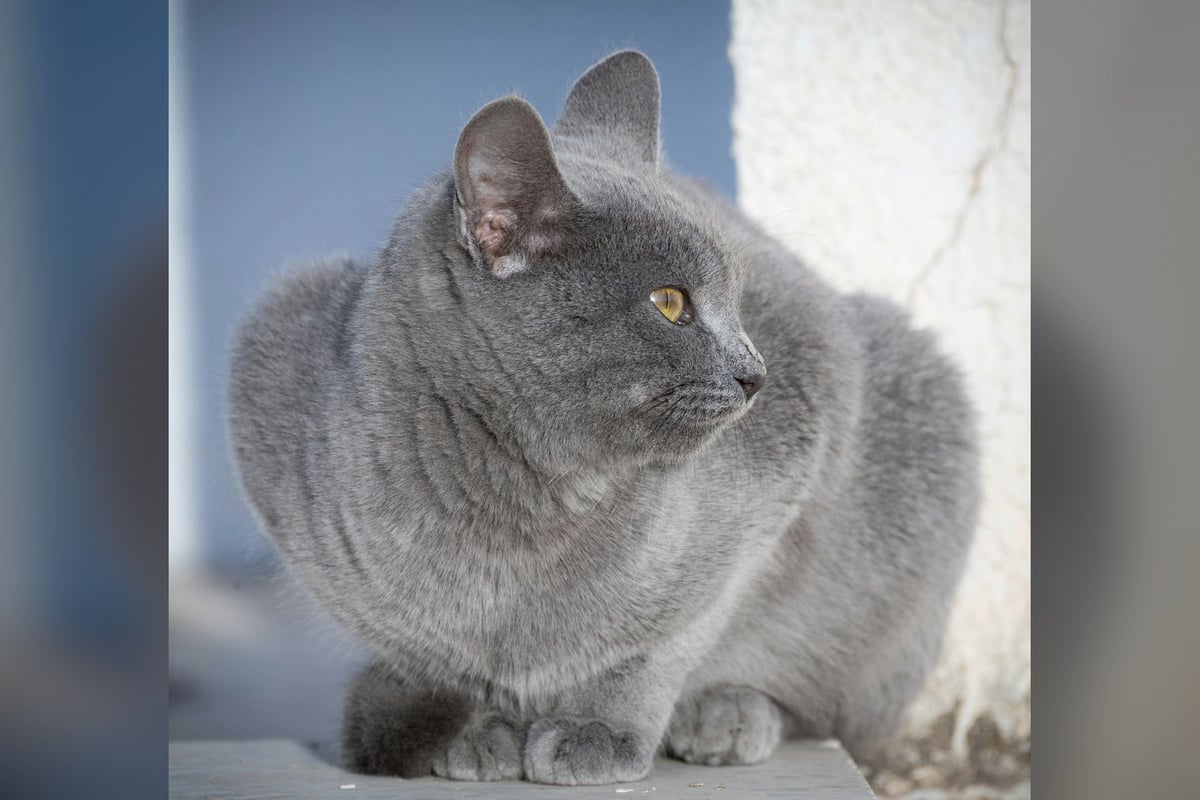
Chartreux
The Chartreux is one of the few cat breeds native to France, developed in the 1930s and officially recognized in 1939. Recognizable by its solid blue coat — ranging from lavender-gray to deep slate — and its intense gold to copper eyes, it ranks among the top 10 most registered breeds at the LOOF, with around 2,000 pedigrees a year. Its legendary discretion, its watchful character and its expression suggesting a permanent "smile" have made it one of the emblematic representatives of French cat fancying.
- Weight
- 4 to 7kg
- Height
- 28 to 36cm
- Life expectancy
- 14years
- Monthly cost
- 60 to 100€
Personality profile
Energy 2/5
Independence 4/5
Trainability 3/5
Good with children 4/5
Talkativeness 2/5
Space needed 2/5
Attachment to home 3/5
Good with strangers 3/5
Good with cats 3/5
Good with dogs 3/5
Coat care 2/5
Exercise needs 2/5
Scores given on measured axes, data confidence: high.
Living with a Chartreux
Description
The semi-cobby build is characteristic: a compact, powerful body, broad-shouldered, deep-chested, carried on relatively slender legs — a distinctive morphological contrast that gives it a bearing both sturdy and agile. The head forms a rounded trapezoid, wide at the base, with full, chubby cheeks particularly pronounced in adult males, and a narrow muzzle forming a subtle, permanent smile. The ears are medium-sized, set high and slightly rounded. The eyes, large and round, are an intense golden yellow to copper — green eyes are a disqualification at shows. The coat is short, slightly woolly in texture and dense, with a thick undercoat that makes the whole coat nearly waterproof. The color is strictly blue, admitted in every shade of blue-gray from pale lavender to deep slate, uniform from root to tip with no markings or white patches. Males reach 5 to 7 kg at full maturity (3 to 5 years), females 4 to 5 kg, for a shoulder height of 28 to 36 cm. Life expectancy: 12 to 15 years.

Temperament
Often called a "cat-dog," it is loyal and watchful: it discreetly follows its owners from room to room without ever being intrusive. Its vocalizing is rare and soft — trills and murmurs rather than sustained meows — which earns it a reputation for exceptional discretion even among calm cats. It forms selective, deep attachments with its people while retaining a natural independence that sets it apart from very clingy breeds. Its practical intelligence shows in its methodical curiosity and its ability to answer to its name or fetch toys. Patient and non-aggressive, it prefers to withdraw calmly from an uncomfortable situation rather than scratch or bite. With children, it is tolerant and dignified; with strangers, reserved without being fearful. Its "permanent smile" expression often contrasts with the contemplative depth of its coppery gaze.
Training
Sufficiently intelligent and motivated by play, it responds well to short training sessions based on positive reinforcement. It can learn to answer to its name, fetch a toy ("cat-dog" behavior often spontaneous in the breed), accept a harness or integrate brushing routines without resistance if socialization starts early. The method should be exclusively incentive-based — treats, play, calm vocal contact — with no physical restraint, which shuts it down immediately. Sessions of 5 to 8 minutes repeated daily give better results than one long weekly session. Its watchful nature means it often learns by observing before acting: allow time between each new request.

Feeding
Its metabolism slows significantly after neutering and with age, combined with a natural tendency toward overweight documented by Royal Canin and the CFA. Free feeding is to be avoided: two split meals a day with strictly measured amounts based on target weight — not actual weight if the cat is already overweight. Favor a diet rich in animal protein (>35%) with moderate fat and carbohydrate content. For a 5-6 kg adult at moderate activity level, plan on about 200-250 kcal/day. Work in wet food (canned or pouches) for at least every other meal to support hydration and urinary health. Kibble formulated for urinary support (controlled pH) should be favored for cats with a urinary history. Taurine should be present in adequate amounts. After 7 years, switch to a senior formula with reduced phosphorus content.
Affiliate links, no extra cost to you. Legal notice

Living conditions
It adapts very well to apartment life thanks to its moderate energy level and contained space needs. A home of 35-60 m² with a few lookout spots (window sill, compact cat tree) and daily interactive play sessions of 10 to 15 minutes are enough for its balance. Indoor life is recommended, particularly in urban settings. It handles moderate daytime solitude well — better than very social breeds like the Siamese — provided the environment is enriched and evenings bring real presence. Its dense undercoat gives it good cold tolerance; excessive heat is less well tolerated, so provide shade and ventilation in summer. Cohabitation with other cats or dogs is possible with a gradual introduction, but it remains fundamentally a cat that values its personal space.

Grooming and coat care
Despite its thick undercoat, it is one of the easiest shorthaired cats to maintain day to day. A weekly brushing with a wide-toothed metal comb is enough outside shedding periods to remove dead hair and preserve the coat's characteristic woolly texture. Two to three brushings a week are needed during the spring molt, which can be heavy and sudden. Avoid overly aggressive slicker brushes that alter the coat's naturally slightly waterproof texture. No regular bathing is required — the coat's structure naturally repels water. Check the ears monthly, clean the eyes if discharge appears, and trim the claws every 3 to 4 weeks.

Health
The breed is generally considered robust, benefiting from a genetic heritage relatively preserved since the post-war reconstruction. The most documented predisposition is patellar luxation, a hereditary joint condition that can affect hindquarter mobility; affected breeding cats should not be bred, per CFA recommendations. A clinical check of the kneecaps is advised at purchase and annually for active cats. The breed also shows a tendency toward overweight, particularly marked in neutered indoor males: weight monitoring and strict ration control are essential preventive measures. The urinary profile deserves attention — as with many compact-bodied breeds, sufficient water intake (wet food recommended alongside kibble) and monitoring urine quality help prevent crystals and stones. No HCM or PKD genetic mutation specific to the breed is documented to date, but routine cardiac follow-up from age 5 remains good general practice.
Breed history
The Chartreux's origin is surrounded by various hypotheses. Popular legend has it descending from cats raised by the monks of the Grande Chartreuse in Isère — but this claim is not backed by any serious historical source, and the monastery's archives make no mention of a specific cat breed. The most plausible hypothesis, supported by several zoogeographers, makes it a descendant of shorthaired cats imported from the Levant (Syria, Turkey, Iran) by Crusaders or merchants, gradually naturalized in France over the centuries. The first precise zoological description is given by Buffon in the 18th century in his Histoire naturelle. The breed as it is fixed today is the work of the Léger sisters, who in the 1920s-1930s developed a selective breeding program from blue cats found living semi-wild on the island of Belle-Île-en-Mer in Brittany. Official recognition came in 1939. World War II nearly wiped out the breed: emergency crosses with blue British Shorthairs, Persians and Russian Blues to save it led to a near-merging of the standards, to the point that cat authorities briefly stopped distinguishing French blue cats from the British Blue. In France, Jean Simonnet led the fight to restore the original standard and obtained, in 1977, the breed's international recognition as a distinct entity, via the FIFe. Today, only Chartreux × Chartreux matings are admitted by the LOOF, and it regularly ranks among the ten most registered breeds in France.
Getting ready for your Chartreux
Four essentials to line up before day one.
Affiliate links, no extra cost to you. Legal notice
FAQ: Chartreux
Sources
- Wikipedia FR — Chartreux (cat) · Probable origin Syria/Turkey, developed by the Léger sisters at Belle-Île-en-Mer in the 1930s, officially recognized 1939. Saved by Jean Simonnet in 1977. ~2,000 LOOF pedigrees a year (7th breed in 2015). Trapezoid morphology, exclusive blue, gold-copper eyes.
- LOOF — Official Chartreux standard · FIFé/LOOF standard: semi-cobby, trapezoid head, short woolly nearly waterproof coat, exclusive blue color, yellow to orange eyes. Approved matings: Chartreux × Chartreux only. Championship eligible.
- Royal Canin FR — Chartreux profile · Males 4.5-7 kg, females 3-5 kg, height 18-28 cm. Life expectancy 12-15 years. Tendency toward overweight, calorie control recommended. Urinary formula and omega-3 advised. Marked seasonal shedding.
- CFA — Chartreux Breed Profile · Breed arrived in North America in 1970. Hereditary patellar luxation documented: affected cats excluded from breeding. Males up to 14 lbs (6.3 kg) at maturity, 3-5 years. Cat-dog behavior, quick reflexes, discreet vocalizing.
Breeds similar to a Chartreux

