


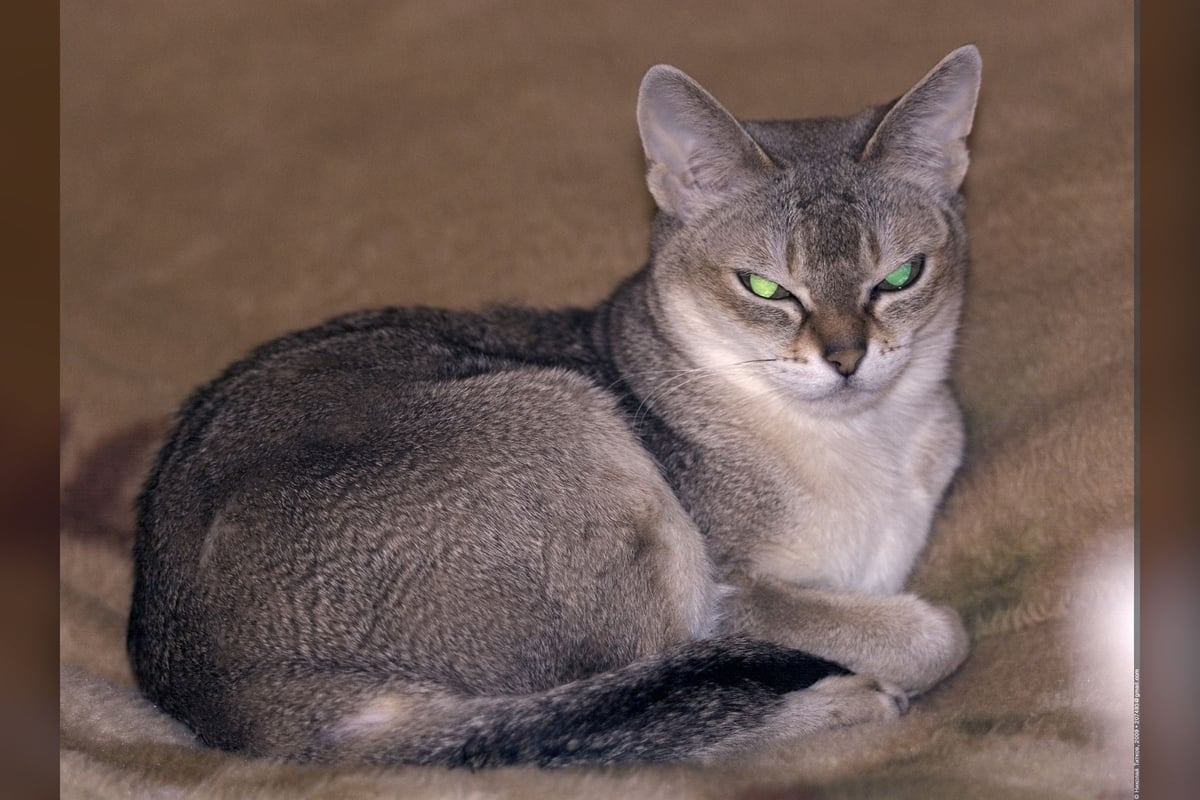
Singapura
The Singapura is the smallest recognized pedigree cat breed in the world, with adult females weighing barely 1.8 to 2.3 kg. Native to the streets of Singapore — where it is called Kucinta, "the cat of love" — it carries a unique coat: sepia agouti ticked on an ivory background, offered in a single official color. Extremely rare in France (fewer than 30 annual LOOF registrations), it charms with its intense curiosity, its strong attachment to humans and its compact size, but demands serious health vigilance around pyruvate kinase deficiency.
- Weight
- 1.8 to 3.2kg
- Height
- 15 to 20cm
- Life expectancy
- 13years
- Monthly cost
- 45 to 80€
Personality profile
Energy 4/5
Independence 2/5
Trainability 3/5
Good with children 3/5
Talkativeness 3/5
Space needed 2/5
Attachment to home 4/5
Good with strangers 2/5
Good with cats 3/5
Good with dogs 3/5
Coat care 1/5
Exercise needs 3/5
Scores given on measured axes, data confidence: high.
Living with a Singapura
Description
The build is semi-cobby: compact and muscular despite the miniature size. The body is short and stocky for its size, carried on legs that are fine but well muscled. The head is round with a short muzzle, a well-developed chin and remarkably large, wide-based ears — disproportionate to its size — which give the animal an attentive, alert expression. The eyes are a major feature: large, almond-shaped, golden hazel, green or yellow in color, framed by distinct facial markings (dark lines from the inner corner of the eye, similar to cheetah lines). The tail is fine, slightly shorter than the body length, with a dark tip. The coat is the only one officially registered: sepia agouti ticked — a warm ivory base on the belly and inner legs, with dark brown ticking on the back creating a characteristic luminous effect. Coat short, fine, satiny, lying close to the body. Males 2.7-3.2 kg, females 1.8-2.3 kg, for 15-20 cm at the withers.

Temperament
Intensely people-oriented, it is curious, playful, affectionate, and sometimes demanding of attention. It follows its owners from room to room, invites itself into every household activity and shows active curiosity about objects and heights. Its energy is sustained but not overwhelming: it alternates exploration phases with long periods of sought-after physical contact. Vocality is moderate — it communicates through soft meows and trills rather than persistent vocalizing. It typically stays reserved with strangers during first interactions, preferring to observe before approaching. Sociability with other cats varies with socialization; it cohabits correctly with cats of compatible temperament. It cannot tolerate noisy or stressful environments and thrives in a calm, predictable home.
Training
It is receptive to active training thanks to its natural curiosity and people-orientation. Clicker training produces good results on simple behaviors (recall, giving a paw, miniature obstacle courses). Sessions should be short — 5 to 8 minutes maximum — given its sustained attention but small energy reserve. Motivation comes more from interaction and play than from treats alone. Harness walking is feasible with gradual habituation from 3-4 months, with the harness specifically fitted to its miniature size (kitten models or very small sizes). The breed cannot tolerate any physical restraint or negative experience — trust is the main capital to build from the earliest days.

Feeding
Its miniature size calls for rigorous dietary management: with females at 1.8-2.3 kg, even a 200-300 g surplus represents a significant relative overweight that can affect mobility and physical condition. Plan 150-200 kcal/day for a light adult female, 200-250 kcal for an active male — clearly less in absolute volume than for a standard-size breed. Favor premium kibble high in animal protein (≥40%) and low in carbohydrates, in small kibble sizes suited to the breed's small mouth. Split into 2-3 meals a day with strict portion measurement — avoid free feeding. A portion-controlled wet food supplement provides hydration and taste stimulation. Recalibrate portions after neutering (lower basal metabolism).
Affiliate links, no extra cost to you. Legal notice

Living conditions
Few breeds adapt as well to apartment life: the miniature size, a lively but easily channeled indoor energy, and a strong need for human contact make it a discreet roommate in compact spaces. A well-arranged apartment of 30 to 50 m² suits it perfectly, provided it offers explorable heights (wall shelves, a cat tree of at least 1.5 m) and daily interactive play sessions. Sensitive to cold — a tropical-origin breed — it favors temperate, warm environments; avoid unheated spaces in winter. Outdoor access is not essential but a secure balcony is appreciated. Due to its low body mass, even minor excess weight quickly affects physical condition — the environment must allow daily activity without excessive sedentary time.

Grooming and coat care
As for maintenance, this is one of the least demanding breeds there is. The short, fine coat, lying close to the body, needs a weekly 5-minute brushing with a grooming glove or soft brush to remove dead hair and maintain the coat's satiny look. Shedding is very discreet and barely seasonal. No regular bathing is needed except in exceptional circumstances or preparation for a cat show. Particular attention to the large ears: check the ear canal weekly, gently clean with a damp cotton pad if earwax is present. Trim the claws every 3 weeks. Weekly dental brushing is recommended, as for every breed.

Health
Two health concerns are well documented in the breed. The first and most critical is pyruvate kinase deficiency (PK-def): a recessive genetic abnormality causing chronic hemolytic anemia through premature destruction of red blood cells. A PKDef DNA test on both breeding parents is mandatory before any purchase; demand written results. The second is uterine muscular weakness reported in some lines, which can require a cesarean during delivery — breeders should be informed of this. The breed also shows extremely low genetic diversity: a 2007 study covering 22 breeds ranked it as the least diverse, with an estimated inbreeding rate of about 10%. This narrow genetic base makes the breed structurally fragile in the face of emerging hereditary conditions; favor breeders who practice diversified crosses. Progressive retinal atrophy (PRA) is occasionally mentioned but without a breed-specific mutation documented to date — monitor vision from age 2. Life expectancy: 11 to 15 years.
Breed history
The Singapura takes its name from the Malay word for Singapore, a city-state of which it became a cultural symbol, to the point of being declared a "living national monument" by the Singaporean government in the 1990s. The breed's official history begins in 1974-1975, when Hal and Tommy Meadow, an American couple living in Singapore, reportedly discovered these small tabby cats on local streets and imported them to the United States. The CFA began registering the breed in 1981 and granted it championship status in 1988. But in 1990, a piece of journalism revealed a troubling reversal: import documents showed that the breed's three founding cats had actually been imported from the United States to Singapore in 1974 — not the other way around. Modern genetic studies fuel the doubt: the breed shares a high number of markers with the Burmese and the Abyssinian, suggesting a possible planned hybridization rather than a street-cat discovery. The CFA has maintained the "natural breed" status despite the controversy. In France, it remains one of the most obscure breeds, with fewer than 30 annual LOOF registrations, ranked 32nd among all registered breeds.
Getting ready for your Singapura
Four essentials to line up before day one.
Affiliate links, no extra cost to you. Legal notice
FAQ: Singapura
Sources
- Wikipedia FR — Singapura (cat) · Controversial origin: founders imported from the USA to Singapore in 1974 according to import documents. Lowest genetic diversity among 22 breeds (2007). Inbreeding ~10%. PKDef, uterine atrophy. CFA 1988, TICA 1984, LOOF recognized.
- CFA — Singapura Breed Profile · CFA registration 1981, championship status 1988. Only color: sepia agouti ticked. Males 6-7 lbs, females 4-5 lbs. Kucinta "cat of love" in Singapore. Founders: Hal and Tommy Meadow, 1975.
- Royal Canin FR — Singapura Profile · PKDef (pyruvate kinase deficiency): main health concern. Male weight 2.75-3.75 kg, female 2.25-2.75 kg. Size 15-20 cm. Weekly brushing. Critical weight monitoring (small size).
- LOOF — Recognized cat breeds · The Singapura is among the breeds officially recognized by the Livre Officiel des Origines Félines. Fewer than 30 annual registrations, ranked 32nd among breeds registered in France.

