


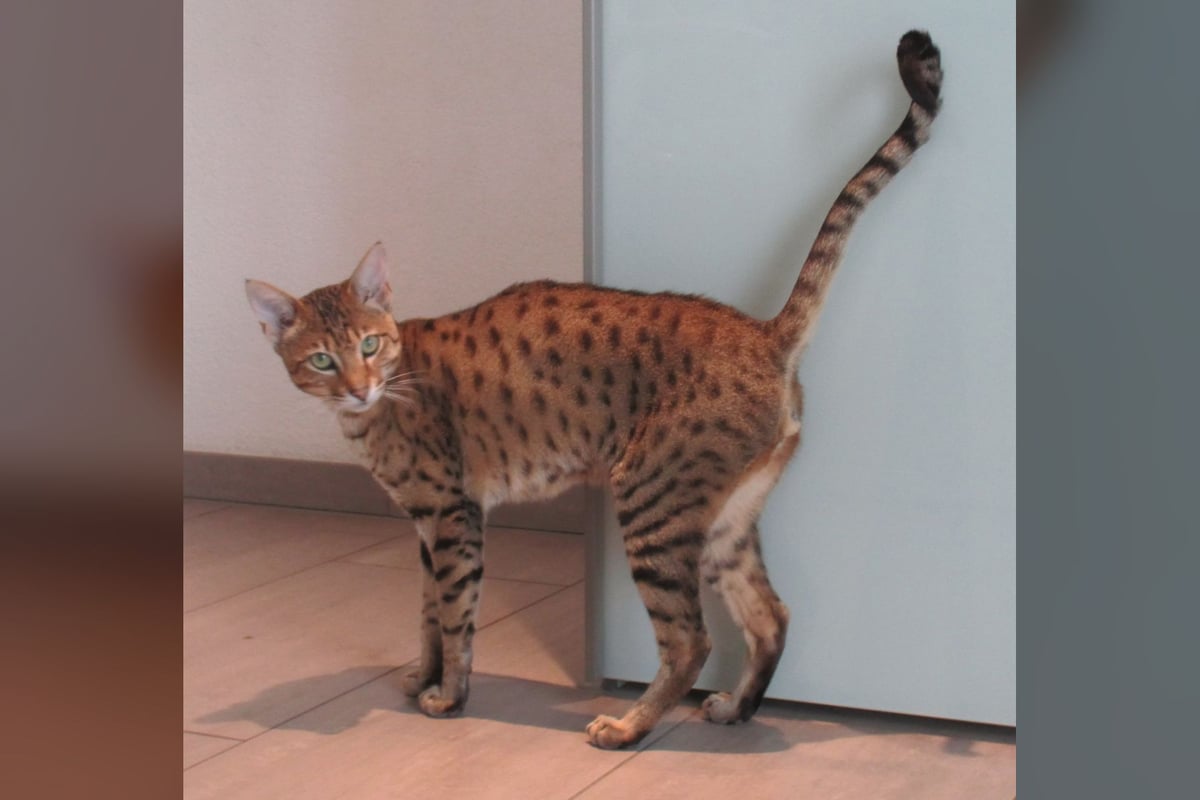
Savannah
The Savannah is a hybrid resulting from crossing the African Serval (Leptailurus serval) with the domestic cat, created in 1986 in the United States by breeder Judee Frank. A breed with extreme variability depending on the generation: an F1 can reach 15 kg and 50 cm at the withers, while an F4+ comes closer to a large, athletic domestic cat at 5-9 kg. Recognized in TICA championship status in 2012, in France it is subject to strict regulation: F1 to F3 generations are classified as non-domestic animals and require a certificate of competence and a prefectural authorization (decree of October 8, 2018).
- Weight
- 4 to 15kg
- Height
- 35 to 50cm
- Life expectancy
- 15years
- Monthly cost
- 100 to 250€
Personality profile
Energy 5/5
Independence 2/5
Trainability 5/5
Good with children 3/5
Talkativeness 3/5
Space needed 5/5
Attachment to home 4/5
Good with strangers 3/5
Good with cats 3/5
Good with dogs 3/5
Coat care 1/5
Exercise needs 5/5
Scores given on measured axes, data confidence: high.
Living with a Savannah
Description
The lean, muscular silhouette owes its athletic elegance to the Serval: hind legs longer than the front ones, an elongated neck, a narrow torso. The head is triangular, longer than it is wide, with a prominent nose and two characteristic dark stripes under the eyes — the Serval's "tear marks." The ears are huge, set high, rounded at the tip, with an "ocellus" (light spot) on the back. The coat is short, dense, slightly coarse in texture, with a bold pattern of large spots: crisp black spots on a golden-fawn to cream base. The tail is short to medium, banded, with a black tip. The eyes are oval, medium-sized, yellow to green. Size variability by generation is radical: an F1 (50% Serval) can reach 10-15 kg and 50 cm at the withers; an F2-F3 typically falls between 7 and 11 kg; an F4 and beyond drops to 5-9 kg, with a build close to a large domestic cat.

Temperament
Few domestic — or semi-domestic, depending on generation — felines are as active or as closely bonded to humans. It is described as curious, alert, extremely intelligent and demanding of stimulation. Unlike most cats, it forms a strong dog-like bond with its primary owner: it follows them from room to room, comes to demand attention, answers to its name and picks up basic commands. It can jump 2.5 m high from the ground, opens doors, manipulates objects with its paws and solves complex food puzzles. Its vocalizing is unusual: alongside the classic meow come chirps (inherited from the Serval) and hisses when stressed. It often enjoys water. Low generations (F1-F2) are less predictable and can show behaviors closer to the wild (wariness of strangers, heightened territoriality, defensive hissing); F4+ cats are much more consistent and sociable.
Training
Few felines are as trainable, or as able to sustain intense exercise sessions and long harness walks. Its motivation through play and food rewards, coupled with exceptional operational intelligence, gives results comparable to certain working dogs. Clicker training works from kittenhood: sit, recall to a whistle, jumping through a hoop, walking on a leash for miles, fetching an object. Harness walking is almost always successful if introduced before 4 months. Sessions should be short (10-15 minutes), daily and always end on a positive success. Coercion or physical punishment is counterproductive and can permanently break the bond of trust, particularly with high generations (F1-F2), which are more wary.

Feeding
The diet must be very high in animal protein and low in processed products. Favor premium kibble with ≥ 40-45% net animal protein and minimal carbohydrate content. For F1-F2 generations, a BARF diet (raw meat) or veterinary-grade premium wet food is often recommended by specialized breeders. For F4+, premium large-breed kibble works provided you require an impeccable composition. Strictly avoid foods based on soy, wheat or corn starch. Splitting into 2-3 meals a day via a food puzzle is the norm for behavioral stimulation. Obesity prevention is less of a priority than for sedentary breeds.
Affiliate links, no extra cost to you. Legal notice

Living conditions
The environment must be spacious and stimulating: a home under 80 m² with no secure outdoor access is not advisable, regardless of generation. A sturdy outdoor enclosure (catio), or a garden fenced at least 2 m high with an anti-jump overhang, is strongly recommended — the breed can clear obstacles most cats wouldn't attempt. Indoors, provide tall vertical structures (cat trees ≥ 2 m), wall-shelf courses, food puzzles and a feline exercise wheel. Walking on a harness is not just possible but necessary for cats living in an apartment: the breed learns quickly and comes to demand its walk once used to it. For F1 to F3 generations specifically, French regulations also require an enclosure meeting non-domestic-animal standards. The breed tolerates heat well (African heritage) and copes moderately with cold.

Grooming and coat care
The short, dense coat requires minimal upkeep. A weekly brushing with a grooming glove is enough under normal conditions to remove dead hair and keep the coat's shine. Shedding is moderate, with no marked seasonal peak. No regular bathing is necessary, even though many cats accept water without resistance. Check the ears regularly: their imposing size can favor debris buildup at the base of the flap. Monthly cleaning with a suitable veterinary product. The claws, long and sturdy, need trimming every 2 to 3 weeks.

Health
The constitution is generally robust, but several points call for vigilance. Hypertrophic cardiomyopathy (HCM) is reported in the breed, as in most hybrids; annual echocardiographic screening from age 2 is recommended for breeding cats. Digestive issues are common, particularly in high generations (F1-F2), when the diet is too processed: tolerance for highly industrial food is markedly lower there than the feline average. F1 and F2 males are almost systematically sterile; fertility recovers from F3 onward and becomes normal at F4+. F1-F2 females are often prophylactically neutered by breeders. The regulatory framework applicable to F1 to F3 generations falls into a different category than health: it's detailed in the FAQ. Life expectancy: 12 to 20 years depending on the source.
Breed history
The first Savannah was born on April 7, 1986 at Judee Frank's cattery in Pennsylvania: a hybrid female born of a male Serval crossed with a domestic queen. Patrick Kelly, fascinated by the breed, acquired one of her descendants and worked from 1989 onward with breeder Joyce Sroufe to stabilize the breed and formalize its standard. In February 1996, Kelly and Sroufe presented the standard to TICA (The International Cat Association). The breed was accepted onto the TICA registry in 2001, then reached Championship status in 2012 — after a decade of work on the genetic stabilization needed for later generations (F4+) to show a temperament suitable for the show ring. In France, the LOOF has allowed show presentation since January 1, 2007, but national regulation on non-domestic animals (decree of October 8, 2018) considerably complicates ownership of high generations F1-F3, which remain classified outside domestic-animal status.
Getting ready for your Savannah
Four essentials to line up before day one.
Affiliate links, no extra cost to you. Legal notice
FAQ: Savannah
Sources
- Wikipedia FR — Savannah (cat) · First Savannah born April 7, 1986, by Judee Frank. Standard presented to TICA in February 1996 by Patrick Kelly and Joyce Sroufe. LOOF regulation: show presentation allowed since January 1, 2007. F1-F2 males sterile.
- Wikipedia FR — Serval · Owning a Serval in France strictly prohibited without a certificate of competence for non-domestic animals. Serval: 12-26 kg (male), 54-66 cm at the withers.
- LOOF — Recognized cat breeds · The Savannah is among the breeds presented at the LOOF, category cats with a distinctive coat. Show presentation authorized since January 1, 2007.
- Decree of October 8, 2018 — Non-domestic animals (Légifrance) · Decree setting the general rules for keeping animals of non-domestic species. Serval hybrids F1-F3 are classified as non-domestic: DDPP certificate of competence and prefectural authorization mandatory. F4+ subject to ordinary domestic-animal law.

