


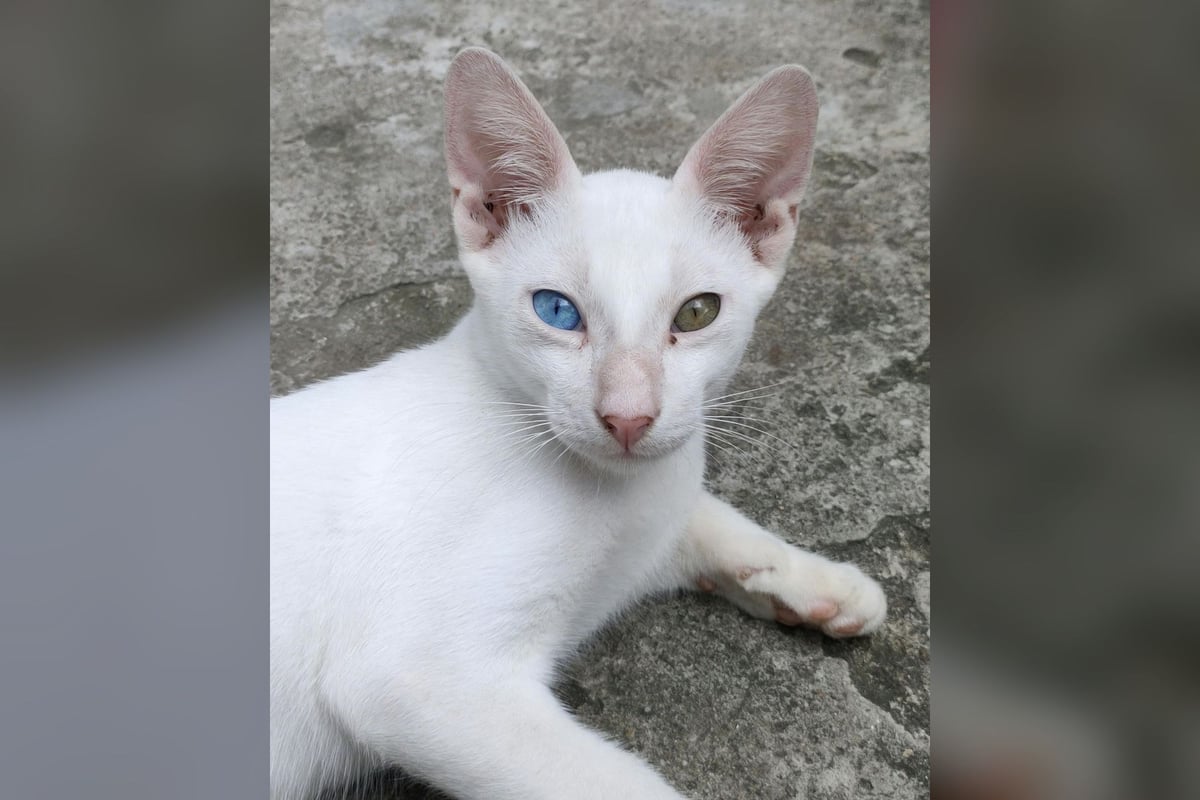
Khao Manee
The Khao Manee is an ancestral Thai cat with a pure white coat, celebrated for centuries for its often odd-colored (odd-eyed) or intensely blue eyes. Bred in the royal palaces of Thailand, it remains one of the rarest breeds outside its country of origin today. Its slender semi-foreign build, its liveliness and its affectionate temperament make it a demanding but endearing companion for anyone able to meet its social needs.
- Weight
- 2.5 to 4.5kg
- Height
- 22 to 27cm
- Life expectancy
- 14years
- Monthly cost
- 45 to 80€
Personality profile
Energy 4/5
Independence 2/5
Trainability 4/5
Good with children 4/5
Talkativeness 3/5
Space needed 2/5
Attachment to home 4/5
Good with strangers 3/5
Good with cats 3/5
Good with dogs 3/5
Coat care 2/5
Exercise needs 4/5
Scores given on measured axes, data confidence: low.
Living with a Khao Manee
Description
The body is semi-foreign: medium-sized, muscular and slender without being extreme, with a moderate bone structure. The head is a modified wedge shape, slightly rounded, with well-developed cheekbones and a medium-length muzzle. The ears are medium to large, well spaced and upright. The eyes are one of the major distinguishing features: large, oval, and can be blue, gold, or odd-eyed (one eye of each color). The coat is short, close-lying, glossy and uniformly pure white, with no markings at all. The nose leather and paw pads are pink. The tail is proportionate in length and tapers to a point.

Temperament
Lively, curious and sociable, it actively seeks human contact and tolerates prolonged solitude poorly — a household that is often present suits it better than an environment that is empty all day. Moderately vocal, it communicates its needs without the insistence of a Siamese, but does not hesitate to make itself heard. Playful and agile, it enjoys varied interactions and chasing games. Its confident temperament, probably an inheritance from a long history of selection in royal settings, makes it not very wary of strangers while still keeping a special bond with the people it knows best.
Training
Intelligent and attentive, it quickly learns household rules and responds well to positive reinforcement. Its liveliness makes it receptive to learning games and clicker training exercises. Its sustained energy needs to be channeled daily through intense sessions of 15 to 20 minutes, two to three times a day, or that energy risks expressing itself in less controlled ways. Learning new activities — recall, indoor leash walking, search games — suits it particularly well.

Feeding
A medium-sized, actively metabolic cat (semi-foreign, 2.5 to 4.5 kg as an adult), it benefits from food rich in quality animal protein. Portions should be adjusted to its actual activity level, which is above average. Partial wet feeding is advisable to support hydration and help prevent urinary stones. No breed-specific food sensitivity has been documented to date. Meals split into two to three daily portions suit an active cat better than free feeding.
Affiliate links, no extra cost to you. Legal notice

Living conditions
Apartment life suits it well as long as it gets enough stimulation: brain games, daily play sessions and regular human presence. Its high energy level calls for structured physical and mental activities — play circuits, interactive toys, perches. Lacking a garden is not an obstacle, but inactivity or prolonged isolation can generate unwanted behavior.

Grooming and coat care
The short, close-lying coat needs minimal care: a weekly brushing is enough to remove dead hair and keep the white coat's shine. Its pale coat can reveal traces of dirt or tear staining, which should be cleaned regularly with a damp cloth. The ears, eyes (particular attention to discharge around the blue eyes) and claws need standard follow-up. No professional grooming is regularly required.

Health
The breed is generally robust, but the pure white coat is linked to the dominant W (White) gene, which brings a significant risk of congenital deafness. Reference studies show that among blue-eyed white cats, roughly 17 to 22% show unilateral or bilateral deafness (Bergsma & Brown, 1971). Among odd-eyed cats, the rate rises to roughly 40% on the blue-eye side (Strain, 1996). Diagnosis is made via a BAER test (Brainstem Auditory Evoked Response), which every serious breeder should carry out before kittens are placed. A unilaterally deaf cat can lead a normal indoor life; bilateral deafness requires specific adjustments. Always ask for the BAER test result before adopting.
Breed history
The Khao Manee — literally "white jewel" in Thai (ขาวมณี) — appears in the Tamra Maew, an illustrated Thai collection of poems written between the 14th and 19th centuries that lists cats of good and bad omen. White cats with distinctive eyes are described there as bringers of luck and prosperity. Under the reign of Rama V (late 19th century), these cats were bred in the royal palaces of Bangkok, and their export was strictly controlled. Long confined to Thailand, the Khao Manee only began gaining international recognition from the 2000s onward. TICA granted it preliminary status in 2009, full registration in 2011, and championship status in 2015. It remains extremely rare outside Thailand and the United States.
Getting ready for your Khao Manee
Four essentials to line up before day one.
Affiliate links, no extra cost to you. Legal notice
FAQ: Khao Manee
Sources
- TICA — Khao Manee Breed Standard · The International Cat Association. Khao Manee breed standard. Championship recognition 2015. Accessed May 2026.
- Strain G.M. (1996) — Aetiology, prevalence and diagnosis of deafness in dogs and cats · Strain G.M. Aetiology, prevalence and diagnosis of deafness in dogs and cats. British Veterinary Journal, 1996; 152(1): 17-36.
- Bergsma D.R. & Brown K.S. (1971) — White fur, blue eyes, and deafness in the domestic cat · Bergsma D.R. & Brown K.S. White fur, blue eyes, and deafness in the domestic cat. Journal of Heredity, 1971; 62(3): 171-185.
- Clutterbuck M. — Siamese Cats: Legends and Reality (Tamra Maew analysis) · Clutterbuck M.R. Siamese Cats: Legends and Reality. White Lotus Press, 2004. Translation and analysis of the Thai Tamra Maew, including the description of the royal white cat.
Breeds similar to a Khao Manee


See also: Oriental Shorthair, Turkish Angora