


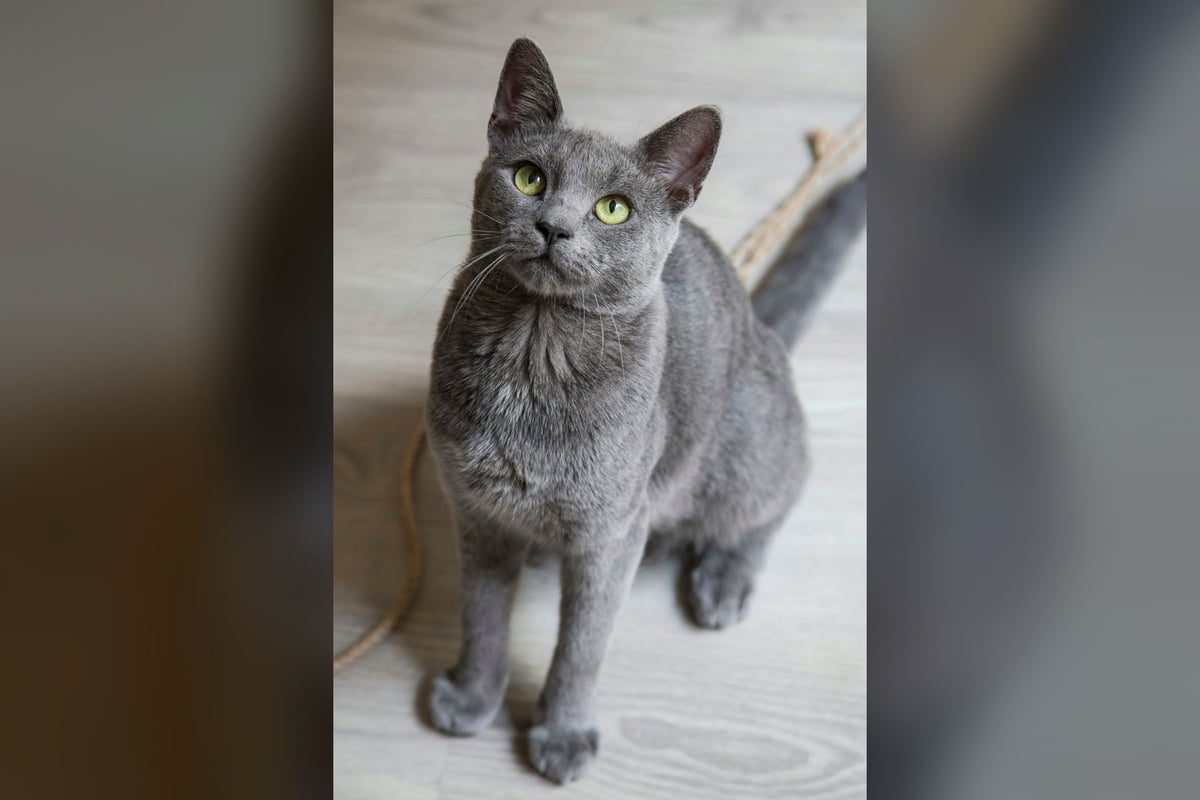
Russian Blue
The Russian Blue is the historic and longest-recognized color variant of the Russian breed, native to the port of Arkhangelsk in northwestern Russia. First shown at the Crystal Palace in London in 1872 under the name "Archangel Blue," it is recognized today by every major cat federation worldwide — FIFe, TICA, CFA, GCCF and LOOF. Its silvery-blue coat with a pearly sheen, its intense green eyes and its short plush double coat are the immediately recognizable markers of a breed with a discreet, devoted, observant temperament.
- Weight
- 3.5 to 7kg
- Height
- 23 to 30cm
- Life expectancy
- 15years
- Monthly cost
- 50 to 90€
Personality profile
Energy 2/5
Independence 3/5
Trainability 3/5
Good with children 3/5
Talkativeness 2/5
Space needed 2/5
Attachment to home 3/5
Good with strangers 2/5
Good with cats 3/5
Good with dogs 3/5
Coat care 2/5
Exercise needs 2/5
Scores given on measured axes, data confidence: high.
Living with a Russian Blue
Description
The build is of the "foreign" type: an elongated medium body, a fine bone structure but firm musculature, long legs with round, compact paws, a thin tapering tail. The head is a moderate wedge, with a flat forehead, a short muzzle with well-developed whisker pads and prominent cheekbones that trace the breed's characteristic natural "smile." The eyes, large and almond-shaped, are a bright, intense green in adults — kittens are born with yellow eyes that gradually turn green between 4 and 12 months, a color shift specific to this breed. The ears, large and pointed, are set high on the skull with a slightly pink, translucent inner skin. The breed's signature is its short, "stand-off" double coat: the dense undercoat and the guard coat of equal length create a plush texture that stands away from the body, producing a visually velvety effect and a remarkably soft feel to the touch. The color is a uniform silvery blue — blue-gray — from the palest to the most saturated shade, with no markings or spots, each hair tipped with a slightly silvery point that gives the coat its characteristic pearly sheen in the light. Males: 5 to 7 kg, females: 3.5 to 5 kg. Height at the withers: 23 to 30 cm. Full maturity around 18-24 months. Life expectancy: 12 to 18 years. Two color variants exist besides blue: the Russian White and the Russian Black, recognized by the LOOF but not by the FIFe, TICA or CFA, which recognize only the blue coat. All three share the same "foreign" build and the same discreet temperament — only the coat differs. For editorial consistency and LOOF alignment, this site presents the Russian under a single unified profile covering these three color varieties.

Temperament
This is a cat with real character, deeply attached to its close circle but happily reserved with strangers. Its temperament is often summed up by an apparent paradox: intense in the bond it forms with one or two key people, almost invisible to occasional visitors. It doesn't seek contact insistently — it picks its moments with a precision that betrays its social intelligence. Its vocalizing is rare: brief murmurs, quiet trills in response to a prompt, never spontaneous, sustained communication. Its sensitivity to the household's atmosphere is marked; it reads moods, adjusts its presence accordingly, and reacts poorly to tension or abrupt changes in routine. This is not an indifferent cat — it's a cat that observes, remembers and chooses. With strangers it favors distant observation before any contact, sometimes never crossing that threshold during a short visit. Its memory for routines is excellent and is one of the pillars of its stability.
Training
Intelligent and gifted with a precise memory for routines, it is not, however, a trick performer. It quickly learns the household rules — off-limits areas, mealtimes, its name — and follows them consistently. Clicker training works for simple goals: coming when called, accepting a harness for a kitten socialized early, using a designated scratching post. Sessions should be very short (3 to 5 minutes), conducted calmly and stopped before any frustration sets in. Physical restraint and raised voices produce the opposite effect: once eroded, its trust rebuilds slowly. Early kitten socialization (3 to 12 weeks) to varied people, household sounds and veterinary handling is decisive in softening the breed's natural reserve in adulthood.

Feeding
The ration must be measured with rigor, since deliberate overeating and overweight are a particular risk after neutering. For a moderately active 5 kg adult, plan on 200 to 250 kcal/day depending on the formula. Two split daily meals rather than free feeding prevent compulsive snacking. Favor premium food high in animal protein (>35%) and low in carbohydrates. Kittens up to 12 months need a dedicated kitten diet, rich in DHA for neural development. Adequate taurine intake is essential for heart function. Avoid abrupt diet changes: the breed is sensitive to changes in routine, including dietary ones.
Affiliate links, no extra cost to you. Legal notice

Living conditions
Everything here is built for apartment life. A moderate energy level, its attachment to routines and its limited taste for outdoor adventure make it an indoor cat at heart. A quiet home with high perches, a few secured windows looking outside and a stable routine suits it better than a busy, unpredictable environment. It tolerates moderate daytime solitude provided returns are regular and the environment enriched. Households with frequent visits from strangers or with very young children are a stressful context for this breed — accessible refuge spaces and gradual integration are essential. Cohabiting with another calm-tempered cat is workable, though not something the breed particularly seeks out. Its dense double coat gives it good tolerance for cool temperatures; excessive heat is less well tolerated.

Grooming and coat care
This short double coat is one of the easiest to maintain among double-coated breeds. In steady state, a weekly brushing with a soft slicker brush or a grooming glove is enough to remove dead hair and preserve the characteristic stand-off structure. During the seasonal molts — spring and fall — two brushings a week for two to three weeks limit shedding onto fabrics without disturbing the coat's plush texture. No regular bathing is needed. Clean the ears once or twice a month with a suitable ear lotion. Trim the claws every three to four weeks.

Health
The breed is generally robust, with no major hereditary predisposition documented to date. Unlike the Russian White, the blue variant does not carry the W gene (dominant white) and therefore escapes the associated risk of congenital deafness — a concrete health advantage. The main metabolic risk is overweight: these cats will readily beg for meals with no real hunger behind it, and neutering amplifies that tendency. Regular weight tracking and a strictly measured ration are the essential prevention steps. To watch generally: dental health and urinary profile, as for most medium-format breeds. That leaves the question of allergies, often raised about this breed: lower-than-average Fel d 1 production has been reported, though that's no individual guarantee — details are in the FAQ.
Breed history
The breed takes its name and presumed origin from the port of Arkhangelsk, in northwestern Russia, from where sailors are said to have carried these cats to Great Britain and Northern Europe starting in the 1860s. The first mentions in the British press date to 1862; the breed was shown at the Crystal Palace in London in 1872 under the name "Archangel Blue." After the Second World War, the population was so reduced that crosses with Siamese Blue Points were needed to rebuild British numbers — crosses whose distinctive traits were then progressively bred out by selection. Blue is the only color recognized from the outset by all the major world federations: FIFe, TICA, CFA, GCCF and LOOF. The Russian White and the Russian Black, developed from the 1960s onward by Frances McLeod in the United Kingdom and then in Australia by Dick and Mavis Jones in the 1970s, are only recognized by certain federations — including the LOOF in France, but not the FIFe, TICA or CFA. This status as a historic and universally admitted variant gives the blue coat a distinct standing in cat breeding.
Getting ready for your Russian Blue
Four essentials to line up before day one.
Affiliate links, no extra cost to you. Legal notice
FAQ: Russian Blue
Sources
- Wikipedia FR — Russian Blue · Origin: port of Arkhangelsk, Crystal Palace show 1872. White and black variants created in the 1960s-1970s, recognized by the LOOF but not FIFé/TICA/CFA. Shy, discreet, intelligent temperament. Short plush double coat. Yellow eyes in kittens, green in adults.
- Wikipedia EN — Russian Blue · First name 'Archangel Blue'. Crystal Palace 1871-1872. Post-WWII Siamese crosses to rebuild the UK population. Universal recognition by FIFé, TICA, CFA, GCCF, LOOF for the blue variant only. Weight 3.6–6.8 kg, stand-off double coat.
- VCA Hospitals — Russian Blue Cat Breed · Life expectancy 12–15 years. Weight 3–6 kg. Gentle, non-intrusive temperament, highly attuned to human moods. Reserved with strangers. Short, dense double coat. Bright green eyes in adulthood.
- PetMD — Russian Blue Cat Breed Profile · Life expectancy 15–20 years. Weight 7–12 lbs. Main risk: overweight. Not hypoallergenic but a light shedder. Dislikes changes in routine. Dental health and urinary profile to monitor.

