


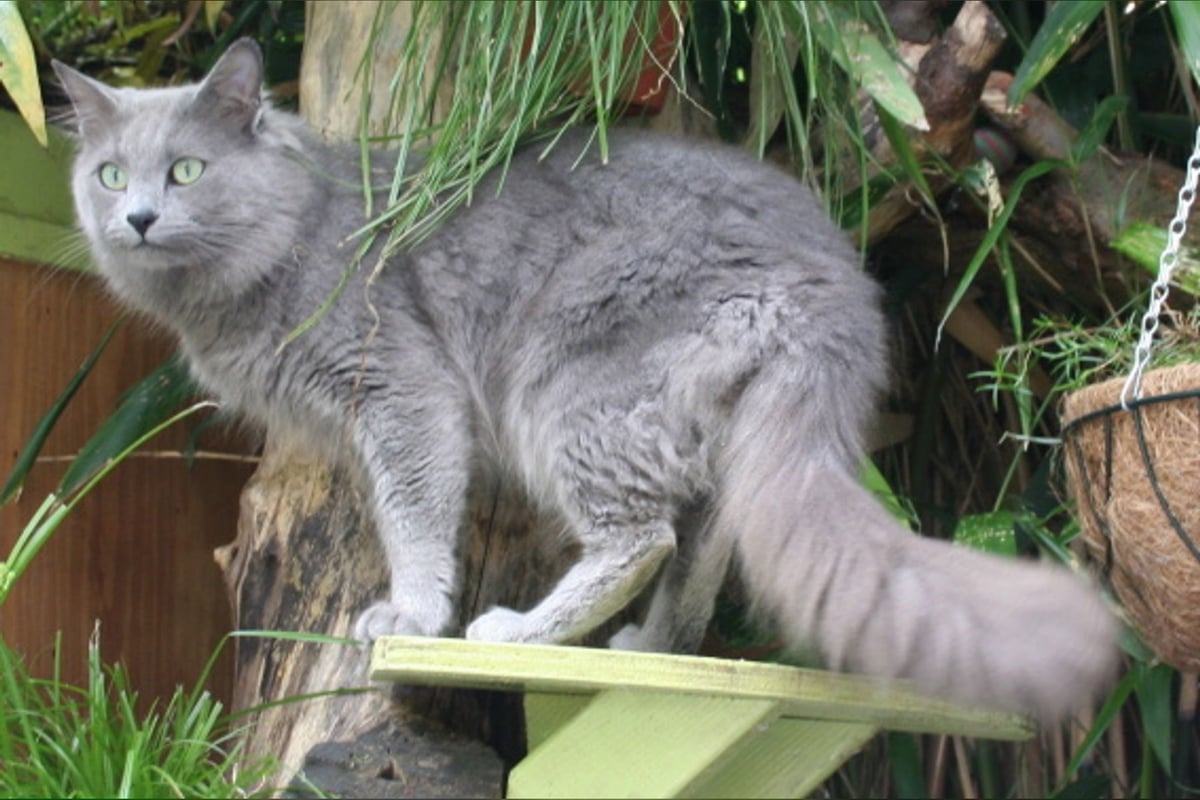
Nebelung
The Nebelung — German for "creature of the mist" — is the semi-longhair variant of the Russian Blue, produced by the expression of a recessive semi-long gene. Developed in the United States in the 1980s, it has been recognized in championship by TICA since 1997 and registered with the LOOF, where its numbers remain small. Its soft, semi-long silver-blue coat with pearly highlights, its intense green eyes and its quiet, contemplative temperament make it a discreet cat of deep loyalty toward its own people.
- Weight
- 3.5 to 6.5kg
- Height
- 23 to 32cm
- Life expectancy
- 15years
- Monthly cost
- 55 to 95€
Personality profile
Energy 2/5
Independence 3/5
Trainability 3/5
Good with children 3/5
Talkativeness 2/5
Space needed 2/5
Attachment to home 3/5
Good with strangers 2/5
Good with cats 3/5
Good with dogs 3/5
Coat care 3/5
Exercise needs 2/5
Scores given on measured axes, data confidence: medium.
Living with a Nebelung
Description
The silhouette is of the "foreign" type: a long, slender body, fine bone structure but firm musculature, long legs with round, compact paws, a bushy tail. The head is a moderate wedge with seven flat planes, a broad forehead, a short muzzle and high cheekbones that draw the same natural "smile" as the Russian Blue. The eyes, large and almond-shaped, are an intense, luminous green in the adult — kittens are born with blue eyes that gradually turn green between 4 and 12 months. The ears, large and pointed, are set high on the skull with a lightly pink, translucent inner skin. The visual signature lies in the semi-long, double-layered silver-blue coat: the dense undercoat and silky guard hairs, slightly longer on the ruff, belly and tail, create a silvery halo effect in the light, particularly pronounced on the tips of the guard hairs. The texture is silky, with no tendency to mat. Females: 3.5 to 5 kg, males: 4.5 to 6.5 kg. Height at the withers: 23 to 32 cm. Full maturity around 18-24 months. Life expectancy: 11 to 18 years.

Temperament
The temperament is that of the Russian Blue, extended by a contemplative dimension typical of long-coated foreign-type cats. It is deeply attached to its own people — often to one or two particular reference figures — but stays invariably reserved around strangers, sometimes to the point of disappearing for the entire duration of a visit. Its bond with the household is intense, selective and non-negotiable: it chooses its interlocutors carefully, observing at length before engaging in contact. Its vocalizing is rare — brief murmurs in response to a prompt, never sustained spontaneous communication. Quiet and observant, it picks up on the household's moods and adjusts its presence accordingly. Routine, predictability and calm are its conditions for stability; any abrupt change of environment or rhythm unsettles it for a long time. This is not an indifferent cat: it is a cat that chooses, remembers and waits.
Training
Intelligent and gifted with a precise memory for routines, it is nonetheless not a trick performer. It quickly learns the household's rules — off-limits areas, mealtimes, its name — and follows them consistently. Clicker training works well on simple goals: coming when called, accepting a harness if the kitten was socialized early, using a designated scratching post. Sessions should be very short (3 to 5 minutes), conducted in absolute calm and stopped before any frustration sets in. Physical restraint and raised voices produce the opposite effect: once eroded, trust rebuilds slowly. Early kitten socialization (3 to 12 weeks) to a variety of people, household sounds and veterinary handling is decisive in softening the breed's natural reserve in adulthood.

Feeding
The ration must be measured rigorously: the breed is prone to voluntary overeating and excess weight, particularly after neutering. For a 5 kg adult with moderate activity, plan for 200 to 250 kcal/day depending on the formulation. Two split daily meals rather than free-feeding prevent compulsive snacking. Favor premium foods high in animal protein (>35%) and low in carbohydrates. Kittens up to 12 months need a dedicated kitten diet, rich in DHA for neural maturation. Adequate taurine intake is essential for heart function. Avoid abrupt dietary changes: the breed is sensitive to variations in routine, including feeding routine.
Affiliate links, no extra cost to you. Legal notice

Living conditions
Everything here is built for calm apartment living. Its moderate energy level, its attachment to routines and its limited taste for outdoor adventure make it an indoor cat at heart. A home with high perches, secure windows looking outside and accessible refuge spaces suits it better than a lively or unpredictable environment. It tolerates moderate daytime solitude provided returns are regular and the environment enriched. Households with frequent strangers passing through or with very young children represent a stressful context — gradual integration and withdrawal spaces are essential. Cohabitation with another calm-tempered cat is feasible, but it is not particularly keen on feline company. Its dense double coat gives it good tolerance for cool temperatures; excessive heat is less well tolerated.

Grooming and coat care
The semi-long coat is less demanding to maintain than its length might suggest: the silky texture and an undercoat that does not felt limit mat formation. In steady state, a weekly brushing with a fine-toothed comb is enough to remove dead hair and preserve the coat's silvery shine. During seasonal shedding — spring and fall — two brushings a week for two to three weeks limit shedding onto fabrics. Pay particular attention to the ruff, belly and tail, the areas where the fur is longest. No regular bathing is necessary. Clean the ears once or twice a month with a suitable ear lotion. Trim the claws every three to four weeks.

Health
The breed is generally considered robust. Being a recent breed with small numbers, long-term epidemiological data remains limited, but no major breed-specific hereditary predisposition is documented to date. The main identified risks are common to many medium-sized breeds: excess weight — the breed tends to demand meals outside of real hunger, especially after neutering — and dental health. Regular weight monitoring and a strictly measured ration are essential preventive measures. To watch generally: urinary profile, as with most indoor cats with moderate activity. A point often reported by breeders: through its Russian Blue heritage, Fel d 1 production is said to be slightly below the breed average — an individual, non-guaranteed trait, expanded on in the FAQ.
Breed history
The Nebelung — a German name meaning "creature of the mist", drawn from Wagner's operas — was born in the United States in the 1980s at the initiative of Cora Cobb, founder of the Nebelheim cattery. Her two founding cats, Siegfried (born 1984) and Brunhilde (born 1985), were blue longhaired kittens from accidental litters of a black female and a blue longhaired male — unknowingly carrying the recessive semi-long gene that turns up sporadically in Russian Blue lines. Cora Cobb developed the standard in collaboration with feline geneticist Dr. Solveig Pflüger, aligning the morphology with that of the Russian Blue with the addition of the semi-long coat. TICA recognized the breed under New Trait status in 1987, then granted full championship in 1997. The CFA does not recognize it to date. The LOOF lists it among its recognized breeds; the first Nebelungs born in France arrived on May 20, 2008, and the French population remains very small — a few dozen individuals registered over the years, spread across two or three active catteries.
Getting ready for your Nebelung
Four essentials to line up before day one.
Affiliate links, no extra cost to you. Legal notice
FAQ: Nebelung
Sources
- Wikipedia EN — Nebelung · Founder Cora Cobb, Nebelheim cattery. Founding cats Siegfried (1984) and Brunhilde (1985). TICA New Trait status 1987, TICA full championship 1997. Weight females 3.5–5 kg, males 4.5–6.5 kg. Long slender body, green eyes in adulthood, semi-long silky silver-blue coat.
- Wikipedia FR — Nebelung · First Nebelungs born in France on May 20, 2008. 46 registered with the LOOF as of July 5, 2011, three catteries. Wedge-shaped head with seven flat planes. Blue eyes at birth, green in adulthood. Blue-grey coat with silvery highlights on the guard-hair tips.
- PetMD — Nebelung Cat Breed Profile · Life expectancy 11–18 years. Weight 7–15 lbs. No specific hereditary predisposition documented. Risks: excess weight and dental health. Silky coat with no tendency to mat.
- LOOF — Recognized cat breeds · The Nebelung is among the breeds officially recognized by the Livre Officiel des Origines Félines, semi-longhair category.
Breeds similar to a Nebelung

