


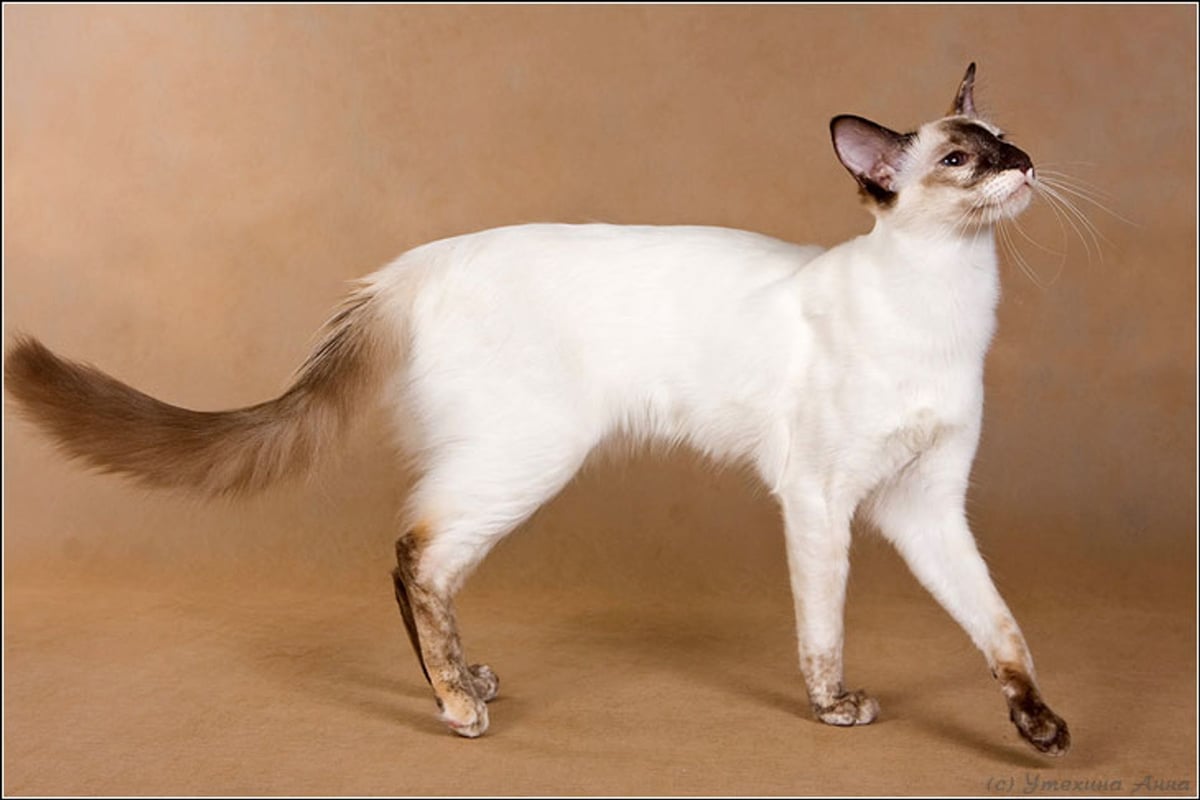
Javanese
The Javanese is the semi-longhair version of the Oriental, developed in the United States in the 1970s. A slender oriental-type body, a fine, silky coat with no undercoat, and a resolutely vocal, deeply bonded temperament: this breed suits people who are available and looking for a very active feline presence.
- Weight
- 3 to 5kg
- Height
- 23 to 28cm
- Life expectancy
- 14years
- Monthly cost
- 40 to 70€
Personality profile
Energy 5/5
Independence 2/5
Trainability 4/5
Good with children 4/5
Talkativeness 5/5
Space needed 2/5
Attachment to home 5/5
Good with strangers 3/5
Good with cats 4/5
Good with dogs 3/5
Coat care 2/5
Exercise needs 4/5
Scores given on measured axes, data confidence: medium.
Living with a Javanese
Description
Bred from crossing shorthaired Oriental cats with Balinese, it carries the elongated, angular build of the oriental family — a triangular head, wide ears, a muscular body and fine legs. The semi-long coat is made up of a single hair type, fine and silky, with no undercoat. What sets it apart from the Balinese is therefore not the coat texture but its pattern: the color can come in a wide range of shades and patterns, excluding colorpoint, which is reserved for the Balinese. Expect 3 to 5 kg for an adult.

Temperament
This is an extremely vocal cat: it will readily comment on its day, demand attention or voice its displeasure with a loud, insistent voice, a direct inheritance from the Siamese family. Its energy level is high — it is constantly on the move, jumps, explores and calls for active play sessions several times a day. Deeply attached to its people, it tolerates prolonged solitude poorly and can develop anxious or destructive behavior if left alone too long. It generally gets along well with other cats and tolerates children who respect its pace.
Training
Few cats are as receptive to clicker training and positive-reinforcement learning. It quickly picks up tricks, recall and structured routines, provided sessions stay short (5 to 10 minutes) and varied enough to hold its interest. Its intelligence and curiosity make it a good candidate for feline agility courses. Consistency in interactions matters: this cat remembers patterns and can exploit loopholes in the rules. Daily sessions of intense exercise remain essential to channel its overflowing energy.

Feeding
Like any oriental-type cat with a fast metabolism, it needs quality food, rich in animal protein and low in carbohydrates. Its tendency to stay active limits the risk of obesity, but keeping an eye on portions remains necessary. Partial wet feeding is advisable to ensure adequate hydration, particularly to help prevent the urinary stones the Siamese family is prone to. Free-feeding should be avoided if the cat shows compulsive, stress-related snacking behavior.
Affiliate links, no extra cost to you. Legal notice

Living conditions
Apartment life suits it as long as its activity level is met: a tall cat tree, brain games, regular exercise sessions and human presence are essential. Without enough stimulation, it will channel its energy in less welcome ways. Because it has no undercoat, it is sensitive to cold and must live indoors in a heated home, particularly in winter. Cohabiting with another active cat is a plus for filling its days if its owners are away.

Grooming and coat care
The semi-long coat is among the easiest to maintain of any longhaired breed: the absence of undercoat almost entirely removes the risk of matting and tangles. A weekly brushing with a soft brush is enough to keep the coat in good condition and reduce shedding. During seasonal coat changes, two sessions a week are preferable. The large, open ears get dirty easily and need regular cleaning.

Health
Its hereditary weaknesses are those of the Siamese family. Systemic hepatic amyloidosis — an abnormal buildup of protein in the liver — is the most serious condition: it can stay silent for several years before causing liver failure. Feline bronchial asthma is also documented in this lineage, showing up as coughing fits or breathing difficulty. Particular care is needed with any general anesthesia, as oriental-type cats are known to be more sensitive to anesthetic agents. An annual vet checkup including a liver panel is recommended.
Breed history
The Javanese was born in the United States in the 1970s, developed by breeders seeking to produce an Oriental Longhair without the colorpoint pattern. The CFA recognized it as a distinct breed in 1979, before merging it into the Oriental Longhair in 1995, a period during which the name "Javanese" was reassigned in some associations to Balinese of non-traditional colors, creating a lasting ambiguity between registries. The name "Javanese" is geographically arbitrary — like its neighbor the Balinese, the breed has no connection to the island of Java — and reflects an exotic-sounding naming convention that was in vogue in the 1970s.
Getting ready for your Javanese
Four essentials to line up before day one.
Affiliate links, no extra cost to you. Legal notice
FAQ: Javanese
Sources
- CFA Breed Profile — Javanese (archived) · Cat Fanciers' Association — Javanese breed standard and history, recognized 1979, merged with the Oriental Longhair 1995.
- LOOF — Recognized breeds: Mandarin / Oriental Longhair · Livre Officiel des Origines Félines — reference registry of breeds recognized in France, FIFe nomenclature.
- Godfrey & Day — Inherited conditions of cats (BSAVA Manual, 2018) · Godfrey D.R., Day M.J. — Inherited and congenital conditions of the cat, BSAVA Manual, 2018 — hepatic amyloidosis and feline asthma in Siamese lines.
- Beatty J.A. et al. — Systemic amyloidosis in Siamese and related breeds (JFMS, 2019) · Beatty J.A. et al., Journal of Feline Medicine and Surgery, 2019 — prevalence and clinical presentation of systemic hepatic amyloidosis in the Siamese family.

