


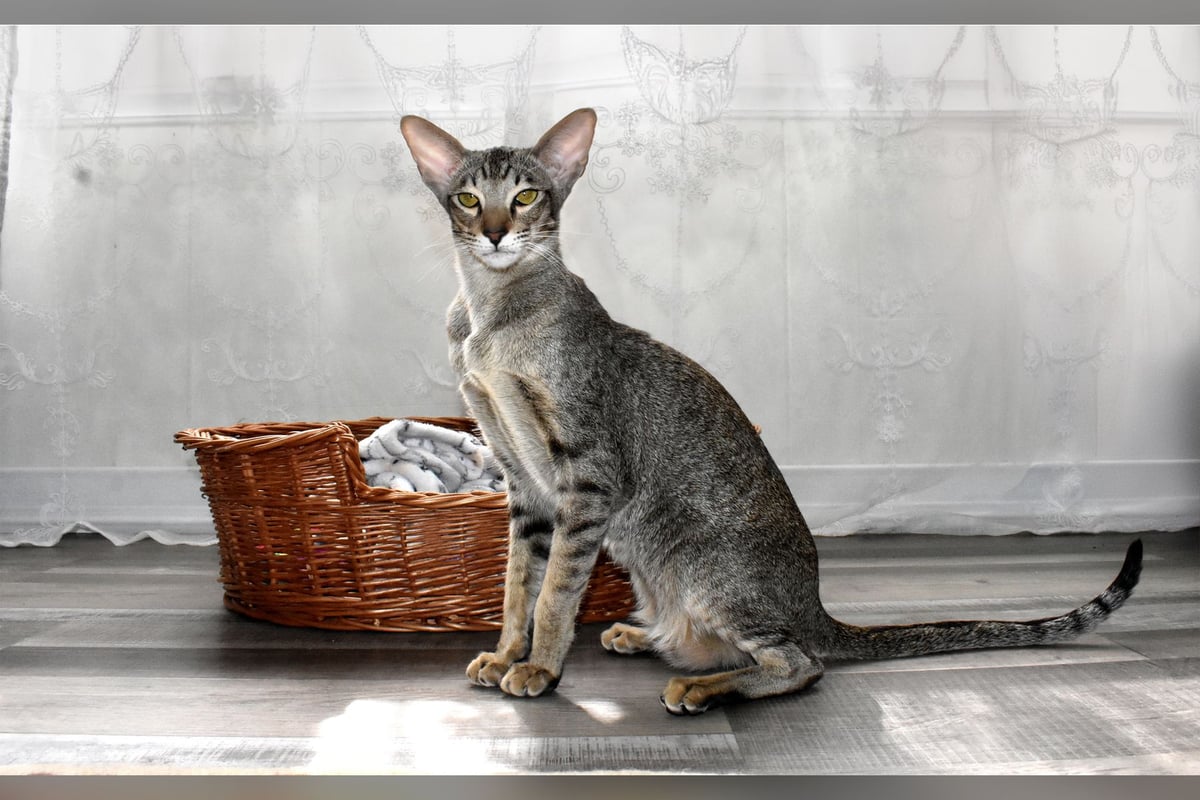
Oriental Shorthair
The Oriental Shorthair is the Siamese freed from colorpoint: the same slender, tubular build, the same hyperactive, talkative temperament, but a palette of more than 300 recognized colors and patterns — solid, tabby, smoke, bicolor — where the Siamese tolerates only its characteristic points. Its eyes are green (not blue), its voice is powerful, and its attachment to humans is absolute. Selectively bred in the United Kingdom in the 1950s–1960s from Siamese crosses, it was recognized in championship by the CFA in 1977 and by the LOOF under the name "Oriental". It is a cat for households that want the intensity of the Siamese without the constraint of colorpoint.
- Weight
- 3 to 5kg
- Height
- 25 to 30cm
- Life expectancy
- 15years
- Monthly cost
- 60 to 110€
Personality profile
Energy 5/5
Independence 1/5
Trainability 5/5
Good with children 4/5
Talkativeness 5/5
Space needed 3/5
Attachment to home 5/5
Good with strangers 4/5
Good with cats 4/5
Good with dogs 3/5
Coat care 1/5
Exercise needs 4/5
Scores given on measured axes, data confidence: high.
Living with an Oriental Shorthair
Description
The morphology is that of the modern Siamese, point for point: a slender, tubular silhouette, a triangular wedge head with a long, straight nose, large, wide-set ears positioned to extend the sides of the facial triangle, a fine, tapered tail. The difference is striking: where the Siamese carries a mandatory colorpoint coat, the Oriental accepts every color except colorpoint, mink (Tonkinese) and sepia (Burmese). The LOOF accordingly recognizes the solids (ebony black, blue, chocolate, lilac, cinnamon, fawn, white), every tabby variation (classic, mackerel, spotted, ticked), the smokes and shaded, as well as the bicolors and particolors. The CFA lists more than 600 color × pattern × coat-length combinations. The eyes are almond-shaped, slightly slanted, an intense green — a diagnostic feature that immediately distinguishes the Oriental from the blue-eyed Siamese. White Orientals may have blue or odd eyes. Males generally weigh 3.5 to 5 kg, females 3 to 4.5 kg. The longhaired variant is called the Oriental Longhair or the Mandarin depending on the registries. Life expectancy: 12 to 15 years.

Temperament
The LOOF describes the Oriental in three words: "hyperactive, hyper-cuddly, hyper-vocal". This is not marketing copy — it is a warning. The Oriental is probably the most demonstrative cat breed there is: it follows its owner everywhere around the home, comments on every action with a loud, insistent voice, and demands physical contact and constant interaction. Some behaviorists even rank it above the Siamese in vocal intensity — not necessarily louder, but more constant and more varied in its expressive registers. Its intelligence is sharp and operational: it observes, memorizes routines, tests limits and learns fast. Prolonged solitude is its kryptonite: left alone more than four to five hours as a routine, it can develop anxiety, destructive behavior or depression. Adopting a pair — another Oriental or a Siamese — is strongly recommended for households with long absences. With children, it is playful and affectionate, provided interactions respect its high energy level.
Training
Few cats take to clicker training as well. Its sharp intelligence, its thirst for interaction with humans and its sensitivity to rewards make it a fast learner: it can learn to give a paw, to come when called by name, to sit on command, to fetch a light object, to run a small agility course, or to string together bouts of intense play. Training is also a major boredom-buster for this breed — a 10-minute clicker session stimulates it mentally as much as half an hour of extended physical play. Sessions should stay short (5 to 10 minutes maximum) and varied to avoid boredom. Positive reinforcement is the only effective approach: the Oriental accepts no physical restraint and may respond to frustration with intense vocalizing or withdrawing cooperation.

Feeding
Despite its slender silhouette, which might suggest a light eater, the Oriental Shorthair is hyperactive and burns through calories. Its ration should be adapted to an intense activity level: premium kibble rich in animal protein (minimum 35–38%) with a good taurine content — a critical nutrient for heart health, particularly relevant given the DCM predisposition. Two split meals a day are better than free-feeding for regulating appetite and detecting drops in appetite that could signal a health issue. The Oriental can demand food out of attention-seeking as much as real hunger — knowing how to tell the two apart prevents overfeeding. Sufficient hydration is recommended given the kidney predispositions linked to amyloidosis: work wet food into the diet alongside kibble. Kittens need a high-calorie-density diet up to 12 months.
Affiliate links, no extra cost to you. Legal notice

Living conditions
A modestly sized apartment works, provided the environment is richly furnished and human presence is sufficient. Cat trees, rotating interactive toys, tunnels and food puzzles are non-negotiable for its mental balance. Plan on at least 30 to 40 minutes of daily interactive stimulation — wand-toy games, clicker training sessions, activity courses — to schedule from the moment of adoption. Its very short coat and low body mass make it sensitive to cold: below 15–16 °C with no heat source available, it seeks to warm up against a human. Outdoor access is not a necessity but a bonus — a secure, netted balcony works well. An indoor-cat lifestyle is recommended to preserve its health. The ideal setup: a household working from home, a multi-person family, or adopting a pair with a companion of similar temperament.

Grooming and coat care
Few breeds require as little coat maintenance. The very short, fine coat, close to the body, sheds little and does not mat. A weekly pass with a rubber glove or chamois cloth is enough to remove dead hair and maintain the coat's natural shine. Bathing is rarely necessary — it can be done occasionally if the cat accepts it. Ear care deserves regular attention: the large ears readily collect wax and need monthly cleaning with a suitable ear solution. The most important maintenance point is dental: weekly brushing (daily if accepted) to prevent the gingivitis and resorptive lesions to which the breed is predisposed.

Health
The breed inherits the predispositions of the Siamese genetic background and adds one more specific to its own line. Feline amyloidosis is the most serious silent threat: abnormal amyloid protein deposits build up in the liver, kidneys or pancreas, potentially leading to organ failure in adulthood or old age. No standardized commercial DNA test is available — annual blood panels (liver and kidney) from 5–6 years are the main monitoring tool. Progressive retinal atrophy (PRA) is documented and partly detectable by genetic test — to check with the breeder. Dilated cardiomyopathy (DCM) is a documented predisposition in the Oriental, distinct from the hypertrophic cardiomyopathy (HCM) more common in other breeds: the heart walls thin and the heart loses contractile capacity. Echocardiogram monitoring from 4–5 years is advised. Feline asthma affects oriental breeds more often than average: any episode of repeated dry coughing or wheezing warrants a prompt consultation. Dental resorptive lesions (FORL) and gingivitis are frequent — regular dental brushing from a young age significantly reduces the risk. Finally, like the Siamese, the Oriental metabolizes certain anesthetic agents differently: systematically inform the vet of the breed before any general anesthesia procedure.
Breed history
The Oriental Shorthair was born in the United Kingdom in the 1950s–1960s, in reaction to a selection decision made three decades earlier. In the 1920s, British breeders had gradually refocused their programs on the pure colorpoint Siamese, abandoning the solid-coated varieties that had nonetheless existed in the breed's origins. After World War II, several breeders set out to recover this lost diversity by crossing Siamese with solid-coated domestic cats, Abyssinians and British Shorthairs, then re-selecting for Siamese morphology over several generations. Each new color obtained was initially treated as a separate breed — the Foreign White, the Havana, the Foreign Lavender — before breeders realized the absurdity of a proliferation of standards for what was fundamentally the same type of cat. Consolidation took place in the 1960s–1970s under the common name "Oriental Shorthair". The CFA registered the breed in 1974 and granted it championship status in 1977. The LOOF recognizes it under the simple name "Oriental", alongside the Siamese, the Thai and the Balinese, with which crosses are permitted to maintain genetic diversity. In 1988, the CFA also folded the Oriental Longhair (called the Mandarin in Europe) into the same breed group, bringing the number of recognized combinations to more than 600.
Getting ready for your Oriental Shorthair
Four essentials to line up before day one.
Affiliate links, no extra cost to you. Legal notice
FAQ: Oriental Shorthair
Sources
- Wikipedia FR — Oriental (cat) · Origin: Siamese × solid-coated cat crosses in the United Kingdom, 1950s–1960s. Weight 4–6.5 kg. All colors except colorpoint. CFA recognized the breed in 1972 (registration). Mandarin = longhaired variant.
- LOOF — Oriental breed profile · Official LOOF name: Oriental. All colors except colorpoint, mink, sepia. Green eyes standard; blue or odd eyes permitted in whites and bicolors. Temperament: hyperactive, hyper-cuddly, hyper-vocal. Club: AFAS.
- CFA — Oriental Breed Profile · Registration 1974, championship 1977. More than 600 color/pattern/length combinations. PRA and amyloidosis documented. Oriental Longhair accepted 1988. Temperament: vocal, affectionate, active, insistent.
- Wikipedia FR — Siamese (cat) — related breeds · Shared Oriental/Siamese predispositions: feline amyloidosis (liver, kidneys, pancreas), feline asthma, sensitivity to general anesthesia, gingivitis and FORL.
Breeds similar to an Oriental Shorthair

