


Oriental Longhair
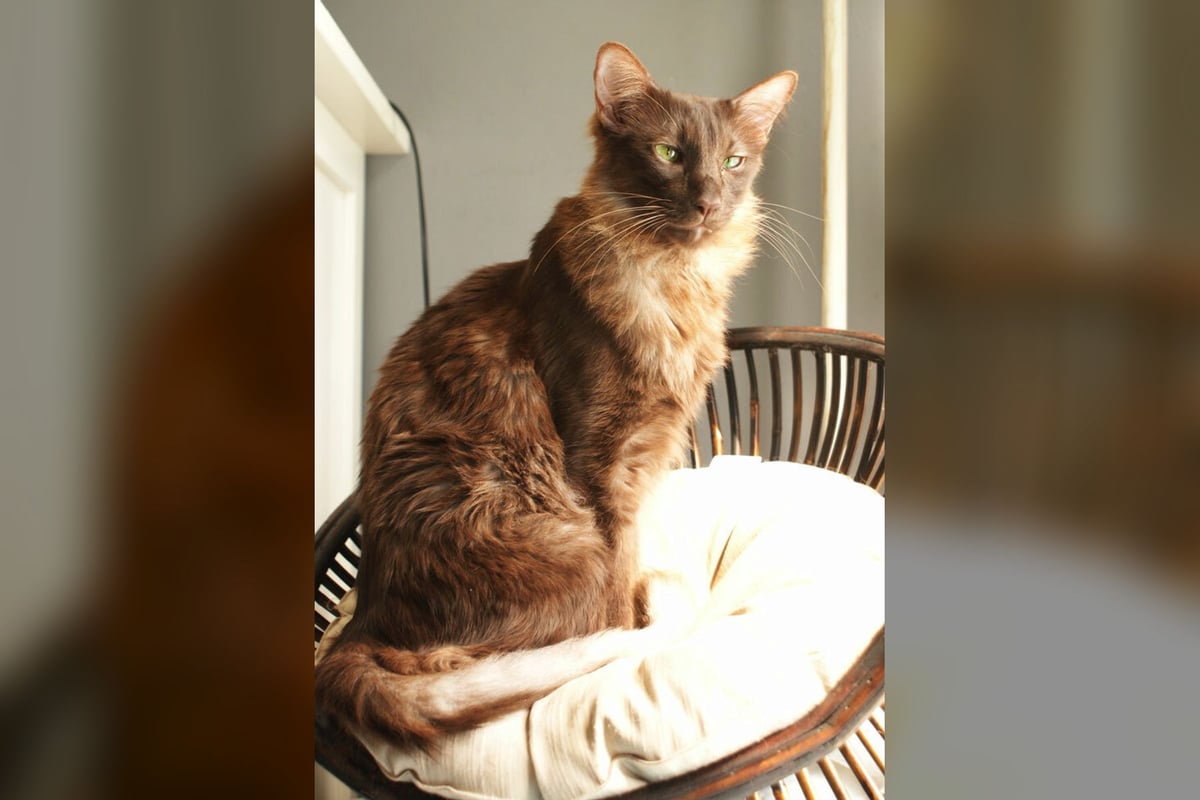
The Oriental Longhair is the semi-long version of the Oriental Shorthair: the same tubular oriental build, the same palette of more than 300 color and pattern combinations, the same green eyes — only the coat differs. In France it is registered under the name Mandarin by the LOOF and FIFe, while the CFA and TICA call it the Oriental Longhair. A rare breed in France, it fully shares the Siamese family's temperament: vocal, hyperactive, deeply attached to people, and quick to struggle in an understimulating environment. Its silky, semi-long coat, with no undercoat, is much easier to maintain than its elegant look might suggest.
- Weight
- 3 to 5kg
- Height
- 25 to 30cm
- Life expectancy
- 15years
- Monthly cost
- 60 to 115€
Personality profile
Energy 4/5
Independence 1/5
Trainability 5/5
Good with children 4/5
Talkativeness 5/5
Space needed 3/5
Attachment to home 5/5
Good with strangers 4/5
Good with cats 4/5
Good with dogs 3/5
Coat care 2/5
Exercise needs 4/5
Scores given on measured axes, data confidence: medium.
Living with an Oriental Longhair
Description
The silhouette is long, tubular and muscular, typical of the extreme oriental type. The head is wedge-shaped, triangular when viewed from the front, with a straight profile from skull to nose leather with no break. The large ears are wide at the base, set in line with the sides of the facial triangle. The eyes are almond-shaped, slightly slanted, set diagonally, an intense green for every non-white coat — whites can have blue or odd eyes. The body is long and fine, carried on slender, elegant legs; the tail is long, tapering, and ends in a full plume reminiscent of a feather duster. The coat is semi-long, fine and silky, entirely without undercoat: it does not form a ruff or a noticeable skirt, lies flat against the body, and does not mat. All traditional colors are admitted — solids, tabby, smoke, shaded, bicolor — except the colorpoint pattern (reserved for the Balinese) and the mink and sepia variants. Males weigh 3.5 to 5 kg, females 3 to 4.5 kg. Life expectancy: 12 to 15 years.

Temperament
The character is that of the Oriental Shorthair, unfiltered: hyper-vocal, hyperactive, hyper-dependent on human presence. It follows its owner from room to room, commenting on every action in a loud, insistent voice, and demands constant interaction. Some owners and breeders observe that longhaired cats from the same oriental litter tend toward a slightly less explosive register than their shorthaired littermates — a subtle difference that does not fundamentally change the breed's profile. It gets bored just as quickly as its shorthaired cousins: insufficient stimulation or too much solitude regularly triggers anxiety, over-grooming and destructive behavior. With children, it is playful and tolerant provided interactions stay respectful. Its confidence level around strangers is high for a cat — it greets a new face with curiosity rather than wariness. Cohabitation with other cats of a similar temperament (Oriental, Siamese, Balinese) generally goes well; cohabitation with an independent, low-activity cat can create tension from a mismatch in pace.
Training
Few breeds are as receptive to clicker training. Sharp intelligence, a craving for contact and sensitivity to food rewards make it a fast learner: giving a paw, coming to its name, running an obstacle course are all within its reach. Leash walking is a realistic option if training starts in kittenhood — oriental breeds respond well to it, and some cats find real stimulation in it. Sessions should stay short (5 to 10 minutes), daily and varied to avoid boredom. Positive reinforcement is the only effective approach: no physical coercion is tolerated. Puzzle toys and wand toys usefully round out these formal sessions by absorbing leftover energy at the end of the day.

Feeding
Activity level is sustained: rations should be calibrated for a hyperactive profile. Favor premium kibble rich in animal protein (minimum 35-38%) with adequate taurine, a nutrient critical for heart health and particularly relevant given the breed's DCM predisposition. Two split meals a day are better than free feeding, to regulate appetite and catch any drop in appetite that could signal a problem. A wet-food portion in the ration supports hydration, useful for preventing kidney issues linked to amyloidosis. Kittens need a high-calorie-density food up to 12 months to support their rapid growth.
Affiliate links, no extra cost to you. Legal notice

Living conditions
Apartment life is possible provided the environment is densely enriched: vertical structures, rotating interactive toys, food puzzles, tunnels, planned play sessions. It does not need a large space but does need activity and sustained human presence. Daily solitude of more than four to five hours as a routine is incompatible with its psychological balance — this limit is non-negotiable for this genetic family. The setup that suits it best: a work-from-home household, a multi-person family, or adoption alongside a companion of similar temperament. A secure netted balcony is an enrichment it appreciates but does not require. Its cold sensitivity (a coat with no undercoat, a modest body mass) makes it poorly suited to poorly heated rooms in winter. Indoor living is recommended: its lack of wariness and slender build make it vulnerable outdoors.

Grooming and coat care
Despite its length, this coat is one of the least demanding to maintain, thanks to the total absence of undercoat. The fine, silky coat does not mat, does not tangle, and sheds little outside seasonal molts. Brushing twice a week with a fine metal-toothed comb is enough in normal times to remove dead hair and keep the coat glossy. During the spring and fall molts, step up to three brushings a week for two to three weeks. Bathing is rarely necessary. The large ears deserve regular attention: monthly cleaning with a suitable ear solution prevents wax buildup. Weekly dental brushing, introduced from kittenhood, prevents the gingivitis oriental breeds are prone to.

Health
Genetic predispositions are those of the Siamese family, with no notable exception tied to coat length. Feline amyloidosis is the most serious risk: abnormal amyloid protein deposits build up in the liver, kidneys or pancreas, potentially progressing to organ failure in adulthood or in senior cats. No standardized commercial DNA test is available for this condition in oriental breeds — monitoring relies on regular blood panels (liver, kidney) from age 4-5 onward. Progressive retinal atrophy (PRA) is documented in oriental lines and is partly testable genetically — ask the breeder for screening results. Dilated cardiomyopathy (DCM) is reported in oriental lines: the heart walls thin and contractile capacity gradually declines; echocardiographic monitoring from age 4-5 is recommended. Feline asthma affects oriental breeds more often than average — any repeated dry cough or wheezing deserves a prompt consultation. Convergent strabismus is present in some oriental lines, without affecting quality of life. Dental resorptive lesions (FORL) and gingivitis are common: regular dental brushing from a young age significantly reduces the risk. Finally, like the Siamese and the Oriental, it metabolizes certain anesthetics differently — always inform the vet of the breed before any general anesthesia.
Breed history
The breed was born from breeding programs carried out mainly in the United Kingdom in the 1960s-1970s, alongside the development of the Oriental Shorthair. Breeders sought a semi-long version of the Oriental, crossing Orientals with Balinese — the longhair variant of the Siamese. The resulting longhaired kittens showed the same tubular oriental phenotype and the same extended color range, but a fine semi-long coat with no undercoat. Terminology then varied by federation: FIFe and the French LOOF adopted the name Mandarin for the non-colorpoint semi-longhaired Oriental, while the American CFA folded it, from 1994 onward, into the unified Oriental group under the name Oriental Longhair (alongside the Oriental Shorthair). TICA granted recognition in 1998. The term Javanese, sometimes used in older literature, is a source of confusion: the CFA used that name until 2008 for Balinese cats in non-classic colors (lynx points, tortie points), not for Oriental Longhairs. In France, the LOOF groups the Balinese and the Mandarin under a single breed sheet with the shared club AFAS (Association Féline des Amis du Siamois), underlining their direct kinship — the only difference being the Balinese's colorpoint pattern versus the Mandarin's solid/tabby/smoke colors. The breed remains rare in French catteries, with LOOF numbers staying modest compared with the Siamese and the Oriental.
Getting ready for your Oriental Longhair
Four essentials to line up before day one.
Affiliate links, no extra cost to you. Legal notice
FAQ: Oriental Longhair
Sources
- Wikipedia FR — Mandarin (cat) · Semi-long variety of the Oriental, a direct descendant of the Siamese. Semi-long coat with no undercoat. Weight 3-5 kg. Recognized by the LOOF, CFA (1994), TICA (1998). Hereditary amyloidosis documented.
- Wikipedia EN — Oriental Longhair · Formerly named the British Angora, renamed in 2002. Tubular oriental body, silky semi-long coat. All colors except colorpoint. Green eyes preferred. Life expectancy ~15 years. Predispositions: amyloidosis, asthma. Active, vocal, not suited to solitude.
- LOOF — Balinese and Mandarin · The Mandarin is grouped with the Balinese in the LOOF breed sheet. All traditional colors accepted, green eyes. Semi-long coat with no undercoat or ruff. Active, affectionate, talkative. Club: AFAS (Association Féline des Amis du Siamois).
Breeds similar to an Oriental Longhair

