


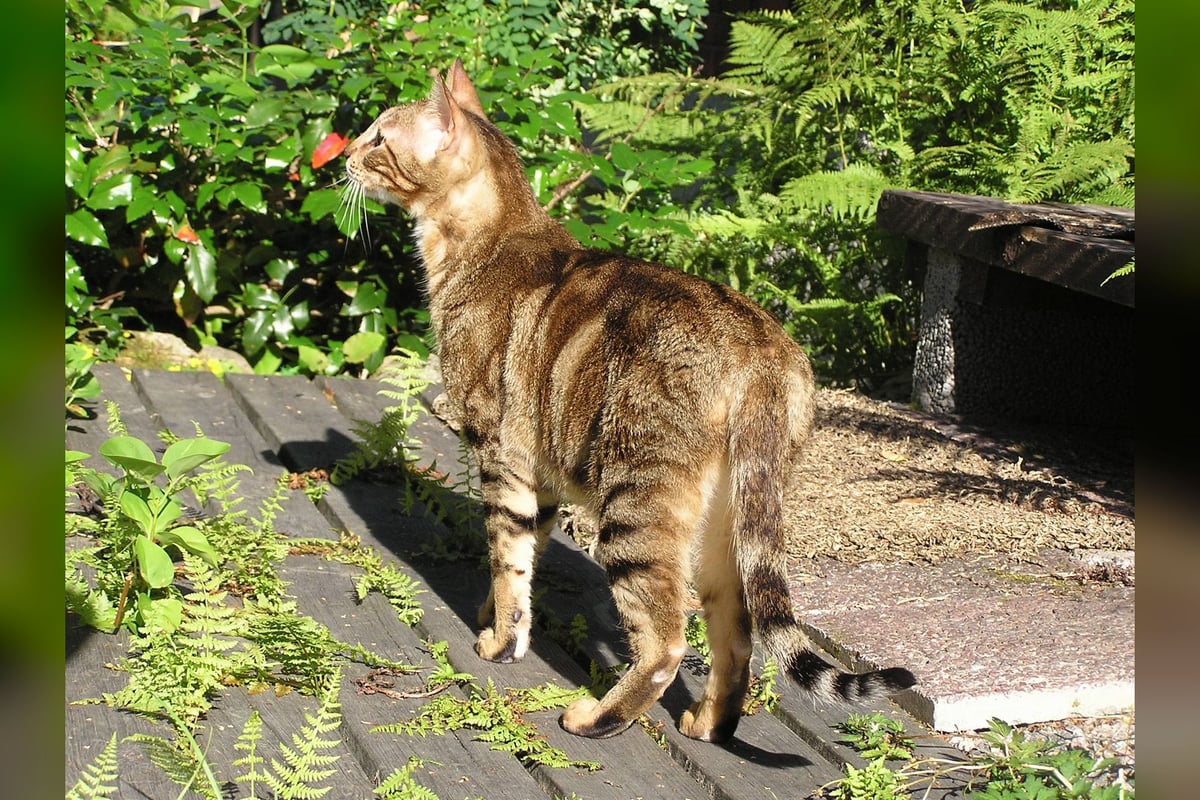
Sokoke
The Sokoke is the only domestic breed of African origin recognized by the major cat federations. Born in Kenya's Arabuko-Sokoke Forest, it carries an entirely singular type of tabby coat — the African Tabby — whose modified blotched pattern evokes the bark of tropical trees under raking light. A very elongated, light body, a gait balanced on the pads, a presence that is both feline and wild: the Sokoke is an ambassador of biodiversity as much as an exceptional companion for a household ready to respect its natural reserve. Extremely rare in France (0 FIFe kittens registered in 2024), it is aimed at seasoned enthusiasts, not an impulse adoption.
- Weight
- 3 to 5kg
- Height
- 25 to 30cm
- Life expectancy
- 14years
- Monthly cost
- 50 to 85€
Personality profile
Energy 4/5
Independence 4/5
Trainability 3/5
Good with children 2/5
Talkativeness 3/5
Space needed 4/5
Attachment to home 3/5
Good with strangers 1/5
Good with cats 3/5
Good with dogs 2/5
Coat care 1/5
Exercise needs 4/5
Scores given on measured axes, data confidence: medium.
Living with a Sokoke
Description
The build is semi-foreign, slender and very light — the fine bone structure recalls an East African feral cat more than a breed shaped in Western breeding programs. The legs are long, the hind legs slightly higher than the front, giving the animal a naturally forward-leaning posture and a distinctive gait known as "tiptoe": the cat moves on the tips of its pads, in the manner of a semi-arboreal animal accustomed to uneven forest ground. The head is wedge-shaped, medium-sized, with slightly defined cheekbones, medium, well-spaced ears and almond-shaped eyes ranging from amber to light green. The coat is the breed's most identifiable trait: short, close-lying, without undercoat, on a tawny background (warm brown with ochre highlights) marked with a modified blotched tabby pattern known as African Tabby. This pattern differs from the classic European blotched by a distortion of the flank spirals into fragmented patterns evoking the bark or grain of tropical wood. Agouti is present even in the dark areas of the markings, giving a rare optical depth. Males 4-5 kg, females 3-4 kg.

Temperament
This is a puzzling breed for anyone expecting a conventional domestic cat. Its first reaction to the unfamiliar is to flee or freeze — it never approaches a stranger, even on its own territory, without going through a long phase of silent assessment. This reserve is often wrongly interpreted as wildness or aggression; it is in fact intense selective attachment. Once the bond is established with its reference household — usually one or two people — it reveals a discreet but real affection: it follows, observes, lies down nearby without necessarily seeking physical contact, and vocalizes in a distinctive register (chirps, trills, short high-pitched meows) to communicate. Owners disappointed by a "cold" cat do not match the Sokoke profile; those who appreciate feline relational subtlety find a remarkably loyal companion in it. Cohabitation with other active cats is possible; cohabitation with dogs or boisterous children is not advised.
Training
This is neither a show breed nor one easily steered toward structured clicker training exercises like the Bengal or the Abyssinian. Its intelligence is undeniable — it quickly memorizes the layout of its environment, anticipates household routines and solves new situations with discernment — but this intelligence is expressed on its own terms, not on human command. Overly formal clicker training sessions are generally ignored or interrupted. Stimulation through hunting play (feathers, artificial prey imitating small animals), on the other hand, triggers a marked predatory instinct that provides the necessary mental and physical exercise. Plan daily active play windows — two to three long, intense 15-20 minute sessions — essential to satisfy the arboreal predator energy inherited from its Kenyan forest ancestors. Harness walking is feasible for early-socialized individuals, but exposure to unfamiliar environments can generate significant stress. The golden rule: never force, always offer.

Feeding
Light-framed and with an active metabolism, it does not need a high caloric intake in volume, but does require an adapted nutritional density. For a 4 kg adult, plan 180-230 kcal/day depending on actual activity. Favor foods very high in animal protein (≥40%), low in carbohydrates, without artificial flavors — the breed shows notable dietary selectivity, probably inherited from an ancestral diet made up of small varied prey (lizards, insects, small forest birds). Quality pâté or a homemade ration (BARF or cooked) is well tolerated and provides valuable behavioral enrichment. Avoid low-end kibble with a high cereal proportion. Split into two to three meals a day. The breed is not very prone to excess weight thanks to its naturally active temperament.
Affiliate links, no extra cost to you. Legal notice

Living conditions
It adapts poorly to noisy environments or ones with a high turnover of outside visitors. Its forest origin naturally directs its behavior toward horizontal and vertical exploration within a stable, predictable space. An apartment can work provided it includes access to heights (shelves, a tall cat tree), retreat zones inaccessible to visitors, and an exposed window with an outdoor view. A house with access to a secure outdoor space (catio, enclosure) is the absolute ideal. Cold is poorly tolerated — the breed is adapted to Kenya's tropical coastal climate and has little insulating undercoat. Do not consider free outdoor access in winter at French latitudes without a heated shelter. The environment's emotional stability matters more than its floor area: a calm one-bedroom beats a bustling house.

Grooming and coat care
The coat is among the least demanding to maintain of any recognized breed. Short, dense, without undercoat, it sheds very little dead hair outside of discreet seasonal molting periods. A weekly brushing with a grooming glove is amply enough to remove debris and preserve the coat's natural sheen. The African Tabby pattern requires no cosmetic intervention — the pattern is structural and not tied to any particular care. As with every cat breed, watch the ears (earwax buildup), the claws (monthly trimming) and the teeth (monthly brushing or dental treats). The breed generally does not enjoy restrictive handling — introduce grooming very early, pairing each step with a positive reward.

Health
Descended from a natural Kenyan coastal population, the breed shows generally solid constitutional vigor. No breed-specific genetic disease is documented to date in the international feline literature — unlike the Abyssinian (PRA rdAc, PKDef) or the Bengal (PRA-b). This partly reflects the very small size of the worldwide population, which has paradoxically limited the spread of deleterious recessive variants, but also the absence of in-depth genetic studies for lack of sufficient numbers. The real, documented risk is inbreeding depression: the worldwide breeding pool is extremely small (fewer than two hundred known individuals outside Kenya), and several European lines show concerning inbreeding coefficients. Controlled outcross programs (toward the Abyssinian or the Egyptian Mau) are under discussion at the FIFe level. Practical recommendations: demand a traceable pedigree certificate over four generations, an annual cardiac echo check from age 5, and an annual blood panel to monitor kidney and liver function from adulthood.
Breed history
The Sokoke's story begins in the coastal Arabuko-Sokoke Forest, on Kenya's eastern shoreline, halfway between Malindi and Mombasa. This tropical forest, now a protected area under the Kenyan government and BirdLife International, hosts one of East Africa's most remarkable endemic faunas — and, within that biodiversity, a population of domestic cats of complex origins, locally called Khadzonzo by the Giriama communities living in the forest's buffer zone. In 1978, Jeni Slater, who grew coconut palms in the area, discovered a litter of kittens on her property bordering the forest and recognized their singular character — coat, build and behavior unlike any known domestic feline. She began breeding these cats with no show ambitions, documenting their characteristics over several years. In 1984, a Danish friend, Gloria Moeldrup, imported several individuals to Denmark, where she launched a rigorous breeding program. It was from Denmark that the breed made its entry into Europe's institutional cat world: FIFe officially recognized it in 1992 under the name Sokoke, ratifying a standard drawn up from the individuals imported by Moeldrup. Two lines coexist today: the Original line (or Khadzonzo), whose individuals descend directly from the Kenyan forest population or its direct imports, and the Old Line, descended from the first generations bred in Europe. Phenotypic differences between the lines are notable in terms of body size and the intensity of the tabby pattern. In France, the breed remains obscure: FIFe registrations recorded no kittens in 2024, making it one of the rarest recognized breeds in the country, if not the rarest. Discussions are ongoing within FIFe breed committees about an outcross program toward the Abyssinian to widen the gene pool without altering the original phenotype.
Getting ready for your Sokoke
Four essentials to line up before day one.
Affiliate links, no extra cost to you. Legal notice
FAQ: Sokoke
Sources
- LOOF — Recognized cat breeds · The Sokoke is among the breeds officially recognized by the Livre Officiel des Origines Félines, shorthair category, with a standard derived from the 1992 FIFe recognition.
- FIFe — Sokoke Breed Standard (EMS: SOK) · Official FIFe recognition 1992. Standard: semi-foreign body, short coat without undercoat, African Tabby pattern on a tawny base. EMS: SOK n 22 (single recognized color).
- Wikipedia FR — Sokoke · Only recognized domestic breed of African origin. Discovered by Jeni Slater 1978, imported to Denmark by Gloria Moeldrup 1984. Critical gene pool, outcross programs under discussion.
- TICA — Sokoke Breed Introduction · Kenyan natural breed, TICA Advanced New Breed class. Unique natural tabby pattern known as African Tabby. Temperament: independent yet loyal to family.

