


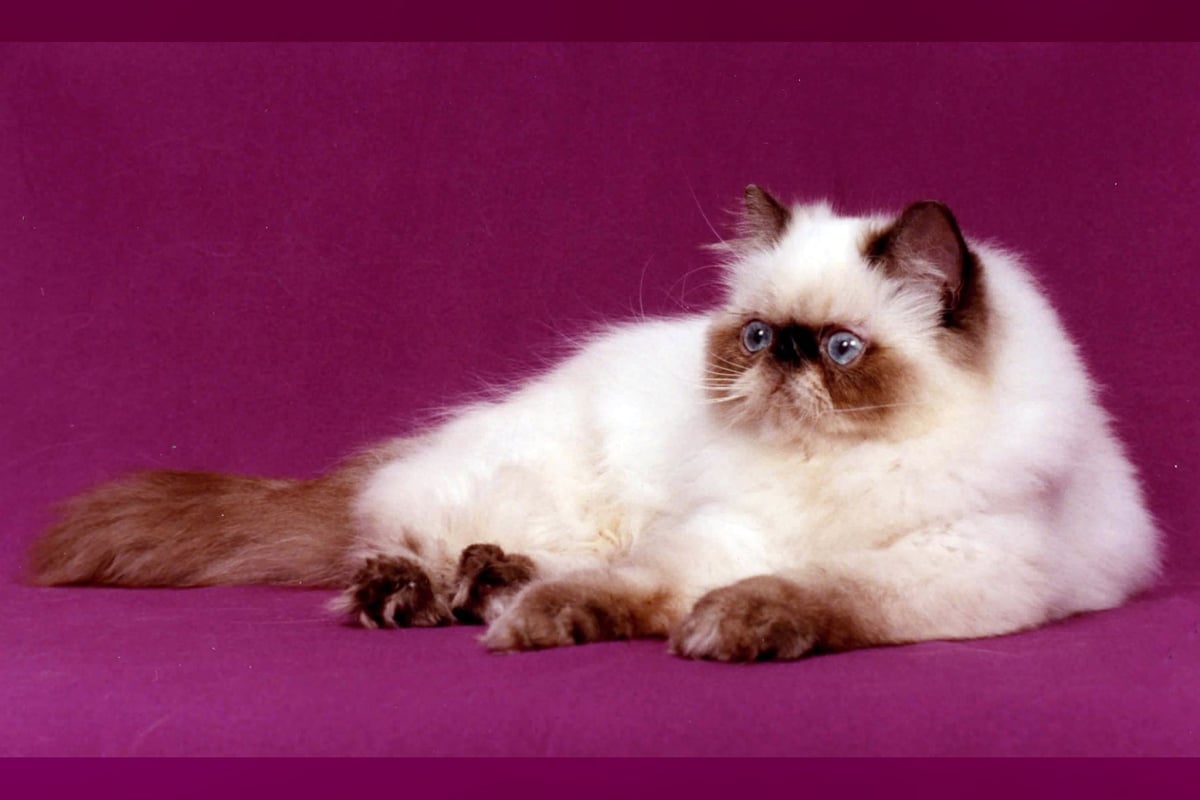
Himalayan
The Himalayan is a colorpoint Persian: the same brachycephalic cobby build, the same extra-long cottony coat, the same calm, placid temperament — plus the colorpoint pattern inherited from the Siamese (light body, dark mask, ears, legs and tail) and mandatory blue eyes. An apartment breed par excellence, it requires rigorous daily coat care and the same health vigilance as the Persian: an essential PKD1 DNA test, HCM and brachycephaly monitoring.
- Weight
- 3 to 5.5kg
- Height
- 25 to 38cm
- Life expectancy
- 13years
- Monthly cost
- 80 to 140€
Personality profile
Energy 2/5
Independence 3/5
Trainability 2/5
Good with children 4/5
Talkativeness 1/5
Space needed 3/5
Attachment to home 5/5
Good with strangers 3/5
Good with cats 3/5
Good with dogs 3/5
Coat care 5/5
Exercise needs 1/5
Scores given on measured axes, data confidence: high.
Living with a Himalayan
Description
Morphologically, nothing sets it apart from the Persian: a short, massive cobby body, solid bone structure, a broad chest, short legs. The head is round with a domed skull, full cheeks, a very pronounced stop and a short muzzle — the degree varying with how extreme the cat's brachycephaly is. What sets it absolutely apart from the standard Persian is the coat: colorpoint. The body is light (cream or off-white), the extremities dark — facial mask, ears, legs, tail — in a point color that can be seal, blue, chocolate, lilac, red, cream or tortoiseshell, including tabby variants (lynx point). The eyes are large, round and always an intense blue. The coat is long (up to 20 cm), very dense, with an abundant cottony undercoat identical to the Persian's. Males generally weigh 3.5 to 5.5 kg, females 3 to 4.5 kg. Life expectancy: 12 to 15 years.

Temperament
The character is, at bottom, still the Persian's: calm, composed, deeply affectionate without being intrusive. It enjoys long cuddle sessions and forms a solid attachment to its owners, with a slight touch of selective distance toward strangers. Its vocalizing is discreet — rare, soft meows, the opposite of its Siamese heritage. Some cats show a level of curiosity or liveliness slightly above the standard Persian, a faint trace of Siamese ancestry, without this calling into question its fundamentally sedentary profile. It cohabits without difficulty with calm, respectful children, balanced cats and other stable indoor animals. Moderate solitude is tolerated, but regular human presence remains conducive to its wellbeing.
Training
Formal training is not its strong suit. Its placid temperament and low level of extrinsic motivation make complex learning of little relevance. On the other hand, its gentleness makes daily handling easier: it tolerates intensive brushing, daily eye care and regular vet exams well when accustomed to them from a young age. Early socialization — exposure to household noises, visitors, care routines — is essential to prevent excessive shyness. Positive reinforcement (treats, a soft voice) remains the only method suited to its sensitive nature.

Feeding
Activity level is very low: caloric intake must be adjusted accordingly to prevent obesity, particularly common in neutered cats. Favor premium food high in animal protein and low in carbohydrates. Kibble shaped to suit the flattened jaw (flat or round) makes it easier to pick up. Partial wet feeding supports hydration, which matters for preventing kidney disease (PKD). Split into two meals a day. For kittens, a breed-specific kitten food with moderate growth is recommended up to 12 months.
Affiliate links, no extra cost to you. Legal notice

Living conditions
This cat is built for apartment life: not very active, not inclined toward intensive exploration, it is content with a modest space provided it has cozy corners and comfortable surfaces. A 40 to 50 m² home is more than enough. Because of its long coat and its brachycephaly, heat is its main enemy: an air-conditioned or well-ventilated room is essential in summer. An exclusively indoor life is strongly recommended — its coat gets dirty and tangled quickly outdoors, and its trusting nature makes it vulnerable to outdoor dangers. Avoid prolonged exposure to direct sunlight and overcrowded settings.

Grooming and coat care
Coat care is identical to the Persian's and represents a non-negotiable daily commitment. Daily brushing is essential: a fine metal-toothed comb to untangle the cottony inner layer, followed by a soft brush. Mats form quickly behind the ears, under the armpits and at the base of the tail; once formed, they require professional intervention or localized shaving. A monthly bath is often necessary. Daily eye cleaning is essential: chronic tearing stains the facial coat and can cause skin irritation. Clean the facial folds with a slightly damp pad. Plan on quarterly professional grooming for the most heavily coated cats.

Health
The health profile is the Persian's, unmitigated. Autosomal dominant polycystic kidney disease (PKD) is the major risk: a mutation of the PKD1 gene causes progressive renal cysts that can lead to kidney failure. The PKD1 DNA test is MANDATORY on both breeding parents — demand the written results before any purchase. Brachycephaly leads to brachycephalic airway obstruction syndrome (BAOS), chronic tearing from blocked tear ducts, risks of entropion, corneal sequestrum and increased anesthetic risk. Epiphora — marked tear staining on the facial coat — is nearly universal in the most extreme-typed cats. Hypertrophic cardiomyopathy (HCM) is documented in the breed. Females show a high rate of dystocia, often requiring a cesarean section. Regular ophthalmologic and echocardiographic checkups are recommended from age 2.
Breed history
The Himalayan was born from a deliberate crossbreeding program between the Persian and the Siamese, carried out in parallel in the United States and Sweden from the 1920s-1930s onward. The goal was to introduce the Siamese colorpoint pattern into the Persian while keeping its cobby build and long coat. The earliest documented genetic work dates back to 1924-1930, producing a cat named "Debutante," the first longhaired cat to carry the colorpoint coat. Structured breeding programs were launched from 1947 onward simultaneously in the United Kingdom and the United States, consolidating the line over several generations. Recognition as a distinct breed came in 1955 in England, then in 1957 in the United States through the CFA. In 1984, the CFA carried out a reclassification: the breed was folded into the Persian as the Himalayan division (Persian/Himalayan), a status it still holds in that organization today. On the European side — FIFe as well as the French LOOF — it is not treated as a distinct breed but as the colorpoint variety of the Persian. The name is a reference to the coat of certain mountain animals bearing a similar pattern — rabbits, Himalayan mountain cats — and not to the breed itself, which is of North American and British origin.
Getting ready for your Himalayan
Four essentials to line up before day one.
Affiliate links, no extra cost to you. Legal notice
FAQ: Himalayan
Sources
- Wikipedia FR — Himalayan (cat) · Persian × Siamese cross, 1924-1930 (US/Sweden), first colorpoint longhair cat "Debutante." Structured program 1947 UK + USA. CFA recognition 1957 as a distinct breed, reclassified as the Persian/Himalayan division in 1984. FIFe/LOOF: colorpoint variety of the Persian. ACFA, TICA, WCF: distinct breed maintained.
- LOOF — Recognized cat breeds · The Himalayan is treated by the LOOF as the colorpoint variety of the Persian (longhair cats), not as a separately registered distinct breed.
- Wikipedia FR — Persian (cat) · Brachycephalic build, historical PKD prevalence 30-50%, coat varieties including colorpoints (mandatory blue eyes). Predispositions: HCM, entropion, BAOS, dystocia.

