


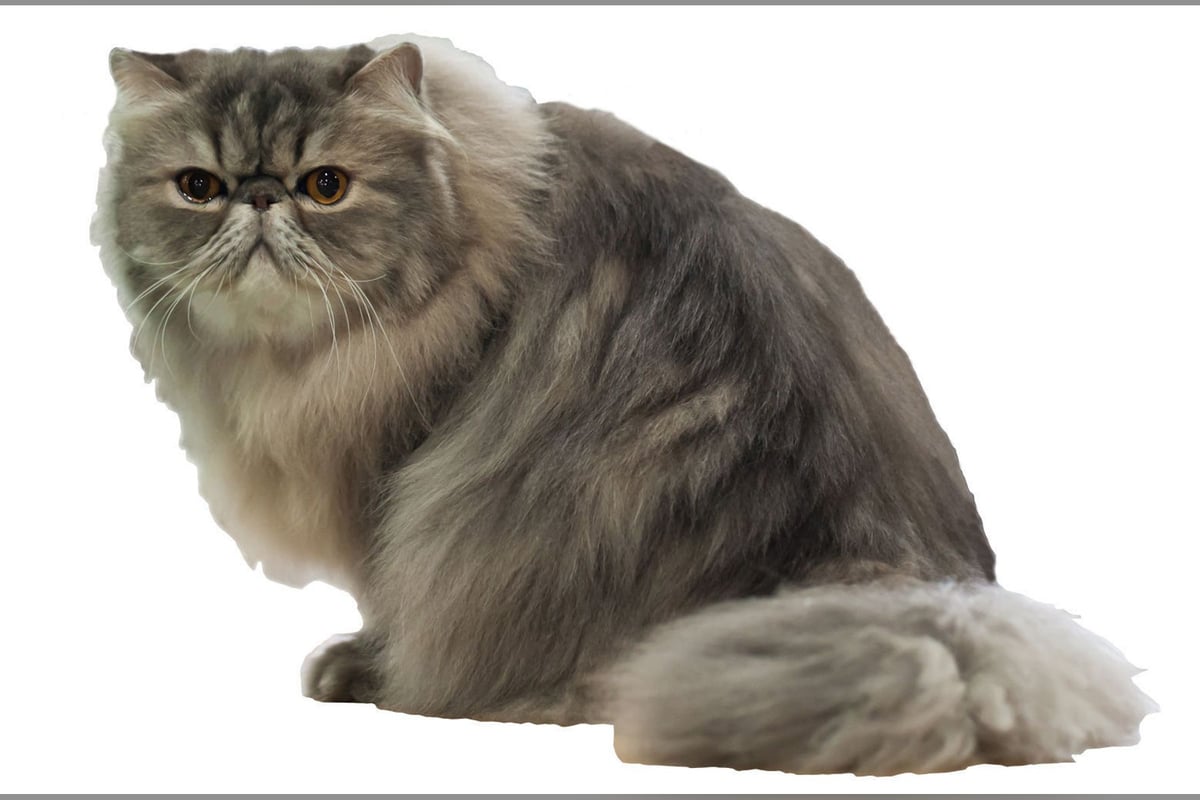
Persian
The Persian is one of the oldest and most recognizable cat breeds in the world, with its long, dense coat, its expressive flat face and its remarkably serene character. An emblematic longhaired breed, it is particularly well suited to apartment life and suits families looking for a calm, affectionate companion — provided they accept daily coat maintenance and heightened health vigilance linked to its brachycephalic build.
- Weight
- 3 to 5.5kg
- Height
- 25 to 38cm
- Life expectancy
- 14years
- Monthly cost
- 70 to 130€
Personality profile
Energy 2/5
Independence 2/5
Trainability 2/5
Good with children 4/5
Talkativeness 1/5
Space needed 3/5
Attachment to home 5/5
Good with strangers 3/5
Good with cats 3/5
Good with dogs 3/5
Coat care 5/5
Exercise needs 1/5
Scores given on measured axes, data confidence: high.
Living with a Persian
Description
The body is short and compact, a cobby build, with solid bone structure, a broad chest and short legs. Its most distinctive feature is its head: round, with a domed skull, full cheeks, a very marked stop and an extremely short muzzle in ultra-typed individuals. The eyes are large, round and wide open, generally copper-orange, except in colorpoints, which have blue eyes. The coat is long (up to 20 cm), very full, with abundant undercoat that gives the whole a cottony appearance. More than 150 coat varieties are recognized, from solids (white, blue, black, red, chocolate) to tabbies, smokes, chinchillas and colorpoints. Males generally weigh 3.5 to 5.5 kg, females 3 to 4.5 kg. Maturity is reached around 2 years. Life expectancy: 12 to 16 years.

Temperament
Home-loving and easygoing, it embodies the indoor cat par excellence. Naturally calm and composed, it prefers the serenity of the home to the bustle outside. It is deeply attached to its owners and enjoys long cuddle sessions, without being intrusive. Not very vocal — its meows are rare and discreet — it expresses itself more through its gaze than its voice. Its placid character makes it particularly compatible with calm, respectful children, as well as with other stable indoor animals. It is not the most playful or curious of domestic felines, but its constant affection and soothing presence suit households seeking tranquility rather than excitement.
Training
This is not the breed most receptive to formal training. Its placid temperament and low level of extrinsic motivation make complex learning of little relevance. That said, its gentleness makes daily handling easier: it tolerates brushing, eye care and veterinary exams well when accustomed to them from a young age. Early socialization — exposure to household sounds, visitors, other animals — is essential to prevent excessive shyness in adulthood. Positive reinforcement (treats, a soft voice) remains the only method suited to its sensitive nature.

Feeding
The activity level is very low: the caloric ration must be adjusted accordingly to prevent obesity, particularly frequent in neutered indoor individuals. Favor premium food high in animal protein and low in carbohydrates. Some brands offer breed-specific kibble shaped to suit the flattened jaw (flat or round kibble that is easier to pick up). A partial wet-food ration promotes hydration, important for preventing kidney conditions (PKD). Split into two meals a day. For kittens, a breed-specific kitten food with moderate growth is recommended up to 12 months.
Affiliate links, no extra cost to you. Legal notice

Living conditions
An apartment suits it fully: not very athletic, not inclined toward intensive exploration, it is content with a modest space provided it has cozy corners and surfaces to settle comfortably. A home of around 40-50 m² is more than enough. Because of its long coat and its sensitivity to heat (worsened by brachycephaly), it is essential to keep the indoors cool in summer, ideally with air conditioning or ventilation. A strictly indoor lifestyle is strongly recommended: its coat gets dirty and matted quickly outdoors, and its trusting nature makes it vulnerable to outdoor dangers. Absolutely avoid exposure to intense heat, prolonged direct sun or overcrowded atmospheres.

Grooming and coat care
Coat maintenance is the breed's major demand, not to be underestimated: daily brushing is imperative, no exceptions. Use a fine metal-toothed comb to detangle the cottony undercoat, followed by a soft brush to smooth the outer coat. Mats form quickly, particularly behind the ears, under the armpits and at the base of the tail; once formed, they require professional intervention or localized shaving. A monthly bath is often necessary to keep the coat clean and limit odor. Daily eye cleaning is essential: the chronic tearing linked to brachycephaly stains the facial coat and can cause skin irritation. Clean the facial folds with a slightly damp pad. Plan for quarterly professional grooming for the fullest-coated individuals.

Health
The breed is exposed to several serious pathologies, some of which are directly tied to its selectively bred morphology. Autosomal dominant polycystic kidney disease (PKD) is the most critical: caused by a mutation in the PKD1 gene, it causes progressive renal cysts that can lead to kidney failure. Historically, prevalence reached 40 to 50% in the breed; it has been reduced through screening programs but remains significant. The PKD1 DNA test is MANDATORY on both breeding parents — demand the results before any purchase. Brachycephaly generates a cluster of problems: brachycephalic obstructive airway syndrome (BOAS), chronic tearing from blocked tear ducts, entropion (inward-turned eyelids), corneal sequestrum, and increased anesthetic risk. Hypertrophic cardiomyopathy (HCM) and progressive retinal atrophy (PRA) are also documented in the breed. Females show a high rate of dystocia, often requiring a C-section. Regular ophthalmological and echocardiogram checkups are recommended.
Breed history
The Persian's origins go back to antiquity, in the regions of present-day Iran. The first documented mention of its introduction to Europe dates to the 17th century: traveler and naturalist Pietro della Valle brought back longhaired cats from his expeditions to Persia around 1620, taking them to Italy, from where they reached France and then England. The breed became formalized in the United Kingdom in the 19th century: the first official standard was established in 1889, and the breed quickly became the star of Victorian cat shows. Over the course of the 20th century, American and then European breeders pushed selection toward increasingly extreme brachycephaly — the so-called "ultra" or "peke-face" type — sparking growing controversy over animal welfare. In reaction, a movement advocates a return to the "traditional Persian" (or "doll-face"), with a less flattened muzzle and more functional airways. Long the best-selling cat breed in the world, it has seen its popularity decline since the 1990s in the face of the rise of the Maine Coon and the Bengal, without ever ceasing to be one of the most iconic breeds in the feline world.
Getting ready for your Persian
Four essentials to line up before day one.
Affiliate links, no extra cost to you. Legal notice
FAQ: Persian
Sources
- Wikipedia FR — Persian (cat) · Origin Persia/Italy 17th century (Pietro della Valle), standard 1889 UK. PKD historical prevalence 40-50%. Brachycephaly: entropion, corneal sequestrum, BOAS. More than 150 recognized coat varieties.
- LOOF — Recognized cat breeds · The Persian is among the breeds officially recognized by the Livre Officiel des Origines Félines, longhair category.
- Royal Canin — Persian Profile · Daily coat maintenance mandatory. Diet adapted to the brachycephalic build (specifically shaped kibble). Weight management in the sedentary neutered cat.

