


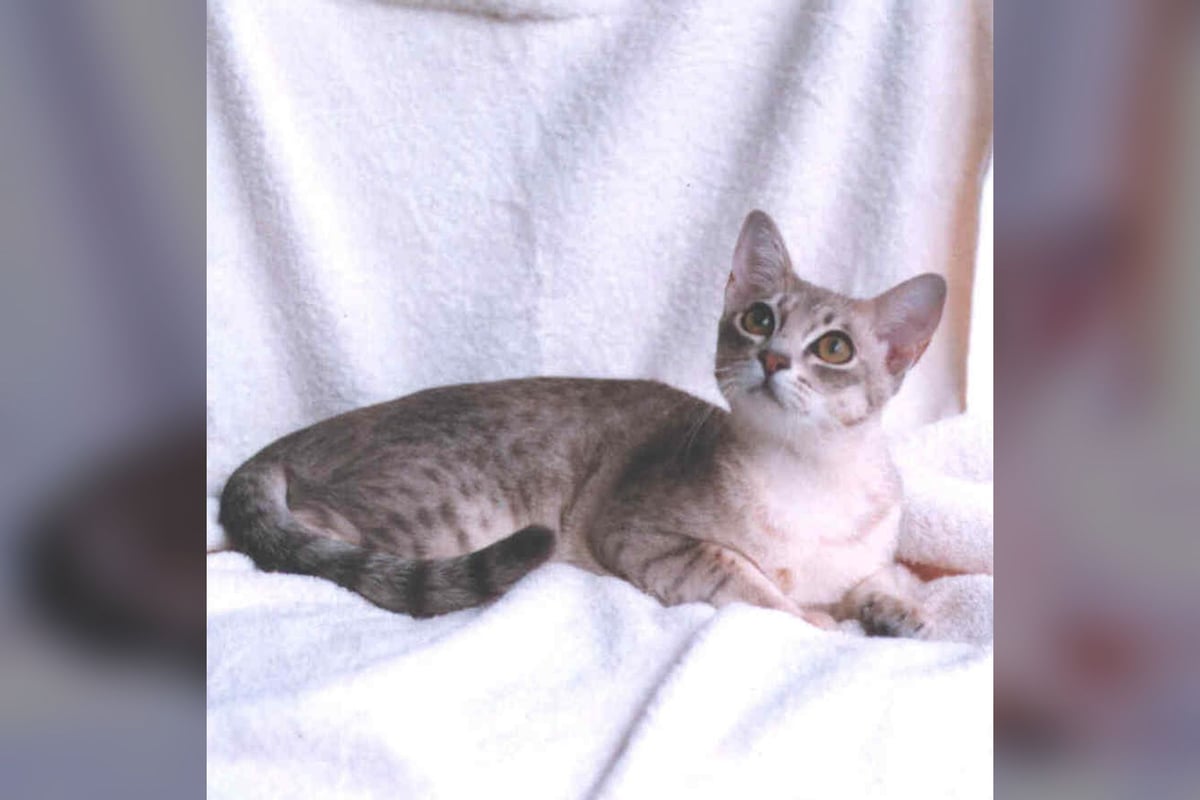
Australian Mist
The Australian Mist is the first cat breed developed entirely in Australia, created in 1976 by Dr. Truda Straede in Sydney through systematic crossing of Abyssinians, Burmese and domestic shorthair cats. Its characteristic coat — a marbled or spotted pattern on a misty background, as if veiled in a light haze — earned it its definitive name in 1998. Virtually absent in France, it has been recognized by FIFe since 2014 and remains an Australian national treasure known for its exceptionally sociable temperament.
- Weight
- 3 to 6kg
- Height
- 22 to 30cm
- Life expectancy
- 16years
- Monthly cost
- 55 to 100€
Personality profile
Energy 3/5
Independence 2/5
Trainability 4/5
Good with children 5/5
Talkativeness 2/5
Space needed 2/5
Attachment to home 5/5
Good with strangers 4/5
Good with cats 5/5
Good with dogs 4/5
Coat care 1/5
Exercise needs 3/5
Scores given on measured axes, data confidence: medium.
Living with an Australian Mist
Description
A medium-sized cat with a semi-foreign type body: well-muscled, solidly built, with no excess and no extreme refinement. The head is rounded, moderately broad, with a slightly domed forehead, high cheekbones and a short but not flattened muzzle — the profile is soft, with no abrupt break. The ears are medium to large, well spaced, broad at the base and slightly rounded at the tip. The eyes, large and expressive, are almond-shaped, slightly oblique, a color ranging from aqua green to golden green — a breed trait that intensifies with age. The coat is short, satiny, fine and dense in texture, with a lightly developed undercoat that gives it excellent year-round performance. The coat shows three overlapping layers visible to the naked eye: a light, slightly misty background (hence the breed's name), a marbled or spotted tabby pattern whose markings are slightly darker than the background, and a veil of ticking that gives that characteristic misty look. The colors allowed in the standard are brown, blue, chocolate, lilac, caramel, gold and cinnamon — always in soft variations, never saturated, which heightens the impression of a light fog. Males generally weigh 4.5 to 6 kg; females, lighter, reach 3 to 4.5 kg. The tail is medium to long, tapering at the tip, with visible ticking. Healthy individuals living past 18 years are not uncommon.

Temperament
In Australia, as in the rare European catteries that offer it, the breed is described as one of the most sociable and tolerant in the whole feline catalog. Its temperament is no coincidence: Truda Straede's explicit goal was to create an indoor cat suited to Australian family life — active but not exhausting, affectionate without being clingy, sturdy without being coarse. The result is a breed that tolerates handling by young children with remarkable patience, cohabits with dogs without major stress, and greets unfamiliar visitors without panic or aggression. Vocalizing is discreet — it communicates, but without insistence. Its energy is moderate: playful and curious, it does not require constant stimulation, which makes it a good fit for owners with busy schedules. It bonds deeply with its family and dislikes prolonged solitude — two cats often cohabit better than a single, isolated one. The domestic streak built into its genetics (the domestic third of its founding cross) gives it a behavioral flexibility that breeds of exclusively wild or oriental ancestry do not always possess.
Training
Keen curiosity inherited from the Abyssinian, strong motivation for human interaction inherited from the Burmese: the ground is ideal for positive training. It quickly learns to answer to its name, to use only designated scratching posts, and to tolerate a harness for supervised outings if socialization starts at the youngest age. Clicker training in short sessions (five to eight minutes) gives excellent results: the breed is one of the most receptive to positive reinforcement among shorthair cats. Tolerance for handling — included in Truda Straede's original selection goals — makes vet visits, routine care and interactions with children easier. This ability is not a spontaneous talent: it depends on early socialization from the first weeks of life, which serious breeders actively maintain. No physical restraint should ever be used — gentleness and consistency are the only effective levers with this temperament.

Feeding
Medium build, moderate activity: a premium diet rich in animal protein (minimum 35-40%) meets its needs well. Two split meals a day are preferable to free feeding: the breed has a decent appetite with no marked tendency toward obesity, but neutering reduces energy needs without dulling the appetite. For an active 4-5 kg adult, plan on roughly 200-250 kcal/day. Including a wet portion in the ration supports hydration — useful in preventing kidney risks linked to the Burmese line. Taurine should sit high in the ingredient list (cardiac support, given the Burmese HCM heritage). Potassium supplementation is only recommended on veterinary prescription in case of a positive hypokalemia test or symptoms. Watch the weight from age 2, more closely from age 7.
Affiliate links, no extra cost to you. Legal notice

Living conditions
Designed from the outset for Australian indoor living, the Australian Mist is the apartment breed par excellence — not out of resignation, but by nature. Its moderate energy level and adaptable temperament let it fully thrive in a well-appointed apartment: scratching posts, perches at different heights and daily interactive play sessions (two ten-minute sessions) meet its needs. Access to secure outdoor space is appreciated but never essential. Its short coat and Australian origin predispose it to tolerate heat better than cold: a well-heated interior is necessary in winter, and particular attention is needed during harsh winters in regions with wide temperature swings. Unlike some oriental breeds that handle changes in routine poorly, the Australian Mist adapts to family reorganizations — moving house, a new baby, welcoming a new pet — with relative ease. Its strong sociability makes it a particularly good choice for families with young children or already-established multi-pet households.

Grooming and coat care
The short, satiny coat is one of the simplest to maintain in the entire catalog of shorthair breeds. Its lightly developed undercoat produces little diffuse shedding: weekly brushing with a rubber grooming glove or a chamois cloth is enough to remove dead hair and maintain the coat's natural shine. Spring and fall molting seasons may call for two sessions a week. The coat's ticking pattern is visually delicate — avoid stiff metal brushes, which alter the surface texture. A bath is very rarely needed. Check the ears twice a month (possible wax buildup, an Abyssinian legacy), and clean the eye corners if secretions build up. Weekly dental care is recommended, particularly for adults from age 3. Claws should be trimmed every two to three weeks depending on activity and access to scratching posts.

Health
The genetic base is diverse thanks to the deliberate inclusion of one-third domestic cats in the founding program — a decision by Truda Straede that considerably widened the gene pool compared with breeds descended from strict crosses between two purebred lines. This diversity contributes to overall robustness superior to that of some breeds with exclusive ancestry. That said, two hereditary predispositions deserve attention. Familial hypokalemia — a potassium metabolism disorder inherited in part from the Burmese line — can cause episodic muscle weakness, particularly in the hind limbs. A dedicated DNA test (Burmese hypokalemia) is available and recommended on breeding cats. Hypertrophic cardiomyopathy (HCM), also documented in Burmese lines, should be monitored with regular echocardiographic screening of breeding cats. Progressive retinal atrophy (PRA), inherited from the Abyssinian line, is the third risk: the rdAc and Rdy mutations are genetically testable — demand negative results on both breeding parents. Aside from these documented predispositions, the breed is generally healthy and robust. An annual veterinary checkup, a cardiac exam from age 4, and an ophthalmological checkup if symptoms appear are the standard recommended follow-up measures. Life expectancy: 14 to 19 years.
Breed history
The Australian Mist is an entirely designed breed, the result of a rigorous breeding program launched in 1976 in Sydney by Dr. Truda Straede, a geneticist specializing in feline biology. Her goal was ambitious and explicit: to create an original Australian breed, suited to indoor living, with an exceptional temperament for families, and carrying a distinctive tabby-patterned coat on a misty background. The program crossed nine to ten founding breeds, but three lines dominate the breed's genetics in roughly equal proportions: the Abyssinian (for the coat's ticking, energy and curiosity), the Burmese (for sociability, an affectionate character and compact musculature) and Australian domestic shorthair cats (to widen the gene pool and anchor an adaptable temperament). The first official litter dates to 1980. The breed was initially registered under the name Spotted Mist, reflecting the spotted pattern that was dominant at the time. In 1998, after the official admission of the marbled pattern, the name was changed to Australian Mist to embrace both variants and assert the breed's national identity. Recognition by the Australian Cat Federation (ACF) came in 1986 — a decade after the program launched. The World Cat Federation (WCF) recognized the breed in 2004; FIFe granted it championship status in 2014. To this day, the breed remains virtually absent from continental Europe and very rare in France: no active breeding program is recorded there, and the few individuals present in the country are generally imported from Australia or the United Kingdom via pioneering breeders. In Australia it remains an emblematic breed, regularly cited in feline behavior studies as a benchmark for sociability and cross-species tolerance.
Getting ready for your Australian Mist
Four essentials to line up before day one.
Affiliate links, no extra cost to you. Legal notice
FAQ: Australian Mist
Sources
- FIFe — Australian Mist Breed Standard (2014) · FIFe recognition 2014, marbled and spotted patterns admitted to standard, 7 colors (brown, blue, chocolate, lilac, caramel, gold, cinnamon). Registered under the code AMI.
- Western Australian Cat Association (WACA) — Australian Mist Breed Profile · Breed developed by Dr. Truda Straede starting in 1976 in Sydney. Founding program: Abyssinian × Burmese × domestic cats. Spotted Mist → Australian Mist (1998). Recognition: ACF 1986, WCF 2004, FIFe 2014. Recommended tests: PRA, HCM, hypokalemia.
- Wikipedia EN — Australian Mist · First entirely Australian breed. Nine founding breeds, three dominant: Abyssinian (ticking), Burmese (temperament/musculature), domestic cats (gene pool). Spotted pattern renamed in 1998 to include marbled. Life expectancy 15-18 years. Rare outside Australia.

