


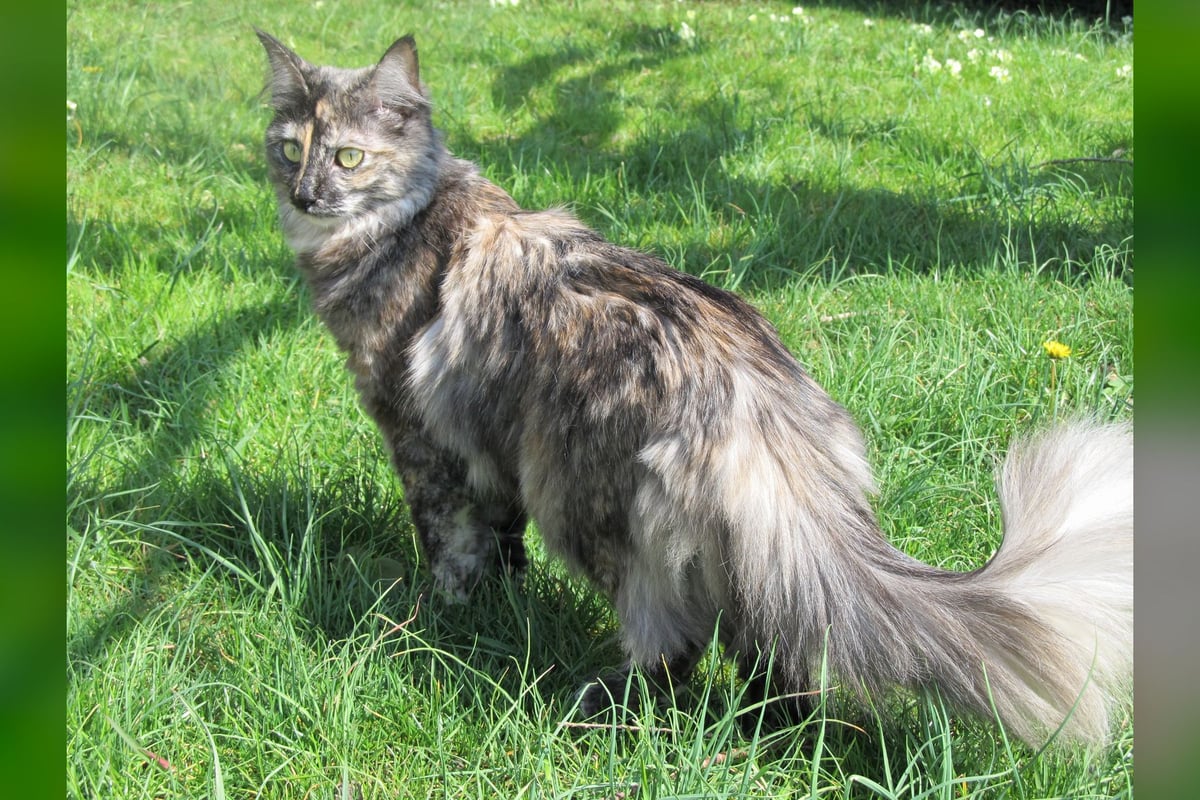
Turkish Angora
The Turkish Angora — "Ankara kedisi" in Turkish — is one of the oldest natural breeds in the world, native to the Ankara region in central Anatolia. Documented in Europe as early as the 16th-17th centuries, it was the first longhaired cat to enter the French royal courts before being eclipsed by the Persian. A medium, slender-bodied breed with a silky semi-long coat and no thick undercoat, it stands out for its agility, its outgoing temperament and the possibility of odd eyes in white individuals.
- Weight
- 2.5 to 6kg
- Height
- 22 to 35cm
- Life expectancy
- 14years
- Monthly cost
- 55 to 95€
Personality profile
Energy 4/5
Independence 3/5
Trainability 4/5
Good with children 3/5
Talkativeness 3/5
Space needed 3/5
Attachment to home 4/5
Good with strangers 4/5
Good with cats 4/5
Good with dogs 3/5
Coat care 3/5
Exercise needs 4/5
Scores given on measured axes, data confidence: high.
Living with a Turkish Angora
Description
The build is fine and slender, described as "foreign" in the standards: a long, muscular body with a light frame, a slim, graceful neck, hind legs slightly longer than the front legs, which gives the breed a characteristic gait that arches slightly toward the rear. The head is small to medium, triangular when viewed from the front, with a two-straight-line profile and no marked stop. The ears are large, tall, well upright and ideally furnished with tufts inside. The eyes are large and almond-shaped, every color accepted; in white individuals, odd eyes — one blue eye and one amber eye — are an emblematic signature of the breed. The tail is long, bushy, carried horizontally or slightly raised, likened to an ostrich feather in standard descriptions. The coat is semi-long, fine and silky, with no dense undercoat (unlike the Persian or the Norwegian): it falls naturally against the body and develops into a ruff, britches, a tail plume and toe tufts starting around 12 months. This lack of a thick undercoat considerably simplifies upkeep. Males 4 to 6 kg, females 2.5 to 5 kg. Physical maturity around age 2. Life expectancy: 12 to 16 years.

Temperament
An active, curious and decidedly outgoing cat, it watches visitors with interest and involves itself in household life with an assertive presence — it's often described as a "dog-cat": it greets arrivals, picks a reference person in the household and follows them faithfully, can retrieve toys and answers to its name. Its intelligence shows in a tendency to open doors, explore high spaces and quickly grasp human routines. Highly playful, it keeps this juvenile behavior well into old age. Its vocal level is moderate: it communicates through trills and modulated meows, without the Siamese's insistence but with more expressiveness than the Norwegian. It's affectionate without being clingy — it prefers closeness on its own terms to imposed cuddling. Its relative independence means it tolerates solitude better than breeds like the Siamese or the Sphynx, but it gets bored if the environment isn't stimulating enough.
Training
This is one of the cat breeds most receptive to active learning. Its operational intelligence, curiosity and strong motivation for play make it an excellent candidate for clicker training: it can learn to give a paw, jump on command, negotiate an obstacle course or accept a harness for supervised outings. Sessions should be short (5 to 10 minutes), regular, and rely exclusively on positive reinforcement — high-value treats, wand-toy play as a reward. The breed is sensitive to boredom and coercive methods: forced, it shuts down and disengages for a long time. Early kitten socialization between 3 and 12 weeks — exposure to varied sounds, regular handling, contact with other animals — is decisive for its adult stability, especially for white individuals, who may be deaf and develop heightened vigilance through visual compensation.

Feeding
A medium breed with an active metabolism, it needs a sustained protein diet proportioned to its high activity level. For a very active 4 kg adult, plan on 200 to 260 kcal/day depending on actual activity. Favor premium kibble high in animal protein (>38%) and essential fatty acids (omega-3 and omega-6) that nourish the shine of the silky coat. Taurine intake should be assured to support heart function, relevant given the documented HCM cases. Two split meals a day rather than free feeding, to prevent compulsive snacking in a cat that can get bored indoors. After neutering, reduce the ration by 10 to 15% to prevent weight gain, as the breed tends to become partly sedentary. For kittens up to 12 months, use kitten-specific kibble rich in DHA to support neurological and bone development.
Affiliate links, no extra cost to you. Legal notice

Living conditions
It lives well in an apartment provided verticality is available: tall cat trees, wall shelves, perches allowing it to survey the whole home. Without these arrangements, its explorer and climber nature turns into unwanted behaviors (climbing furniture, knocking over objects). A net-secured balcony is a welcome enrichment. The breed doesn't tolerate boredom or long periods of solitude without stimulation; if the household is away a lot, adopting two compatible cats eases this risk. Indoor cat recommended to prevent accidents linked to its agility and curiosity. It generally gets along well with school-age children who respect its movements, but its liveliness can be too much for very young children. Cohabitation with other cats is possible with a gradual introduction.

Grooming and coat care
The semi-long coat, with no dense undercoat, is one of the simplest to maintain among longhaired breeds. Brushing two to three times a week with a fine, close-toothed comb is enough under normal conditions to remove dead hair and keep the natural sheen of the silky coat. During seasonal molts (spring and fall), step up to four to five sessions a week for two to three weeks to prevent hair ingestion and the occasional mats that can form at the britches. No professional grooming is necessary. The large, upright ears should be checked monthly — the breed accumulates less wax than breeds with drooping ears, but the cleanliness of the inner tufts should be watched. An occasional bath (once a year) is well tolerated by individuals accustomed to it from kittenhood. White individuals may need gentle cleaning of tear stains.

Health
The best-documented predisposition in the breed concerns congenital deafness linked to the W gene (white dominant), responsible for both the white coat and blue eye color. This gene causes degeneration of the organ of Corti in the inner ear, leading to deafness that can be unilateral or bilateral. The prevalences documented in the scientific literature are significant: roughly 65 to 85% of blue-eyed white cats show bilateral or unilateral deafness; in odd-eyed individuals, roughly 30 to 40% are deaf on the blue-eye side; white individuals with amber or green eyes are markedly less affected. The BAER test (Brainstem Auditory Evoked Response) is the reference method for screening deafness — it should be performed before any breeding use. A deaf white individual can live a full life indoors in a secure environment, but should not be bred. The breed is generally robust outside of deafness: cases of hereditary ataxia (a neuromuscular disorder) have been reported in kittens, appearing between 2 and 4 weeks of age, but remain rare. Cases of hypertrophic cardiomyopathy (HCM) are also documented in adults, with no breed-specific mutation identified — an annual echocardiogram screening from age 2 is advised for breeding cats. A kitten from a serious LOOF cattery should have parents BAER-tested (for whites) and with no history of ataxia.
Breed history
The Turkish Angora takes its name from Ankara, formerly called Angora, the capital of central Anatolia where the breed developed naturally over the centuries. The first written mentions in Europe date back to the 16th and 17th centuries: the French naturalist Pierre Belon mentions longhaired cats imported from the East as early as 1558, and Nicholas-Claude Fabri de Peiresc reportedly had the first Angoras brought to the French court in the early 17th century. These white, silky-coated cats quickly became symbols of refinement in European royal courts. The Persian's massive arrival starting in the 18th century — more opulent, more imposing — progressively eclipsed the Angora, which nearly disappeared through uncontrolled crossbreeding. Turkey itself is what preserved the breed: starting in the 1930s, the Ankara Zoo maintained a strict breeding program for white, odd-eyed Angora cats, considered a national treasure ("Ankara kedisi"). The breed returned to the West thanks to American breeders who imported breeding cats from the Ankara Zoo in the 1960s: the CFA recognized it for championship status in 1973 (initially white only, then all colors in 1978). The FIFe followed in 1988; the LOOF added it to its recognized breeds after its founding in 1996. Today, colored variants (tabby, bicolor, non-white solid) compete with the historic white in the show ring.
Getting ready for your Turkish Angora
Four essentials to line up before day one.
Affiliate links, no extra cost to you. Legal notice
FAQ: Turkish Angora
Sources
- Wikipedia FR — Turkish Angora · Breed documented in Europe as early as the 17th century. Weight 2.5-5 kg. Life expectancy >15 years. CFA recognition 1973, FIFe 1988. Deafness linked to the W gene in blue-eyed white individuals.
- LOOF — Turkish Angora breed profile · LOOF standard: long, fine and muscular body, triangular head, tall upright ears, silky semi-long coat with no undercoat. Admitted coats: all except chocolate, lilac, cinnamon, fawn and colorpoint. Weekly brushing sufficient.
- Royal Canin FR — Turkish Angora profile · Males 4-6 kg, females 3-5 kg. Very high energy, juvenile behavior retained into adulthood. HCM and ataxia documented. Nutritional needs for highly digestible protein and fatty acids for coat health.
- Wikipedia EN — Turkish Angora · Origin central Anatolia, Ankara region. CFA championship recognition 1973, white only until 1978. W gene responsible for deafness and blue eyes. Ataxia and HCM documented. Temperament: playful, intelligent, athletic, highly involved in household life.
Breeds similar to a Turkish Angora

