


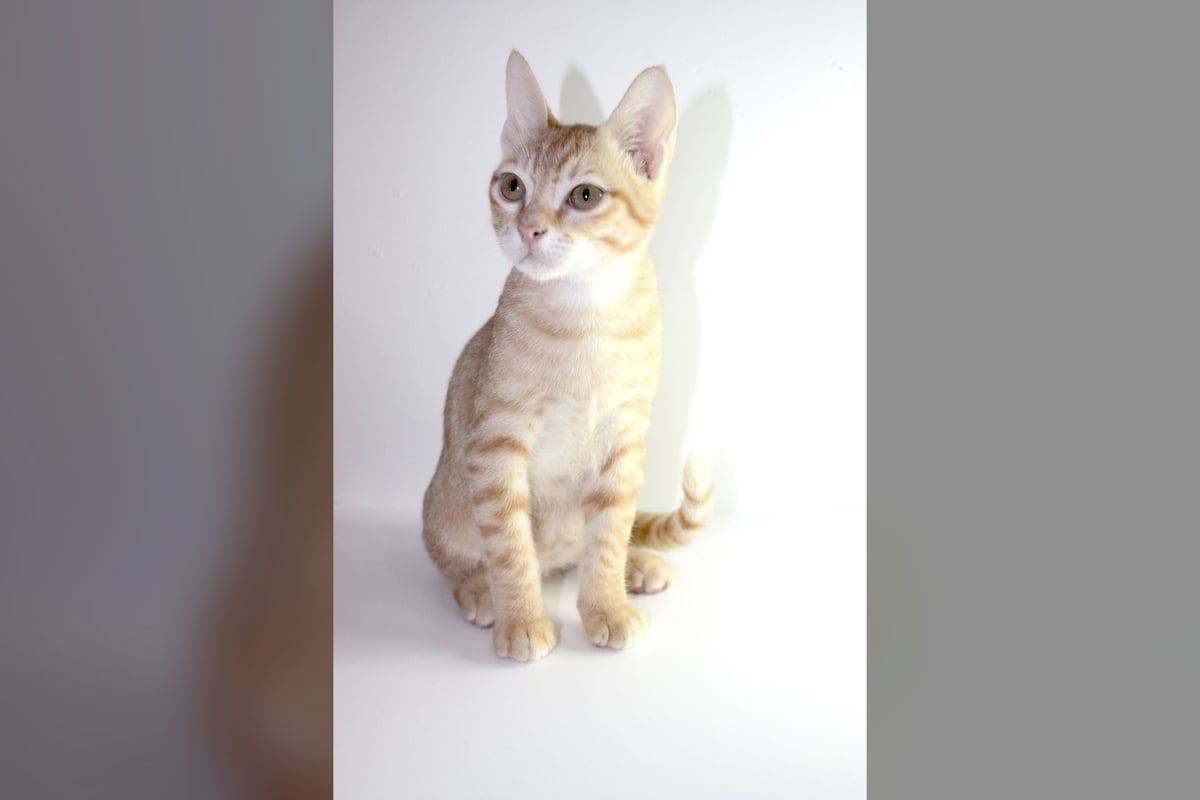
Arabian Mau
The Arabian Mau is a natural street cat of the Arabian Peninsula, naturally spotted like its Egyptian namesake but drawn from a distinct geographic pool — the deserts and cities of Qatar, the United Arab Emirates and Oman. Recognized by the WCF in 2014 at championship rank, it is almost unknown in France and remains rare in European breeding. Its body is long, fine-boned and extraordinarily agile, adapted to the extreme climate conditions of its homeland. It is a natural working breed: robust, low-maintenance in grooming, vocally discreet, capable of selective affection toward its own people without seeking to please every visitor.
- Weight
- 3 to 5.5kg
- Height
- 22 to 32cm
- Life expectancy
- 14years
- Monthly cost
- 40 to 80€
Personality profile
Energy 4/5
Independence 3/5
Trainability 3/5
Good with children 3/5
Talkativeness 2/5
Space needed 4/5
Attachment to home 3/5
Good with strangers 2/5
Good with cats 3/5
Good with dogs 3/5
Coat care 1/5
Exercise needs 4/5
Scores given on measured axes, data confidence: low.
Living with an Arabian Mau
Description
The morphology is markedly foreign type, more slender and lighter than that of the Egyptian Mau. The body is long, muscled without being massive, carried on fine, well-proportioned legs, the hind legs slightly longer — the silhouette of a dune hunter, built for speed over open ground. The head is moderately triangular, the profile light, the ears large and open, very widely spaced, broad at the base — a functional trait enabling efficient thermoregulation. The eyes are large, almond-shaped, green to amber depending on the individual, and very bright. The short, close-lying coat is one of the breed's distinctive traits: very fine, dense fur, slightly glossy, with almost no undercoat, which favors heat dissipation. The spotted pattern is natural — round or oval spots, well defined on a sand, light fawn or silver background. The facial "M" marking on the forehead is present, more discreet than in the Egyptian Mau. The tail is medium length, slightly tapered. Males 4-5.5 kg, females 3-4.5 kg.

Temperament
The temperament is balanced but fundamentally independent. Descended from cat populations living semi-free in the urban and peri-urban zones of the Arabian Peninsula, it has developed a relationship with humans based on elective cooperation rather than dependence. It can bond deeply with one person or a stable household, expressing affection discreetly — a quiet presence, proximity sought without being clingy. With strangers, it adopts a posture of watchful observation before any approach: it is not aggressive, but it judges. Its vocal level is low; it does not demand attention insistently and communicates mainly through behavior and gaze. It is an active hunter, highly alert to fast movement and small prey, with a well-developed predatory instinct. Its energy is sustained without being frantic — it alternates bursts of intense activity with deep rest, in the manner of desert felines.
Training
Intelligent and observant, it cooperates selectively. Its hunting instinct is the most effective training lever: interactive prey-style games (wand toys, remote-control mice, short-circuit laser) build a trusting bond while channeling its energy. Clicker training is achievable for simple behaviors — coming when called, sit, fetching a toy — but demands short sessions (5-7 minutes) and strong food motivation. The breed is not performative: it cooperates when it sees the point and the atmosphere is calm. Any coercive attempt produces the opposite effect — withdrawal, loss of trust, lasting avoidance. Introduction to transport (carrier, car) and veterinary care should be done early through gradual desensitization. An ongoing environmental enrichment program (toy rotation, food puzzles) is more effective than repeated formal training sessions. Its need for intense exercise is high: plan at least two long sessions of active play per day (15-20 minutes each) to channel its hunter's energy.

Feeding
An active breed with a sustained metabolism, it requires food rich in animal protein: aim for ≥ 40% protein on a dry-matter basis, with a fat content matched to its activity level (15-20%). For an active 4 kg adult, daily intake ranges between 190 and 250 kcal. Supplementing with wet food or a home-prepared ration is strongly recommended to maintain sufficient hydration — the breed, adapted to arid environments, does not spontaneously drink much free water, historically compensating through the moisture content of its prey. A running water fountain encourages fluid intake. Avoid formulas heavy in cereal filler and low-end kibble. Split into two meals a day. The breed is not very prone to obesity as long as its activity level is maintained.
Affiliate links, no extra cost to you. Legal notice

Living conditions
It adapts better to a space with outdoor access or a large, richly stimulating apartment than to an urban studio without enrichment. Its heat tolerance is exceptional — it is in its element during a Mediterranean summer — but it suffers in cold, damp environments, typical of northern France. Heating in winter is a necessity, not a comfort. It appreciates high perches, hunting surfaces (moving toys, feathers, mechanical mice) and spaces where it can observe from height without being disturbed. The presence of very boisterous children or frequent visitors can push it into withdrawal — it is not stressed, but it chooses its interactions. A secure garden or an outdoor corridor is a considerable asset for expressing its need to explore. In a strict apartment setting, provide a cat tree ≥ 1.8 m, daily predatory play and a stable routine.

Grooming and coat care
The short, fine coat, almost devoid of undercoat, requires minimal upkeep. A weekly brushing with a chamois cloth or grooming glove is enough to remove dead hair and maintain the coat's natural sheen. Shedding is light and only mildly seasonal. No regular bathing is necessary; the breed is naturally clean and not prone to odor. The large, open ears are functionally well-ventilated but deserve regular inspection (every two weeks) to detect excess wax. Claws should be trimmed every three weeks. Grooming handling is well tolerated when introduced early.

Health
The breed benefits from the inherent robustness of natural, low-inbreeding populations: its gene pool, drawn from large cat populations of the Arabian Peninsula, is far more diverse than that of Western-created breeds founded on a handful of individuals. No breed-specific hereditary disease is documented, which reflects both its genuine robustness and the small number of clinical studies available — the breed being very sparsely represented in Western breeding programs. Predispositions common to shorthaired cats of oriental origin apply as a precaution: cardiac monitoring (hypertrophic cardiomyopathy, though not documented in the breed), dental surveillance, and sufficient hydration to prevent urinary problems in households feeding exclusively dry food. Life expectancy is estimated at 13-15 years based on related cat populations. Because of the small number of breeders in Europe, buyers should verify individual traceability and the controlled origin of the lines.
Breed history
The breed descends from the natural cat populations of the Arabian Peninsula — cats of the souks, ports and desert areas of Qatar, the United Arab Emirates, Oman and Kuwait. These populations, genetically distinct from the Mediterranean cats that gave rise to the Egyptian Mau, were identified as worthy of breed interest in the early 2000s by European enthusiasts, notably German breeder Petra Müller, who undertook a documentation and importation program from Qatar and the UAE. The Middle East Cat Society, an association bringing together breeders and enthusiasts from the region, contributed to formalizing the morphological standards. The WCF (World Cat Federation, headquartered in Germany) opened a preliminary studbook for the breed in 2009, granting it championship status in 2014 — official recognition that makes it one of the rare breeds to have been formalized exclusively by the WCF, with no TICA, FIFe or CFA equivalent to date. The breed remains almost absent in France, where the LOOF does not recognize it, and very sparsely represented in Central Europe. Its development in Western breeding is embryonic, making it one of the least documented breeds in French-language feline literature.
Getting ready for your Arabian Mau
Four essentials to line up before day one.
Affiliate links, no extra cost to you. Legal notice
FAQ: Arabian Mau
Sources
- WCF — Arabian Mau Breed Standard · Official WCF standard: foreign-type morphology, long and fine body, large ears, short and fine coat. Preliminary recognition 2009, championship 2014. Natural spotted pattern, admitted colors: red, white, black, spotted tabby on a fawn/silver background.
- Wikipedia — Arabian Mau · Natural breed of the Arabian Peninsula (Qatar, UAE, Oman, Kuwait). Petra Müller and the Middle East Cat Society. Importations in the early 2000s. WCF is the only registry recognizing the breed. Naturally spotted coat, high heat tolerance, independent temperament.
- WCF — Breeds Overview · Arabian Mau listed among the WCF championship breeds. The only international body to have granted official breed status as of the time of writing (2026).

