


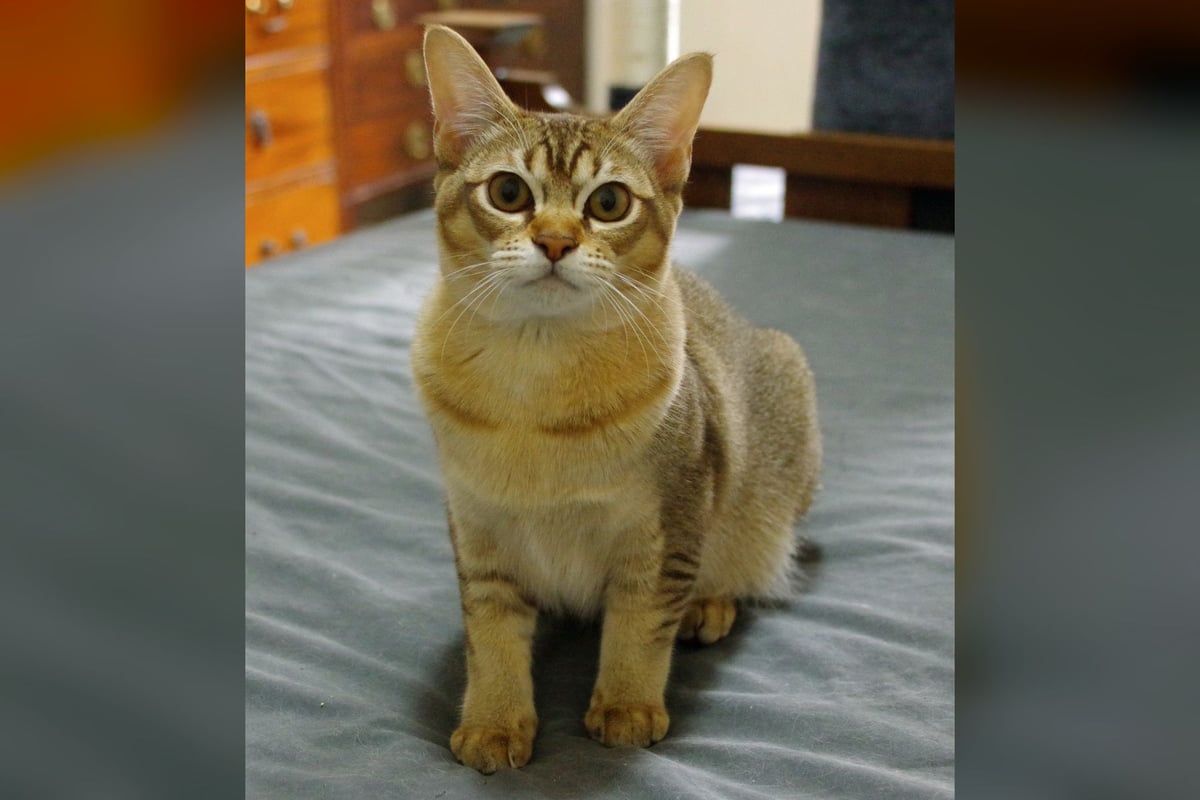
Asian
The Asian (Asian UK group) is a family of shorthair breeds developed in the United Kingdom starting in the 1980s, derived from the founding Burmese × Chinchilla Persian cross that also gave rise to the Burmilla. This profile covers the Asian Self (solid coat), Asian Tabby, Asian Smoke and Asian Shaded variants — all sharing the semi-foreign Burmese morphology and recognizable by the same natural black eyeliner around the eyes. Rare outside the United Kingdom, the breed is registered with LOOF under the name Asian et Burmilla.
- Weight
- 3 to 6kg
- Height
- 22 to 30cm
- Life expectancy
- 15years
- Monthly cost
- 55 to 105€
Personality profile
Energy 3/5
Independence 2/5
Trainability 3/5
Good with children 4/5
Talkativeness 3/5
Space needed 3/5
Attachment to home 4/5
Good with strangers 3/5
Good with cats 4/5
Good with dogs 3/5
Coat care 2/5
Exercise needs 3/5
Scores given on measured axes, data confidence: medium.
Living with an Asian
Description
The group shares with the Burmilla and the Tiffanie the same founding body structure: a medium-sized, semi-foreign-type body, more elongated than the cobby American Burmese without reaching the angularity of the Siamese. The musculature is firm and dense — the cat feels heavier than it looks when picked up. The head is moderately rounded, with a slightly domed forehead, well-placed cheekbones and a short muzzle with a subtle stop. The ears are medium to large, tilted slightly forward, which gives the profile its characteristic expressiveness. The eyes are one of the Asian group's defining markers: large, slightly oblique almond shape, rimmed with a natural black eyeliner — the same "eyeliner" that also outlines the nose and defines the lips. Eye color ranges from golden-yellow to green depending on the coat. The coat is short, close-lying and satiny, without a dense undercoat: it lies naturally against the body, accentuating the muscle lines. It is precisely in the coat that the four Asian group variants are distinguished from one another. The Asian Self has a solid coat in one of the Burmese colors (black, blue, chocolate, lilac, red, cream, and their tortoiseshell variations) — with no markings and no silver effect. The Asian Tabby comes in the four classic tabby patterns (mackerel, classic, spotted, ticked) on an agouti background, in the same colors as the Self. The Asian Smoke shows a coat in which the white undercoat contrasts with a strongly pigmented top coat, creating a smoky effect visible when the cat moves. The Asian Shaded shows intermediate pigmentation at the tips of the top coat (colored top third), similar to the Burmilla Shaded but in non-silver colors. Males generally weigh 4 to 6 kg, females 3 to 4.5 kg.

Temperament
The Asian's temperament is inherited directly from the Burmese, its founding ancestor: sociable, attentive to its owner, attached to domestic life, with an assertive presence without being intrusive. Curious and observant, it follows household activities with interest, gets involved in daily tasks and shows genuine affection — physical contact, sharing the couch, following you around. It is calmer than the pure Burmese but keeps its taste for human interaction. Its vocal level stays moderate: it communicates without Siamese-level intensity, preferring soft, contextual vocalizations. Its sociability extends to children — it handles being handled well provided interactions stay respectful — and to other cats in the household. Cross-species cohabitation is helped by its Burmese heritage, known for its tolerance toward other cats and, to a lesser extent, dogs. Prolonged solitude remains its weak point: this cat is made to live in connection with a person or a regular animal presence.
Training
An attentive, curious cat, it observes and memorizes household routines with an efficiency inherited from the Burmese. Its motivation for human interaction makes simple learning easy: answering to its name, accepting the carrier, using a designated scratching post. Clicker training in short sessions of 5 to 8 minutes, with positive reinforcement through treats and physical contact, gives good results. Harness walking is possible if socialization starts at a young age. The breed does not chase performance: it enjoys the mental stimulation these exercises provide more than the technique itself. Consistency and gentleness are the two effective levers — any physical restraint is counterproductive with this balanced temperament.

Feeding
Medium build, moderate activity: a premium diet rich in animal protein (minimum 35%) is suitable, with no need for a breed-specific formula. Two split meals a day are preferable to free feeding, especially after neutering, when energy needs drop without appetite dropping proportionally. For a 4 to 5 kg adult, plan on roughly 200 to 240 kcal a day depending on actual activity. Including a wet portion in the ration supports hydration — an important point in preventing kidney conditions linked to the PKD1 risk. Taurine should sit high in the ingredient list for cardiac support. Watch the weight from age 2 and adjust portions to individual build.
Affiliate links, no extra cost to you. Legal notice

Living conditions
An indoor breed, it adapts well to apartment living, even in a limited space, provided environmental enrichment is present: high perches, scratching posts, rotating toys, and regular interactive play sessions. Its moderate energy level — inherited from the Burmese without its maximum intensity — needs about ten minutes of play morning and evening to maintain physical and mental balance. Access to secure outdoor space (netted balcony, enclosed garden) is appreciated but not essential. Its short coat and reduced undercoat make it sensitive to cold environments: a heated interior is required in winter. The breed's trusting, unwary nature clearly argues for exclusively indoor living in an urban setting. Adopting in pairs is often recommended for households with low daytime human presence.

Grooming and coat care
The short, satiny coat is one of the least demanding among shorthair cats. Weekly brushing with a rubber grooming glove or a soft chamois cloth is enough to remove dead hair and maintain the coat's natural shine. The texture of the top coat — more or less pigmented depending on the Self, Tabby, Smoke or Shaded variant — needs a light touch: stiff metal brushes should be avoided on Smoke and Shaded coats so as not to degrade the contrast effect. Shedding is discreet but present in spring and fall — switch to two brushings a week during these periods. The ears should be checked twice a month (wax buildup). The eyes deserve a regular pass with a damp cotton pad to prevent buildup in the inner corners — the natural black eyeliner makes secretion traces more visible. Weekly dental care and claw trimming every two to three weeks.

Health
Two serious genetic predispositions, inherited from the founding breeds, should be known before buying. Autosomal dominant polycystic kidney disease (PKD1) is the most critical concern: passed down through the Chinchilla Persian line introduced in the founding 1981 cross, this PKD1 gene mutation causes the progressive formation of kidney cysts that can develop into chronic kidney failure. Since the mutation is autosomal dominant, a single carrier parent is enough to pass the risk on to 50% of the kittens. The PKD1 DNA test is MANDATORY on both breeding cats — demand the written certificates before any purchase. A breeder who cannot produce these documents should be avoided. Hypertrophic cardiomyopathy (HCM) is the second documented risk, inherited from the Burmese parent breed: thickening of the heart muscle can remain asymptomatic for years before causing heart failure or a thrombus. Echocardiographic screening of breeding cats is recommended, along with a cardiac checkup every two years for adult companion cats from age 4. The gene pool remains narrow, particularly outside the United Kingdom, where active breeding programs are concentrated: this narrowness obliges serious breeders to maintain rigorous selection to avoid the accumulation of recessive abnormalities. Aside from these hereditary predispositions, the breed is generally robust, with no specific orthopedic condition documented. Annual veterinary checkup including a cardiac exam from age 4. Life expectancy: 14 to 17 years.
Breed history
The Asian group originates from the same founding event as the Burmilla: on September 11, 1981, in the British cattery of Baroness Miranda von Kirchberg, a male lilac Burmese — Bambino Lilac Fabergé — accidentally mated with a female Chinchilla Persian, Jamari Sanquist. The four female kittens born displayed an unexpected shaded silver coat that would become the basis of the Burmilla. However, the breeding programs run from these founders quickly produced a diversity of coats that went beyond the single silver pattern: cats with solid, smoke, tabby and shaded coats appeared in subsequent generations. Rather than discarding these variations, British breeders — under the auspices of the GCCF — decided to organize them into distinct variants within a common group named the Asian Group. This group thus brings together the Asian Self (solid coat), the Asian Tabby, the Asian Smoke, the Asian Shaded, the Burmilla (silver tipped or shaded, a distinct variant within the group) and the Tiffanie (the semi-longhair version of all the variants). The GCCF formalized the standards for the various Asian variants in the 1980s-1990s. LOOF registers the whole group under the name Asian et Burmilla. Spread outside the United Kingdom remains limited: the group today is mainly found in Britain, with a few active breeding programs in continental Europe, and remains uncommon in France compared with other semi-foreign breeds.
Getting ready for your Asian
Four essentials to line up before day one.
Affiliate links, no extra cost to you. Legal notice
FAQ: Asian
Sources
- Wikipedia EN — Asian (cat) · Asian Group UK: Asian Self, Asian Tabby, Asian Smoke, Asian Shaded, Burmilla, Tiffanie. Origin 1981, cross of a lilac Burmese × Chinchilla Persian, Baroness von Kirchberg. GCCF recognition. Semi-foreign morphology inherited from the Burmese. Black eyeliner on eyes/nose/lips. PKD1, HCM risks.
- Wikipedia FR — Burmilla · Asian UK group: historical background, founding 1981 cross, LOOF designation "Asian et Burmilla." Group variants listed: Self, Tabby, Smoke, Shaded, Tiffanie.
- LOOF — Recognized cat breeds · The Asian is registered with LOOF under the name "Asian et Burmilla" among the officially recognized breeds.

