


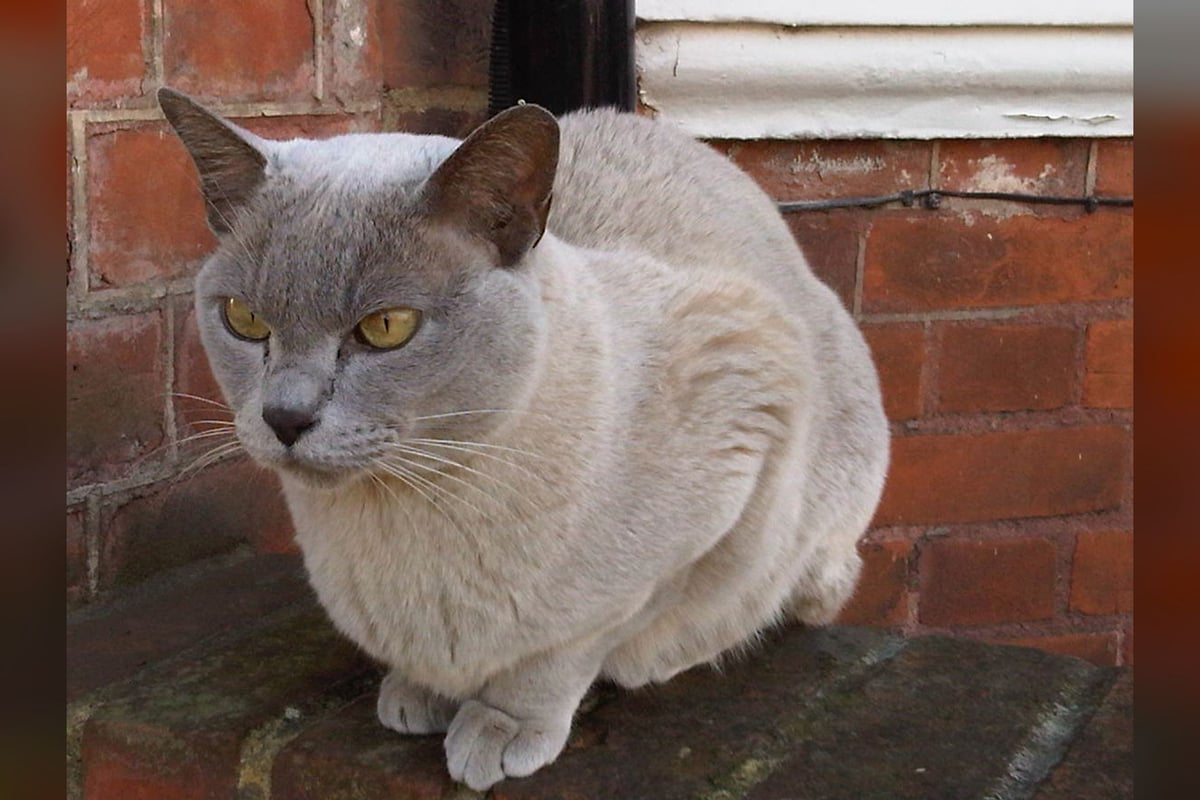
European Burmese
The European Burmese is a cat with a muscular semi-foreign body, descended from British and German lines developed from the 1950s onward. Its build is less extreme than the American Burmese's: a moderate V-shaped head, a muzzle that is not flattened, and amber almond eyes. Its silky sable-brown coat can also come in blue, chocolate or lilac.
- Weight
- 3.5 to 6.5kg
- Height
- 25 to 30cm
- Life expectancy
- 15years
- Monthly cost
- 40 to 80€
Personality profile
Energy 4/5
Independence 2/5
Trainability 4/5
Good with children 4/5
Talkativeness 4/5
Space needed 2/5
Attachment to home 5/5
Good with strangers 3/5
Good with cats 4/5
Good with dogs 3/5
Coat care 2/5
Exercise needs 3/5
Scores given on measured axes, data confidence: medium.
Living with a European Burmese
Description
Recognized by the FIFe in the 1950s and by the LOOF in the 1990s, the European Burmese sits at an intermediate build between the svelte Siamese and the stocky British Shorthair. Its body is compact but not cobby: dense muscle, heavy bone for its size, a short satin coat that shines in the light. The head, a moderate wedge, has high cheekbones and a clear but non-brachycephalic stop, which clearly sets it apart from its American cousin. The eyes, always gold to amber, are slightly almond-shaped rather than round. The original sable coat is the reference standard, but European committees recognize ten in total, including blue, chocolate, lilac, cream and the tortie variants.

Temperament
The European Burmese is a sociable, vocal cat that does not hesitate to express its needs through repeated vocalizing, though less shrill than the Siamese's. Playful and curious well into old age, it actively seeks out human presence and copes poorly with prolonged isolation. Its strong emotional dependency makes it poorly suited to households where it would stay alone for several hours a day with no stimulation or feline companion.
Training
Sharp and responsive, it quickly picks up clicker-training exercises and can master simple behaviors (sitting, coming when called, a simple trick) in a few short sessions. Its social motivation — the relational reward matters as much as the treat — makes positive-reinforcement work easier. Sessions should stay brief (5 to 10 minutes) to hold its attention without overloading it.

Feeding
A quality complete diet, matched to life stage (kitten food up to 12 months, then adult food), covers its needs. This cat tends to overeat if the bowl is left out for free feeding; rationing into two daily meals prevents obesity. If there is a family history of hypokalemia, a low-potassium diet is not indicated without a vet's prescription, since the disease is genetic in origin, not nutritional.
Affiliate links, no extra cost to you. Legal notice

Living conditions
This cat gets along well with apartment life provided it is enriched with height (cat trees, shelves) and interactive toys. Its short coat and thin undercoat make it sensitive to cold: a heated home and sleeping spots away from drafts are recommended in winter. The presence of a second cat or an adult at home during the day significantly reduces the risk of stress from solitude. Households with young children suit it well, provided interactions are supervised.

Grooming and coat care
Coat care is minimal: a weekly pass with a soft brush or a chamois cloth is enough to keep the natural shine of the short satin coat. It is among the low-shedding breeds, which significantly limits hair on furniture. Routine hygiene care — ear cleaning, monthly claw trimming and regular tooth brushing — rounds out the routine without excessive demands.

Health
The European Burmese shares two major hereditary risks with the American Burmese: Burmese hypokalemia (BHK), caused by a recessive autosomal mutation of the KCNJ10 gene that causes episodic muscle weakness, and congenital craniosynostosis, a malformation of the cranial sutures documented mainly in contemporary American lines and almost absent in European lines. DNA screening of breeding cats for the KCNJ10 mutation is recommended before any breeding program. Average life expectancy is between 14 and 16 years in the absence of hereditary disease.
Breed history
The European type of the Burmese arose from the cat Wong Mau, imported from Burma to the United States in the 1930s, whose descendants were exported to the United Kingdom in the late 1940s. British breeders, then German ones, opted for a morphological standard less extreme than the one developed on the American East Coast, favoring a longer head and a profile with no facial flattening. The FIFe recorded the European Burmese standard in the 1950s; the LOOF granted it recognition in the 1990s, consolidating a distinct line that remains today the reference type in most European countries.
Getting ready for your European Burmese
Four essentials to line up before day one.
Affiliate links, no extra cost to you. Legal notice
FAQ: European Burmese
Sources
- FIFé Standard — European Burmese (Group 3) · Fédération Internationale Féline. Breed standard: European Burmese. FIFé, 2023.
- LOOF — Livre Officiel des Origines Félines, European Burmese breed profile · Livre Officiel des Origines Félines. Descriptive profile: European Burmese. LOOF, accessed 2026.
- Gandolfi B. et al. — KCNJ10 mutation causes hereditary hypokalaemia of Burmese cats (PLOS Genetics, 2012) · Gandolfi B., Grahn R.A., Creighton E.K. et al. KCNJ10 mutation causes hereditary hypokalaemia of Burmese cats. PLOS Genetics, 2012.
- Malik R. et al. — Hereditary myopathy of Devon Rex and related breeds including Burmese (J Small Anim Pract, 1993) · Malik R., Mepstead K., Yang F. et al. Hereditary myopathy of Devon Rex cats. Journal of Small Animal Practice, 1993; 34: 539–546.
Breeds similar to a European Burmese

