


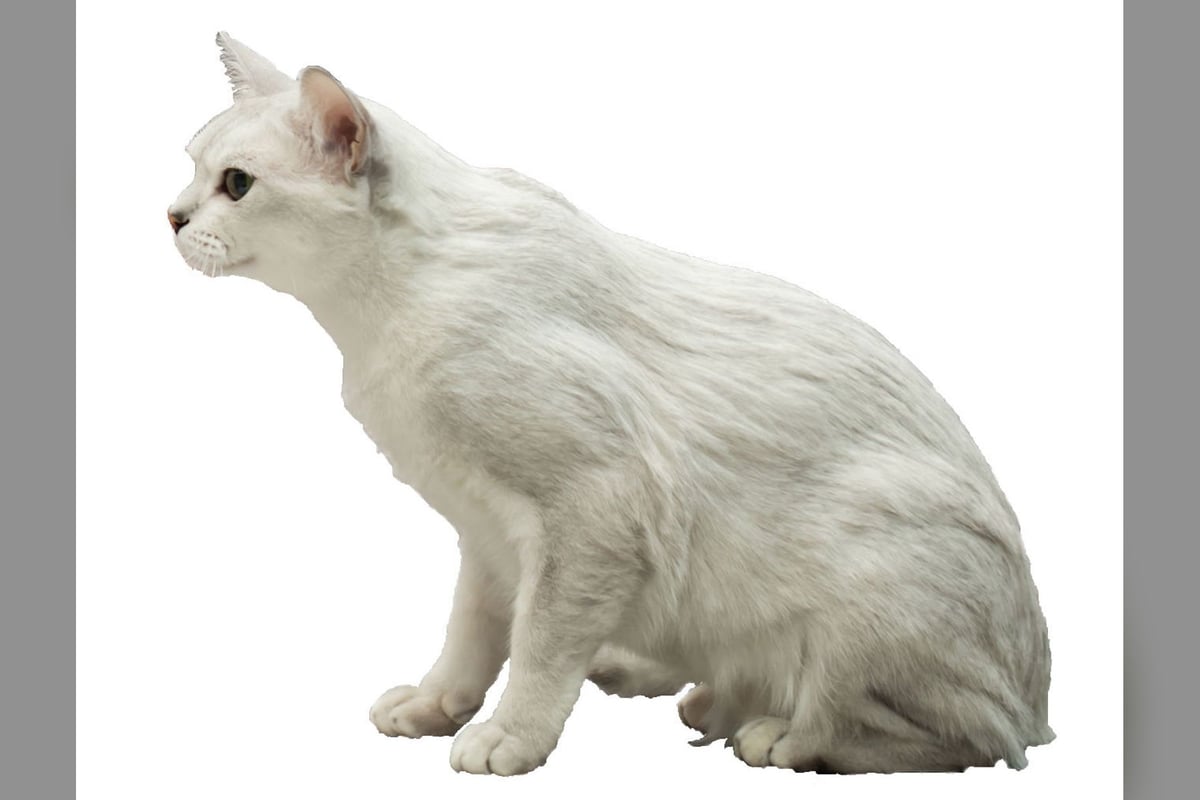
Burmilla
The Burmilla was born in 1981 in England from an accidental cross between a lilac Burmese and a Chinchilla Persian. Its silver or golden coat with shaded tips, its large green eyes rimmed with a natural black outline, and its muscular semi-foreign body make it an immediately recognizable breed. Moderately common in France — more widespread in the United Kingdom — it is registered with the LOOF under the Asian and Burmilla category.
- Weight
- 3 to 6kg
- Height
- 22 to 30cm
- Life expectancy
- 15years
- Monthly cost
- 60 to 110€
Personality profile
Energy 3/5
Independence 2/5
Trainability 3/5
Good with children 4/5
Talkativeness 3/5
Space needed 3/5
Attachment to home 4/5
Good with strangers 3/5
Good with cats 4/5
Good with dogs 3/5
Coat care 2/5
Exercise needs 3/5
Scores given on measured axes, data confidence: medium.
Living with a Burmilla
Description
The body is medium-sized, of the semi-foreign type: more elongated and slender than the cobby American Burmese, less angular than the Siamese. The musculature is firm, its weight more substantial than it looks. The head is moderately rounded, with a slightly domed forehead, high cheekbones and a short muzzle with a discreet stop — neither flattened like the Persian's nor tapered like the Siamese's. The ears are medium to large, tilted slightly forward. The eyes are one of the breed's signatures: large, slightly oblique almond shape, an intense green that deepens with maturity (kittens can have yellow or bluish eyes), rimmed with a natural black outline — as if traced with kohl — that also runs around the nose and lips. This "makeup" is a formal feature of the GCCF standard. The coat is short and satiny, with a white-to-cream undercoat and a guard-hair layer whose tips carry the color: this is the tipped, shaded or shell pattern, depending on how much of the hair carries color. Admitted tipping colors include black, blue, brown, chocolate, lilac, as well as the tortoiseshell variants. Males generally weigh 4 to 6 kg, females 3 to 5 kg. A semi-longhair variant exists, recognized under the name Tiffanie within the Asian group. Life expectancy: 14 to 17 years.

Temperament
The breed's character sits between its two founding parents: more composed and less dependent than the Burmese, livelier and more playful than the Persian. It stays active and curious well into adulthood — interactive play sessions genuinely interest it — without the overflowing energy that characterizes the Burmese. Its sociability is real: it bonds with its owners, follows their movements, and enjoys physical closeness without being as demanding as its Burmese parent. Vocal expressions exist — it communicates readily — but stay moderate, far from the Siamese register. With children, its tolerant temperament and patience under handling make it compatible with families, provided interactions stay respectful. It generally cohabits well with other cats, particularly breeds of a similar profile. Prolonged daily solitude is not its strong point: a household with regular human presence or a second cat suits it better than a consistently empty apartment.
Training
Curious and attentive, it observes and memorizes household routines efficiently. Its Burmese component gives it a motivation for human interaction that eases simple learning: answering to its name, accepting a harness for supervised outings, using a designated scratching post. Clicker training in short sessions (5-8 minutes) gives good results with positive reinforcement through treats and contact. It does not chase performance but enjoys the mental stimulation these exercises provide. Leash walking is possible if harness socialization starts at a young age. No physical restraint — its balanced temperament responds well to consistency and gentleness.

Feeding
This medium-framed cat has moderate activity. A premium diet rich in animal protein (minimum 35%) suits it well, with no need for a specific formula. Two split meals a day are preferable to free feeding: the breed tends to maintain a stable weight, but neutering reduces energy needs without reducing appetite. For a 4-5 kg adult, plan on about 200-240 kcal/day depending on actual activity. A partial wet-food ration promotes hydration — important in preventing kidney conditions linked to the PKD risk. Taurine should rank prominently in the formula to support the heart. Monitor weight from age 2.
Affiliate links, no extra cost to you. Legal notice

Living conditions
It lives well in an apartment, even in modest square footage, provided the environment is enriched. Its moderately active nature calls for perches, scratching posts and regular play sessions — about ten minutes morning and evening are enough to maintain its balance. Access to secure outdoor space (enclosed garden, netted balcony) is appreciated but not essential. Its short coat with no thick undercoat makes it more sensitive to cold than northern breeds: a heated indoor space in winter is required. Indoor life is recommended, especially in urban settings, given its trusting temperament, which makes it not very wary of outdoor risks. Feline cohabitation is often positive — it belongs to the Asian group, which brings together breeds known for getting along well with other cats.

Grooming and coat care
The short, satiny coat is easy to maintain. A weekly brushing with a rubber grooming glove or a soft chamois is enough to remove dead hair and maintain the coat's natural shine. The tipped or shaded texture of the guard-hair layer is delicate: avoid overly aggressive brushes that flatten the relief of the colored tips. Shedding is not very intense but occurs in spring and fall — switching to two brushings a week during those periods limits deposits on fabrics. A bath is rarely necessary, except for shows or a mishap. Check the ears twice a month (wax buildup) and the eyes regularly — the natural black outline is an aesthetic asset, but eye discharge can accumulate in the inner corners. Weekly dental care is recommended. Trim the claws every two to three weeks.

Health
The breed inherits two serious genetic predispositions from its parent lines, which every buyer should know before acquisition. Autosomal dominant polycystic kidney disease (PKD1) is the most critical: transmitted by the Chinchilla Persian parent, this mutation of the PKD1 gene causes the formation of progressive kidney cysts that can lead to chronic kidney failure. The mutation is autosomal dominant: a single carrier parent is enough to pass the risk on to 50% of kittens. The PKD1 DNA test is MANDATORY on both breeding cats — require written results before any purchase. A breeder unable to provide these tests should be avoided without hesitation. Hypertrophic cardiomyopathy (HCM) is the other documented risk, inherited from the Burmese parent: the thickening of the heart muscle can remain asymptomatic for years before causing heart failure or a thrombus. Annual echocardiographic screening of the breeding cats, and every two years for adult companion cats from age 4, is recommended. The breed is young — the first structured breeding programs date from the 1980s — and the gene pool remains limited, particularly outside the United Kingdom. This narrow pool obliges serious breeders to maintain rigorous selection protocols to avoid the buildup of recessive abnormalities. Aside from these hereditary predispositions, it is an overall robust breed. An annual veterinary check-up including cardiac auscultation is recommended from age 4.
Breed history
The Burmilla was born on September 11, 1981, in the British cattery of the Baroness Miranda von Kirchberg. A domestic mishap — a door left open — allowed a lilac male Burmese named Bambino Lilac Fabergé to mate with a female Chinchilla Persian called Jamari Sanquist. Four kittens were born, all female, sporting an unexpected shaded silver coat that immediately captivated the breeder. Rather than treat the litter as an anomaly, she decided to structure a breeding program to fix these traits. The standard was formalized in 1984; the breed gained championship status with the GCCF (Governing Council of the Cat Fancy) in the 1990s. The FIFe recognized it in 1994. The CFA and TICA grant it provisional or championship recognition. In France, the LOOF registers the breed under the name Asian and Burmilla. The breed belongs to the GCCF's Asian group — a Burmese-derived family that includes the Asian Self (solid coat, no silvery highlights), the Asian Tabby, the Asian Smoke, and the Tiffanie. Its popularity remains modest in France — the breed ranks around 31st out of 72 breeds recorded with the LOOF — but it is considerably more present in the United Kingdom, its country of origin, where active breeding programs maintain rigorous selection.
Getting ready for your Burmilla
Four essentials to line up before day one.
Affiliate links, no extra cost to you. Legal notice
FAQ: Burmilla
Sources
- Wikipedia FR — Burmilla · Origin 1981, von Kirchberg, UK, accidental cross of lilac Burmese × Chinchilla Persian. Recognition: GCCF 1989 (standard 1984), FIFé 1994. LOOF rank: 31st/72. Tipped/shaded pattern, multiple colors.
- Wikipedia EN — Burmilla · Cross of Bambino Lilac Fabergé × Jamari Sanquist, September 11, 1981. Standard formalized 1984, GCCF championship in the 1990s. Asian Group: Asian Self, Tabby, Smoke, Tiffanie. Weight 3-6 kg. Black eyeliner around eyes, nose, lips. Large green eyes.
- LOOF — Recognized cat breeds · The Burmilla is listed under the name "Asian and Burmilla" among the breeds officially recognized by the LOOF.

