


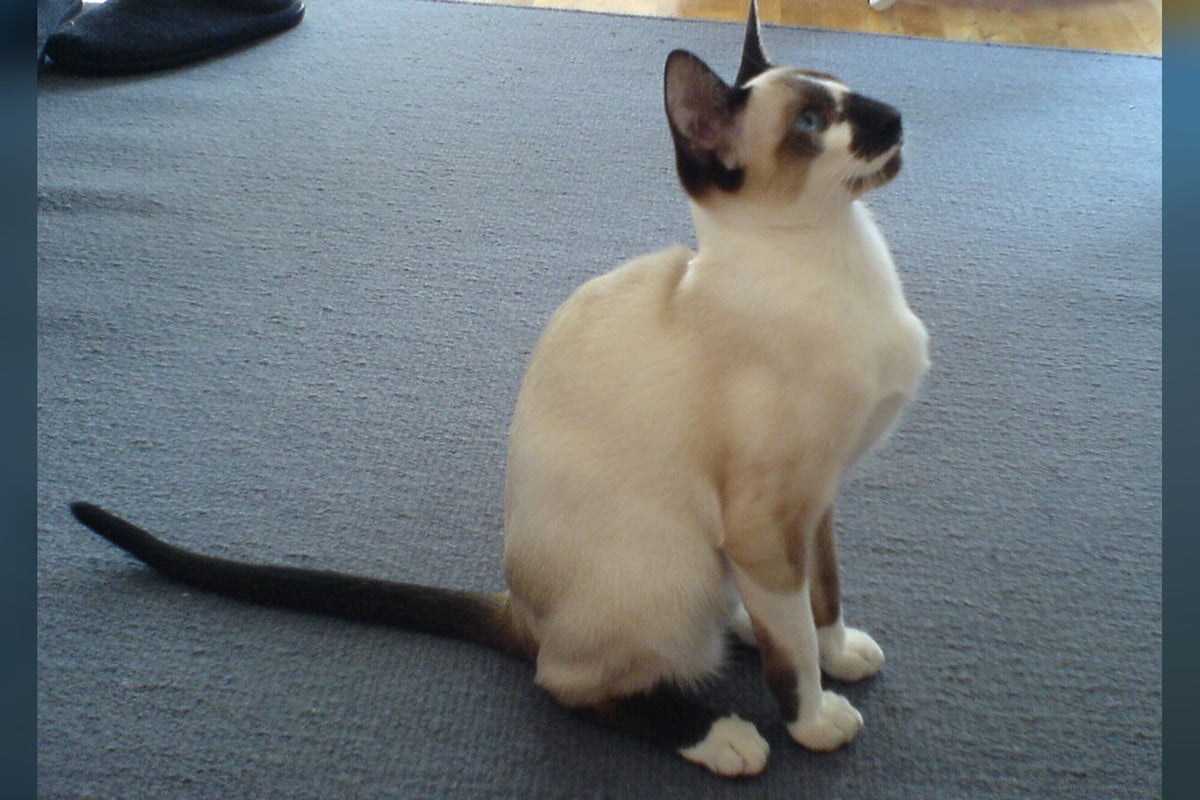
Seychellois
The Seychellois is one of the rarest recognized cat breeds in the world: born in the United Kingdom in the 1980s to recreate the bicolor and tricolor cats seen on Mahé Island in the Seychelles, it combines the slender build and intense temperament of the Oriental Shorthair with a fragmented colorpoint coat — dominant white scattered with color at the extremities and on the body. Three varieties define the breed according to the proportion of white: Ninth (little white), Eighth (dominant white, a few colored patches) and Seventh (almost entirely white). Its rarity is extreme: worldwide numbers are counted in dozens of breeding cats. For Oriental enthusiasts looking for something even more exclusive, it is a rare encounter with the living history of a feline reconstruction project.
- Weight
- 3 to 5kg
- Height
- 25 to 30cm
- Life expectancy
- 14years
- Monthly cost
- 70 to 120€
Personality profile
Energy 5/5
Independence 1/5
Trainability 4/5
Good with children 4/5
Talkativeness 5/5
Space needed 3/5
Attachment to home 5/5
Good with strangers 3/5
Good with cats 4/5
Good with dogs 3/5
Coat care 1/5
Exercise needs 4/5
Scores given on measured axes, data confidence: medium.
Living with a Seychellois
Description
The build is directly modeled on that of the Oriental Shorthair: a long, tubular body, a triangular wedge-shaped head with a long straight nose, large widely-set ears whose base aligns with the sides of the facial triangle, a long graceful neck, and a fine tail tapering from base to tip. The legs are long and slender, the paws oval. Everything is angular, elongated, slender — the opposite of round or cobby types. The coat is short, fine, glossy and lying close to the body. The coat is the breed's distinguishing feature: it is a bicolor or tricolor pattern on a colorpoint base. A white base is mandatory; the colored patches are carried in colorpoint (points at the extremities — ears, mask, legs, tail) and can also extend over the back and flanks depending on the degree of pigmentation. Recognized colors include seal, blue, chocolate, lilac, cinnamon and fawn, in solid or tabby-point variants. The eyes are blue, a vivid blue characteristic of Siamese genetic backgrounds. The classification into three degrees — Seventh (maximum white), Eighth (intermediate proportion) and Ninth (minimum white) — follows the nomenclature derived from piebald spotting, identical to that of the Van and Bicolor patterns in international nomenclature. Males: 3.5 to 5 kg. Females: 3 to 4.5 kg. Estimated life expectancy between 12 and 15 years.

Temperament
The Oriental Shorthair's temperament is inherited here in full, without attenuation. It is a hyper-affectionate, hyperactive and hyper-vocal cat that constantly seeks contact with its human and cannot bear indifference. It follows its owner from room to room, comments on every action with a powerful, insistent voice borrowed from the Siamese genetic background, and demands intense play sessions several times a day. Its intelligence is sharp: it observes, memorizes household routines and quickly tests the limits set for it. Novelty — an unfamiliar visitor, a move, a change in furniture — can trigger a noisy vocal adjustment phase before its natural curiosity takes over. With children, it is playful and tolerant provided the interaction respects its high energy level; roughness or forced handling triggers a quick withdrawal rather than an aggressive reaction. Prolonged solitude — more than four to five hours in a daily routine — is its greatest vulnerability: it generates anxiety, excessive vocalization on return, or stereotyped behaviors. Adopting in a pair with a companion of similar temperament (Oriental, Siamese, Balinese) is strongly advised for households with long absences.
Training
Clicker training produces excellent results here. Its intelligence inherited from the Oriental line, its sensitivity to positive rewards and its thirst for human interaction make it a nimble learner: it can learn to come to its name, give a paw, sit on command, fetch a light object or navigate a mini obstacle course. Clicker sessions are also an excellent anti-boredom tool — ten minutes of mental work is as stimulating as thirty minutes of intense physical play. Sessions should stay short (five to ten minutes maximum) and highly varied to keep this cat engaged, as it quickly tires of mechanical repetition. Positive reinforcement — treats, a soft voice, play — is the only effective method: any physical restraint or punishment triggers an immediate withdrawal of cooperation and can durably damage the relationship of trust. Accustoming it from a young age to travel, veterinary care and dental brushing through short, rewarded sessions considerably eases its handling as an adult. Its need for intense exercise is high: plan at least two long active play sessions a day (15-20 minutes each) to channel its overflowing energy.

Feeding
Very active, it burns through calories quickly despite an apparently light build. The ration must be matched to a high activity level: premium kibble rich in animal protein (minimum 35–40%) with a good taurine content, a nutrient critical for heart and retinal health — particularly relevant given the predispositions of the Oriental genetic background. Two split meals a day are better than free feeding for regulating appetite and detecting early any drop in appetite signaling a health issue. Adding wet food alongside kibble supports adequate hydration and reduces long-term kidney strain — worth taking seriously given the amyloidosis predisposition. It sometimes asks for food out of a bid for attention as much as real hunger: learning to tell the two apart prevents overfeeding and weight gain that would throw off its slender build. Kittens need a calorie-dense diet up to 12 months to support their growth.
Affiliate links, no extra cost to you. Legal notice

Living conditions
Despite a slender silhouette that suggests delicacy, this is an athlete that demands as much vertical space as horizontal. A well-equipped apartment — ceiling-high cat trees, wall shelves, tunnels, rotating interactive toys — suits it perfectly, provided the stimulation is there. Thirty to forty minutes of daily interactive play is a non-negotiable minimum: wand toys, throw toys, clicker training sessions. Its low body fat and very short coat make it sensitive to low temperatures; an indoor temperature kept above 18–19 °C and accessible heat sources (radiator, heated blanket) are a prerequisite in winter. Outdoor access is not a necessity but a bonus — a netted secure balcony is enough to enrich its environment. The ideal setup remains a home with extended human presence or a pair of active cats; left alone in an empty home all day, the animal suffers.

Grooming and coat care
Maintenance is minimal. The short, fine coat, lying close to the body, sheds little and never mats. A weekly pass with a rubber grooming glove or a chamois mitt is enough to remove dead hair and maintain the coat's natural shine — an operation the cat generally enjoys as a contact and attention session. Bathing is rarely necessary and can be done occasionally if the cat has been accustomed to it from a young age. The large ears, an Oriental legacy, deserve monthly attention: their inner surface easily accumulates earwax and should be cleaned with a suitable ear solution. The top-priority maintenance point remains dental: weekly brushing at minimum, daily if accepted, to prevent the gingivitis and FORL to which the Siamese genetic background predisposes. Trimming the claws every three to four weeks completes the routine.

Health
All the predispositions documented in the Oriental Shorthair and the Siamese, its direct genetic parents, apply here. Feline amyloidosis is the most serious silent threat: abnormal amyloid protein deposits accumulate in the liver, kidneys or pancreas, potentially leading to organ failure in adulthood or as a senior. No standardized commercial DNA test is available for this condition; annual liver and kidney blood panels from age 5–6 are the main surveillance tool. Progressive retinal atrophy (PRA) is documented in Siamese-Oriental lines and partially detectable by genetic test — check results with the breeder before adoption. Dental problems — gingivitis, resorptive lesions (FORL) — are common in this genetic background; regular dental brushing from a young age significantly reduces the risk. Feline asthma affects oriental breeds more often than average: any episode of repeated dry coughing or wheezing deserves a prompt consultation. The breed's rarity implies a narrow genetic base — the risk of inbreeding is real in small-scale breeding programs. Always inform the veterinarian of the breed before any general anesthesia: anesthetic agent metabolism differs in orientals.
Breed history
It all starts with a genetic reconstruction project carried out in the United Kingdom in the 1980s under the aegis of the GCCF. The initial goal was to recreate a type of cat described by travelers and residents as characteristic of the Seychelles archipelago, and in particular of Mahé Island: bicolor or tricolor cats with a white coat scattered with colored patches, living semi-free in the ports and villages of the archipelago. These cats had never been formally selected; their distinctive coat was the result of natural genetic mixing between feral populations and companion cats imported from various origins. To recreate this type, British breeders crossed bicolor Persians — to bring pigmentation and the piebald (dominant white) pattern — with Oriental Shorthairs and Balinese to recover the slender build, colored points and colorpoint structure. The program produced cats carrying both the colorpoint gene (which concentrates pigmentation at the extremities) and the piebald gene (which dilutes white into the coat), producing this unique pattern of colored patches on a white background. GCCF recognition was granted and LOOF registered the breed. Despite this official recognition, worldwide numbers have remained extremely low: the breed never reached the critical mass needed to establish itself durably in European breeding circuits. It remains today one of the rarest recognized cat breeds, with a few dozen active breeding cats worldwide, mainly in the United Kingdom and a handful of continental European countries.
Getting ready for your Seychellois
Four essentials to line up before day one.
Affiliate links, no extra cost to you. Legal notice
FAQ: Seychellois
Sources
- Wikipedia FR — Seychellois (cat) · Breed created in the United Kingdom in the 1980s through crosses of bicolor Persian × Oriental Shorthair and Balinese, to recreate the bicolor cats of Mahé Island. Three degrees of white: Seventh, Eighth, Ninth. Oriental build, blue eyes, colorpoint + piebald pattern.
- LOOF — Seychellois Breed Profile · LOOF-recognized breed. Oriental/Siamese genetic background. Bicolor or tricolor colorpoint coat. Three varieties according to proportion of white. Very low numbers in France.
- Wikipedia FR — Oriental (cat) — related breeds · Shared Oriental/Seychellois morphology: wedge-shaped head, tubular body, large widely-set ears, almond-shaped eyes. Shared health predispositions: amyloidosis, PRA, asthma, FORL, anesthetic sensitivity.

