


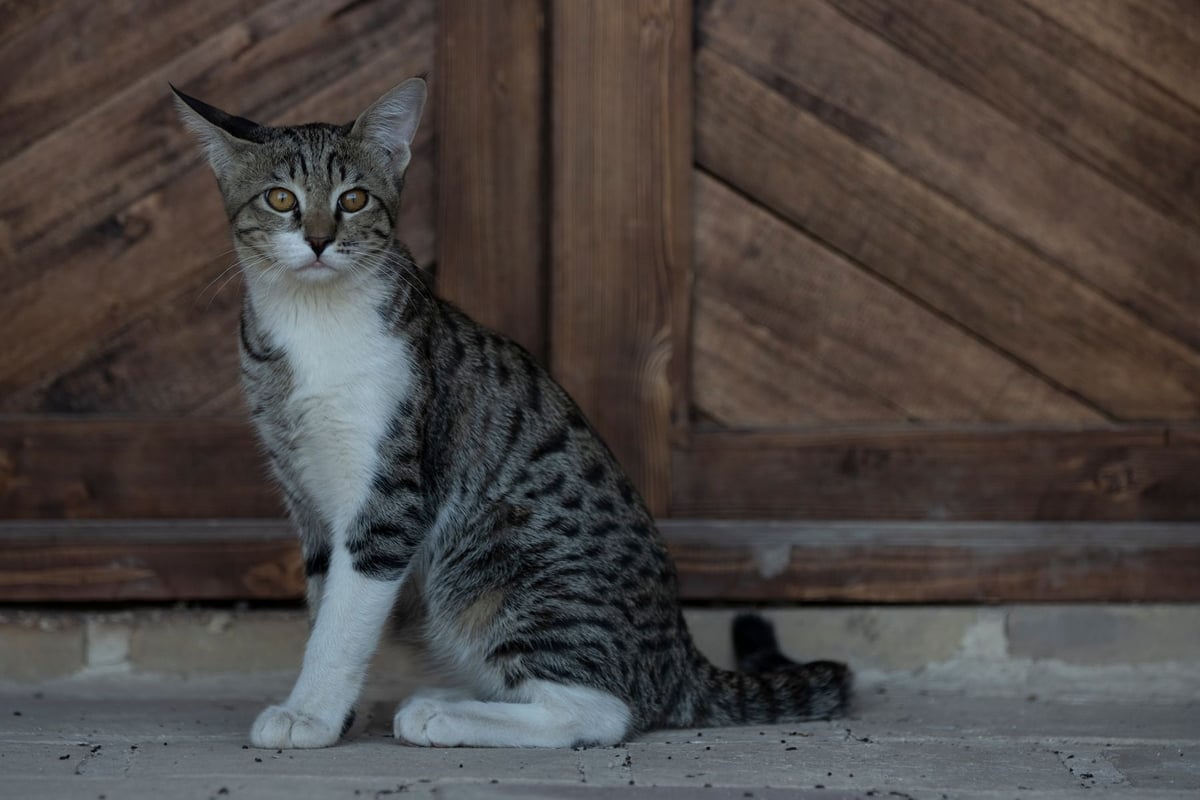
Ocicat
The Ocicat is an entirely domestic breed that visually mimics the wild ocelot without sharing a single gene with it. Born in 1964 from an accidental cross between an Abyssinian and a Siamese in the United States, then refined with the American Shorthair, it combines a spotted tabby coat with round, high-contrast spots with an athletic, sociable and remarkably trainable temperament — often described as a dog in a cat's body.
- Weight
- 2.5 to 7kg
- Height
- 25 to 35cm
- Life expectancy
- 15years
- Monthly cost
- 55 to 100€
Personality profile
Energy 4/5
Independence 3/5
Trainability 5/5
Good with children 5/5
Talkativeness 3/5
Space needed 4/5
Attachment to home 4/5
Good with strangers 4/5
Good with cats 4/5
Good with dogs 4/5
Coat care 1/5
Exercise needs 4/5
Scores given on measured axes, data confidence: high.
Living with an Ocicat
Description
The build is semi-foreign, muscled and well-proportioned, deceptive to the touch: the animal looks light to the eye but proves noticeably heavier when picked up, a sign of dense musculature. The body is long and athletic, the legs strong, the tail medium to long and tapered. The head forms a slightly softened triangle with marked cheekbones and a muzzle with a slight square suggestion — neither as elongated as the Siamese nor as round as the British. The ears are medium-sized, preferably with a tuft at the tip. The eyes are a pronounced oval and can be any color except blue. The breed's absolute signature is its spotted tabby coat: rounded or thumbprint-shaped spots, large, clearly defined, contrasting strongly with a lighter background. The spots are distributed over the flanks, abdomen, limbs and tail in a regular pattern. The coat is short, satiny and close-lying, with no heavy undercoat. Six base colors are recognized by the LOOF: tawny (brown), chocolate, cinnamon, blue, lilac and fawn, each also available in a silver version where the white undercoat intensifies the spots' contrast. Males 4-7 kg, females 2.5-5 kg.

Temperament
Breeders and federations unanimously describe it as "a dog in a cat's body" — and the phrase is not undeserved. It answers to its name, follows its owners from room to room, accepts walking on a harness and leash after gradual training, and can spontaneously fetch toys. Its intelligence is high, and its motivation by play and food rewards makes clicker training particularly effective. Sociability is one of the breed's most marked traits: unlike the Bengal or the Abyssinian, which can be reserved toward strangers, it generally greets visitors with open curiosity. It tolerates children and other animals well, including dogs. Its vocalness is moderate: more discreet than the Siamese, from which it partly descends, it communicates through trills and soft meows. Prolonged solitude does not suit it well — a household away during the day should pair it with a second cat to prevent boredom.
Training
It is probably the most trainable cat breed there is — the maximum trainability score (5/5) reflects a reality documented by breeders and federations. Clicker training gives fast, lasting results: fetching objects, weaving between legs, jumping through a hoop, going through a tunnel, answering to its name, sitting on command, small agility courses. Walking on a harness is not only possible, but is often actively sought out. Sessions are best kept short (5 to 10 minutes) and daily, using positive reinforcement, food rewards or play. No coercion is tolerated; on the other hand, its tolerance for frustration is unusual for a cat: it readily perseveres through a difficult puzzle. Without active training, the breed is left understimulated and looks for ways to occupy itself, sometimes at the expense of the furniture.

Feeding
Energy is sustained, without reaching the extreme level of the Bengal or the Abyssinian: its caloric expenditure is moderate to high. For an active 5 kg adult, plan for 230-300 kcal/day depending on activity level and neuter status. The predisposition to urate urolithiasis points toward food that favors urinary acidification and maximal hydration: alternate premium kibble high in animal protein (≥40%) with quality wet food as a supplement. A water fountain encourages spontaneous hydration. Avoid foods rich in purines (excess organ meat) that favor urate crystal formation. Split into 2-3 meals a day. The breed is not very prone to obesity thanks to its activity level, but watch the weight after neutering.
Affiliate links, no extra cost to you. Legal notice

Living conditions
Apartment life suits it provided there is enough space and regular stimulation. A cramped home is not advisable for a cat with sustained energy (level 4/5): count on at least 60 m², or better a house with a garden, with vertical structures (cat tree ≥ 1.80 m, wall shelves) and 20 to 30 minutes of interactive play a day. Unlike the Bengal, the breed does not necessarily require outdoor access: a well-fitted-out apartment suits it, notably thanks to its less explosive temperament. Harness walking is an enriching option the breed readily takes to. Heat is well tolerated (Abyssinian heritage), cold more moderately. It thrives in active households and continuously seeks human or animal company.

Grooming and coat care
The short, close coat is one of the easiest to maintain in the feline world. A pass with a grooming glove once a week is enough to remove dead hair and maintain the coat's satiny shine. The breed sheds little, with no marked seasonal peak. No regular bathing is necessary. The absence of heavy undercoat limits hair buildup on fabrics — a notable advantage over semi-longhaired breeds. Check the ears and clean if wax accumulates. Teeth should be monitored, particularly in lines inheriting the Abyssinian's gum sensitivity. Trim the claws every 3-4 weeks.

Health
No genetic disease specific to the breed is documented at the same level as in the Bengal (PRA-b, PKDef) or the Abyssinian (rdAc, amyloidosis). Its main documented risk is urate urolithiasis: veterinary studies place the breed at an odds ratio of 16.8 for this type of urinary stone compared with other breeds — a non-negligible risk that justifies an annual blood and urine panel from age 3 and optimal hydration (wet food supplementation, water fountain). The risk of pyometra is also reported as above average in unspayed females — early spaying is recommended. Through hereditary transmission from the parent breeds (Abyssinian, Siamese), a susceptibility to hypertrophic cardiomyopathy (HCM) and progressive retinal atrophy (PRA) is theoretically possible: the CFA recommends screening in breeding cats. Ask a serious breeder for an echocardiogram cardiac assessment of the parents and a health history of the line. Outside of these points, the breed enjoys excellent general robustness, with a long life expectancy of 14 to 18 years depending on the source.
Breed history
It all starts in 1964 in Michigan (United States), with an unplanned cross made by breeder Virginia Daly, who was trying to produce tabby-point Siamese by crossing a male Abyssinian with a seal point Siamese female. The resulting litter included an unexpected male kitten, spotted like an ocelot, named Tonga by Virginia's daughter — hence the name Ocicat, a blend of "ocelot" and "cat". Tonga was neutered and given away as a pet, but the discovery alerted other breeders, who deliberately reproduced the cross. The American Shorthair was later incorporated to bulk up the bone structure and introduce the silver gene absent from the two original parent breeds. The CFA registered the breed as early as 1966 but granted it championship status only in May 1987; TICA and the FIFe recognized the breed in 1986 and 1992 respectively; the British GCCF granted it championship in 2006. In France, the first Ocicats arrived in 1989; the breed remains uncommon within the LOOF despite growing popularity, often mistaken for the Bengal by the general public.
Getting ready for your Ocicat
Four essentials to line up before day one.
Affiliate links, no extra cost to you. Legal notice
FAQ: Ocicat
Sources
- Wikipedia FR — Ocicat · Breed created in 1964 by Virginia Daly (Michigan). Abyssinian × Siamese crosses then American Shorthair. TICA and CFA recognition 1986-1987. First Ocicat in France 1989.
- Wikipedia EN — Ocicat · CFA championship May 1987. 12 recognized colors (6 base + silvers). Urate urolithiasis odds ratio 16.8 vs other breeds. Above-average pyometra rate in females.
- Royal Canin — Ocicat Profile · Life expectancy 15-18 years. Confident, sociable breed, patient with children and other animals. Minimal coat maintenance.
- CFA — Ocicat Breed Profile · CFA standard: medium-to-large, muscled, high-contrast thumb-print-shaped spots. 12 colors in 8 classes. Championship 1987. HCM, amyloidosis and PRA screening recommended in breeding cats.
Breeds similar to an Ocicat

