


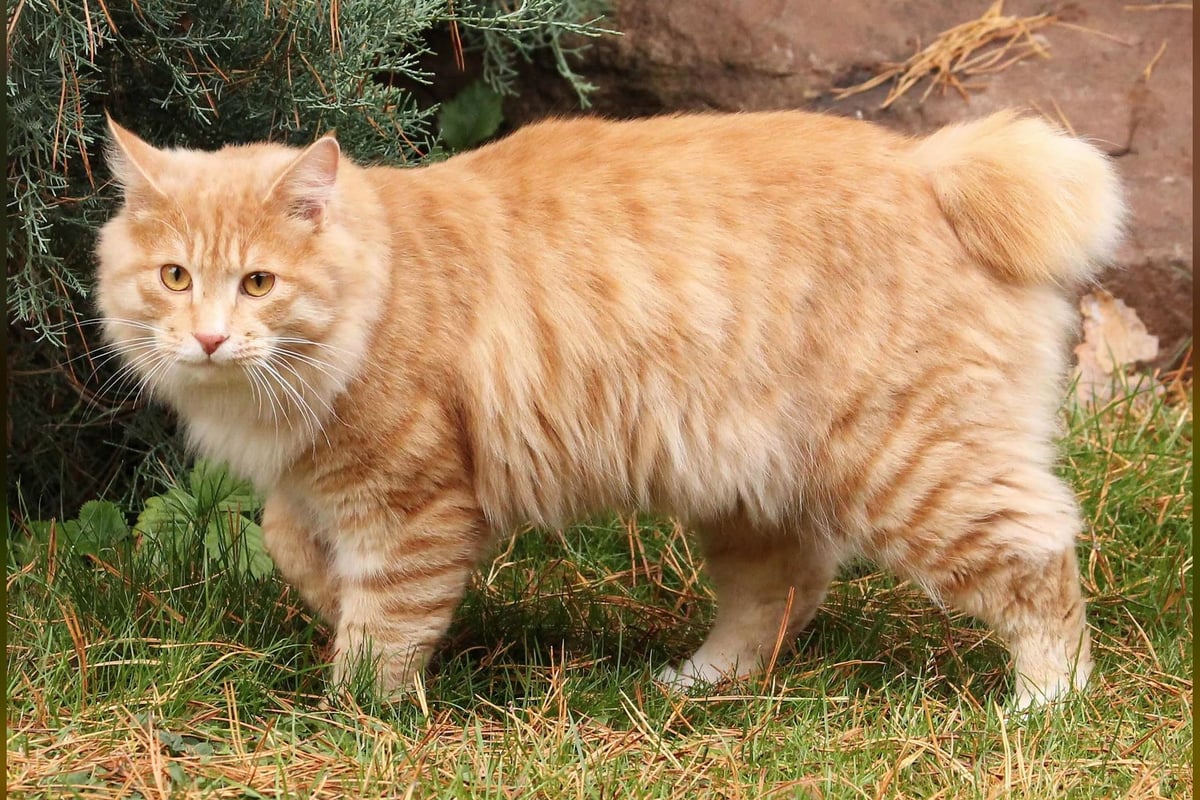
Kurilian Bobtail
The Kurilian Bobtail is a natural breed native to the Kuril Islands, a volcanic archipelago located between Russia's Kamchatka and the Japanese island of Hokkaidō. It stands out for its short, dense pompom tail measuring 3 to 12 cm, the result of an autosomal dominant mutation genetically distinct from the Manx's, the Japanese Bobtail's and the American Bobtail's. A heavily muscled semi-cobby build, a waterproof double arctic coat, and an independent hunter's temperament suited to the outdoors: a rare breed in France, sturdy and hardy, with a life expectancy of 14 to 19 years.
- Weight
- 3 to 7kg
- Height
- 26 to 38cm
- Life expectancy
- 16years
- Monthly cost
- 60 to 110€
Personality profile
Energy 4/5
Independence 4/5
Trainability 3/5
Good with children 4/5
Talkativeness 2/5
Space needed 4/5
Attachment to home 3/5
Good with strangers 3/5
Good with cats 4/5
Good with dogs 3/5
Coat care 3/5
Exercise needs 4/5
Scores given on measured axes, data confidence: medium.
Living with a Kurilian Bobtail
Description
The silhouette is semi-cobby — a compact body, barrel-shaped chest, substantial bone structure — more compact than the Norwegian's or the Maine Coon's but with remarkable musculature. The hind limbs are slightly longer than the front ones, giving the back a slight upward arch toward the rump. The head has a trapezoidal profile with high cheekbones, large round eyes accepting any color, and medium-sized, well-spaced ears. The emblematic feature is the tail: visible over 3 to 12 cm, it forms a dense pompom with vertebrae fused in a spiral or irregular angles, each cat showing a unique configuration. The tail mutation is autosomal dominant and causes no neurological or vertebral disorder — unlike the Manx, whose mutation affects the spine. The coat exists in two varieties officially recognized by FIFe: shorthair (dense short hair with no marked ruff) and longhair (semi-long with a neck ruff and britches on the hind legs, very thick undercoat). In both cases, the outer coat is waterproof and the undercoat dense, direct adaptations to the Kurils' arctic winters. All coats are accepted except colorpoint. Males: 5 to 7 kg; females: 3 to 5 kg. Physical maturity around age 3.

Temperament
Descended from several centuries of semi-wild life on an isolated archipelago, this cat retains a marked hunting instinct: observant, reactive, capable of prolonged focus on a target. It is no less social with its close family — it bonds with its home and owners without demanding constant attention. Its nature is reserved on first meeting, typical of breeds with an independent temperament: it watches strangers before deciding to approach, and this initial reserve fades only with familiarity. Not very vocal, it communicates through discreet trills and purring. Playful well into advanced adulthood, it enjoys structured interactions but knows how to entertain itself. Its cold tolerance and its atypical relationship with water — a legacy of island adaptation, an ability it shares with the Turkish Van — mean it can accept, or even seek out, contact with running water or wet surfaces. It cohabits well with other cats and, with gradual introduction, with dogs.
Training
Intelligent and curious, this cat is receptive to learning through positive reinforcement, even though its native independence makes it less demanding of structured interaction than very socialized breeds. Leash walking is generally well accepted with progressive introduction from kittenhood, allowing long, stimulating walks that channel its need for intense exercise. Light agility sessions, obstacle courses or interactive sport (a long wand toy, motorized mice) match its hunter profile. Clicker training is effective for simple behaviors (coming to its name, returning to the carrier). Sessions should stay short (5 to 10 minutes) and varied to keep a fundamentally independent cat engaged, and its intense physical activity needs must be met daily. Avoid any physical restraint: the breed holds onto negative experiences for a long time.

Feeding
For an active 5 to 7 kg adult, plan on 260 to 340 kcal/day depending on exercise level and season (more in winter for cats with outdoor access in a cold climate). Favor large-breed kibble high in animal protein (≥38%) and taurine for cardiac support. Females at 3 to 5 kg will have lower needs — match the ration to individual build rather than to an average. Split into two meals a day. The breed can gain weight after neutering if physical activity is not maintained: reduce intake by 15% and eliminate free feeding.
Affiliate links, no extra cost to you. Legal notice

Living conditions
A large, active breed with a strong hunting instinct, it thrives in a house with a secure garden or in any space offering access to a large outdoor area. A strict apartment setup is discouraged unless it is spacious (≥70 m²), equipped with substantial vertical structures (cat trees ≥2 m, wall shelves) and complemented by secure outdoor access. Its activity level and daily physical exercise needs cannot be met long-term in a confined space. Suited to temperate and cold climates — its cold tolerance is maximal thanks to the waterproof double coat. Sensitive to prolonged heat above 25 °C: ventilation, shade and access to cool water are necessary in summer. Enriched outdoor access (climbing trees, lawn, simulated hunting space) is the most effective enrichment for this breed.

Grooming and coat care
The double coat needs regular brushing 2 to 3 times a week with a wide-toothed metal comb for the longhair variant, and 1 to 2 times a week for the shorthair variant. During seasonal molts (spring and fall), step up brushing to a daily frequency for 2 to 3 weeks to remove the thick undercoat before it mats. The waterproof, slightly oily structure of the coat protects it from excessive tangling, but the ruff and hind britches of the longhair variant deserve particular attention. A bath is rarely necessary — the breed maintains itself well and its coat naturally repels moisture. Watch the base of the pompom tail, an area where residue can build up without being visible. Clean the ears and between the toes regularly.

Health
The breed is robust: natural selection over several centuries in a harsh island environment eliminated major genetic weaknesses. No breed-specific genetic disorder is documented in the FIFe or WCF literature — unlike the Manx, whose mutation causes vertebral malformations, the Kurilian's mutation affects only the distal caudal vertebrae with no impact on the main spine. Hypertrophic cardiomyopathy (HCM) still needs monitoring, as with any large feline breed: echocardiographic screening of breeding cats from age 2 is advised, even absent an identified mutation. Polycystic kidney disease (PKD) is not documented as a breed-specific problem, but a PKD DNA test on breeding cats remains good breeding practice. Litters are small (2 to 3 kittens on average), which contributes to the breed's rarity outside its area of origin. Remarkable life expectancy: 14 to 19 years.
Breed history
The Kuril Islands form a volcanic chain of 56 islands stretching 1 200 km between Russia's Kamchatka in the north and Japan's Hokkaidō in the south. Isolated, with harsh winters, they hosted for 200 years or more semi-wild feline populations that naturally developed the pompom-tail mutation there. Known locally since at least the 17th century, these cats were used as rodent hunters on fishing boats and in coastal warehouses, on both the Russian and Japanese sides of the archipelago. The breed remained little-known outside the region until the end of the Soviet era: restricted access to the Kuril Islands, a territory disputed between Russia and Japan, limited the breed's international spread. The first structured breeding programs emerged in mainland Russia in the late 1980s. Official recognition by the WCF (World Cat Federation) came in 1991 for the longhair variant, consolidated for both varieties in 1994. FIFe recognized the breed in 1994, distinguishing shorthair and longhair as two varieties of the same breed. Genetic research conducted in the 2000s confirmed that the Kurilian tail mutation is autosomal dominant, distinct from those of the Manx (M gene, dominant and lethal when homozygous), the Japanese Bobtail and the American Bobtail — three independent mutations that produced a superficially similar morphology. The breed arrived in France in the 2000s-2010s via a few pioneering breeders, and today counts about ten active breeding programs in the country.
Getting ready for your Kurilian Bobtail
Four essentials to line up before day one.
Affiliate links, no extra cost to you. Legal notice
FAQ: Kurilian Bobtail
Sources
- Wikipedia FR — Kurilian Bobtail · Natural breed of the Kuril Islands, pompom tail 3-8 cm, irregular vertebrae, shorthair/longhair variants. ~6 active breeders in France, 600-1 000 €/kitten. FIFe recognition in the early 1990s.
- Wikipedia EN — Kurilian Bobtail · WCF recognition 1994 as single breed. Males 11-15 lbs (5-7 kg), females 8-11 lbs (3.5-5 kg). Pompom tail 2-5 inches (5-13 cm). Life expectancy 15-20 years. Small litters, 2-3 kittens. A hunter, drawn to water, intelligent.
- LOOF — Recognized cat breeds · LOOF recognized-breeds reference; the Kurilian Bobtail is listed there under the longhair cats category.

