


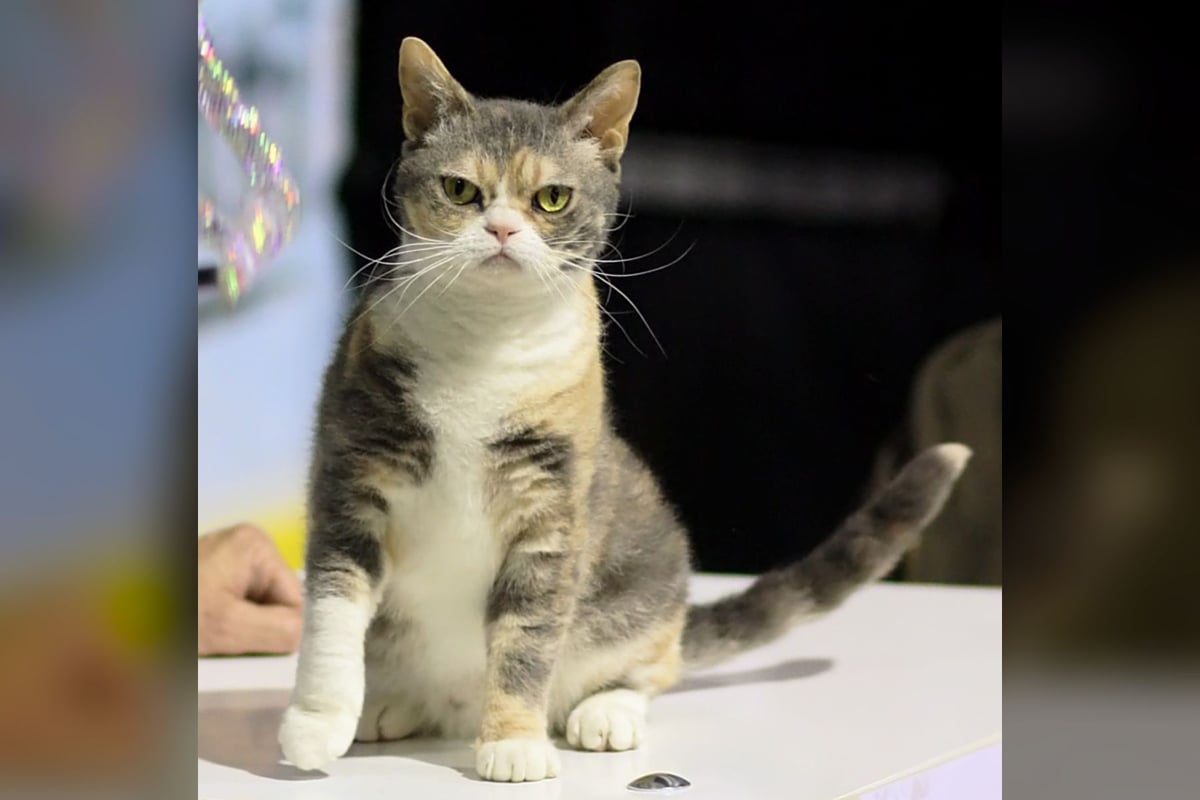
American Wirehair
The American Wirehair emerged in 1966 from a spontaneous mutation in a litter of farm cats in Verona, New York: every hair — including the whiskers — is crimped, wavy and rough to the touch, evoking a twisted wire. This autosomal dominant mutation sets the breed apart from the curly-coated rex breeds (Cornish, Devon), whose genes are recessive. A semi-cobby body identical to the American Shorthair's, and a balanced, low-maintenance temperament. An extremely rare breed, ranked last among the CFA's 41 breeds by registration numbers.
- Weight
- 3 to 7kg
- Height
- 25 to 35cm
- Life expectancy
- 16years
- Monthly cost
- 55 to 95€
Personality profile
Energy 3/5
Independence 3/5
Trainability 3/5
Good with children 4/5
Talkativeness 2/5
Space needed 3/5
Attachment to home 3/5
Good with strangers 3/5
Good with cats 3/5
Good with dogs 3/5
Coat care 2/5
Exercise needs 3/5
Scores given on measured axes, data confidence: medium.
Living with an American Wirehair
Description
The morphology is that of the American Shorthair: a solid, muscular semi-cobby body, medium-sized bone structure, broad chest, legs of proportional length. The head is round with full cheeks, high cheekbones, a well-developed muzzle and medium-sized ears slightly open at the base. The eyes are large, round, slightly slanted, allowed in any color that matches the coat. The tail is thick at the base, tapering to a rounded tip. What absolutely sets the breed apart is the texture of the coat: every individual hair — guard hairs, awn hairs, undercoat and even the vibrissae (whiskers) — is crimped, that is, notched or curled at its tip, forming a dense, elastic surface that is rough to the touch and evokes a metal scouring pad or the coat of a wire-haired terrier. The CFA assigns 45 points out of 100 to the coat in its standard — the highest weighting given to coat of any breed in the registry. The hairs inside the ears also show this crimped texture. Males generally weigh 4.5 to 7 kg, females 3 to 5 kg.

Temperament
The character is that of the American Shorthair, from which the breed is directly descended: balanced, stable, with no extremes. It is neither excessively clingy nor distant — it watches household life with calm interest, joining in activities without disrupting them. Its vocalizing is discreet and its demands for attention moderate. Playful without being frantic, it keeps a moderate activity level as an adult. It tolerates respectful children well and cohabits without marked friction with other animals. Its calm nature and tolerance of daytime solitude make it a cat suited to households with regular absences, provided the environment is sufficiently enriched. It is not listed as a vocal breed: it communicates occasionally, without the insistent repertoire of the Siamese or the Bengal. Its general gentleness and low stress level make it an easy cat for everyday veterinary care.
Training
Its intelligence is solid, but without the Bengal's or the Maine Coon's intense responsiveness to formal training. It learns its name, household routines and useful behaviors — going into the carrier, tolerating light brushing, accepting veterinary handling — through positive reinforcement with treats and a calm voice. Short sessions of 5 to 10 minutes, repeated regularly from a young age, give the best results. Early socialization is decisive for its tolerance of strangers and children. Since it does not demand particularly intense stimulation, it does not need a structured clicker-training program to stay balanced.

Feeding
No nutritional need is specific to the breed. A premium diet high in animal protein suits its moderate activity profile. The ration should be adjusted to actual weight and breeding status: intact males or very inactive cats tend to gain weight, which calls for ration control. Two split meals a day are preferable to free feeding. Wet food can make up 30 to 40% of the ration to maintain good hydration.
Affiliate links, no extra cost to you. Legal notice

Living conditions
Apartment or house both work equally well, since its moderate activity level does not require large spaces. An average-sized apartment, structured with a few climbing spots, rotating toys and accessible windows, satisfies its needs. Its short coat does not require any particular thermal conditions: neither marked sensitivity to cold nor excessive fragility in heat. Exclusively indoor living is preferable to preserve the crimped texture of the coat, which can be altered by repeated rubbing against abrasive outdoor surfaces. Moderate interactive play sessions — 10 to 15 minutes daily — are enough to maintain its physical and mental balance. The breed tolerates daytime solitude reasonably well.

Grooming and coat care
The wirehair coat is paradoxically low-maintenance — but for a counter-intuitive reason: vigorous brushing is contraindicated, because it breaks the hooks and waves that make up the breed's characteristic crimped texture. A monthly pass with a soft glove or a very soft natural-bristle brush is enough to remove dead hair without altering the structure. During seasonal molting, a gentle hand inspection is preferable to intensive brushing. Ear cleaning should be regular — every two weeks — because of the crimped hairs in the ear canal, which encourage buildup. Claws should be trimmed every three to four weeks.

Health
No genetic predisposition is documented as specific to the breed. The CFA explicitly states the absence of a breed-characteristic health problem. Genetic closeness to the American Shorthair — a robust breed with a large gene pool — contributes directly to this. Two practical points deserve attention: crimped-texture hairs inside the ear canal can promote wax buildup and ear infections if the ears are not checked regularly; the skin can be slightly more reactive in certain lines because of the crimped texture, which alters the structure of the coat's protective layer. Standard annual veterinary checkups are enough in the absence of symptoms, with no breed-specific DNA test panel. Hypertrophic cardiomyopathy (HCM), documented occasionally in the American Shorthair, remains something to watch in general terms, but with no established prevalence in the wirehair breed. Estimated life expectancy is between 14 and 18 years.
Breed history
It all begins in 1966 on the Adams farm in Verona, New York State. Among a litter of ordinary farm cats, a red tabby male kitten showed a radically different coat: every hair was crimped, wavy, rough — whiskers included. This kitten, named Council Rock Farm Adam of Hi-Fi, was acquired by breeder Joan O'Shea along with a normal-coated female from the same litter. The breeding program began with a brother-sister cross (Adam with his smooth-coated sister), producing two wirehair kittens out of five: the mutation was confirmed to be heritable, autosomal and dominant. This dominance fundamentally sets the breed apart from the rex mutations: the Cornish Rex (rex1 gene, 1950, Cornwall) and the Devon Rex (rex2 gene, 1960, Devon) are both recessive — two copies of the gene are needed to express the curly coat. In the American Wirehair, a single carrier parent is enough: a wirehair × American Shorthair cross statistically produces 50% wirehair kittens. This genetic feature simplifies maintaining the breed while preserving health through regular outcrossing with the American Shorthair, avoiding inbreeding. The CFA recognized the breed as early as 1967, just a year after its discovery, and granted it Championship status in 1978, the year of its first National Win. Despite this early recognition and more than five decades of existence, the breed remains rare: in 2017, it was ranked last among the CFA's 41 breeds by annual registration numbers. In France, numbers are negligible — the breed is virtually absent from the national breeding circuit, though LOOF recognizes it. Its unassuming morphology, its lack of any documented genetic problem and its stable temperament have not been enough to secure it meaningful reach beyond the United States.
Getting ready for your American Wirehair
Four essentials to line up before day one.
Affiliate links, no extra cost to you. Legal notice
FAQ: American Wirehair
Sources
- Wikipedia EN — American Wirehair · Spontaneous mutation 1966, Verona NY, Adams farm. Founder Council Rock Farm Adam of Hi-Fi (red tabby male). Joan O'Shea, founding breeder. CFA recognized 1967, championship 1978. Rarest of the CFA's 41 breeds in 2017. Autosomal dominant mutation, all hair types affected including whiskers and ear hair. Temperament balanced, identical to the American Shorthair.
- CFA — American Wirehair Breed Profile · Crimped/hooked coat, 45 pts in the standard (the CFA's highest coat weighting). Semi-penetrant dominant mutation: a wirehair × straight cross gives ~50% wirehair. Founder Council Rock Farm Adam of Hi-Fi. Accepted by the CFA 1967, championship 1978. No documented health problem specific to the breed. Body identical to the American Shorthair: round head, high cheekbones, powerful body.
- Wikipedia FR — American Wirehair · Breed born in 1966 in New York, spontaneous dominant mutation. Coat mixing crimped/crinkled/hooked hairs, wavy whiskers. Morphology identical to the American Shorthair. Little-known breed outside the USA. LOOF certification in France.

