


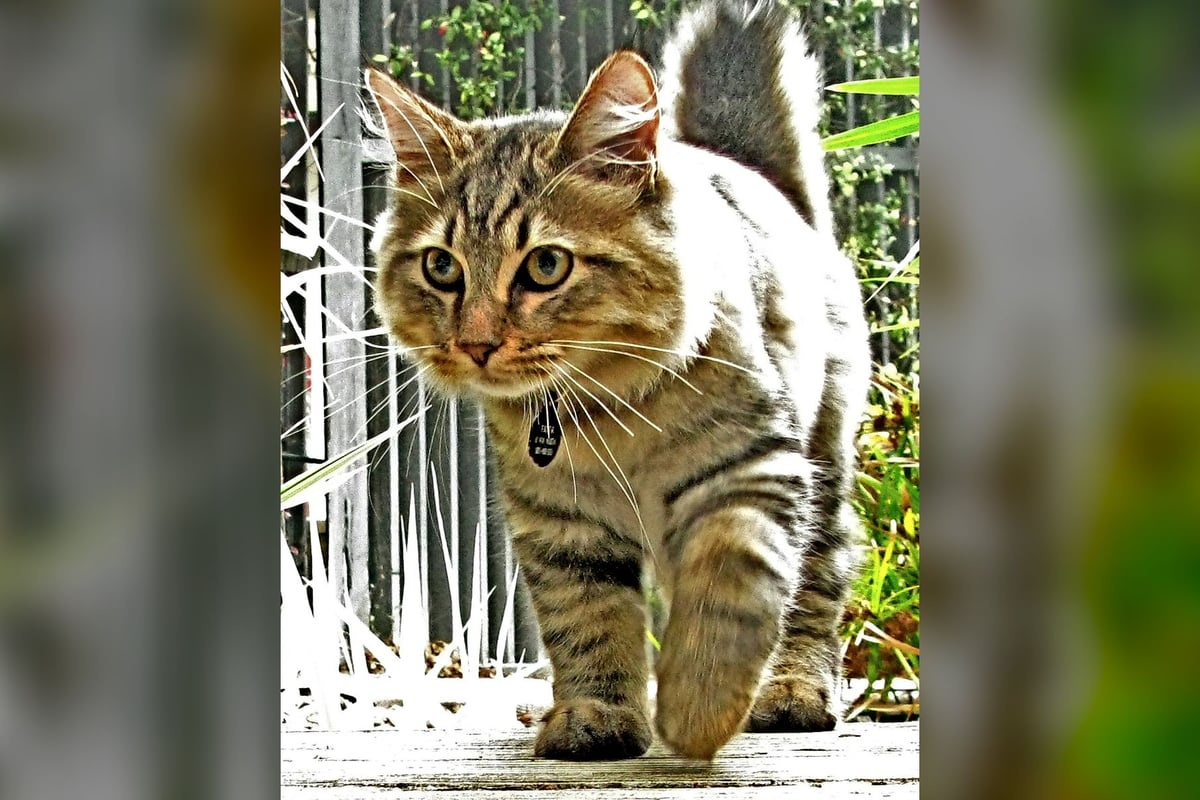
American Bobtail
The American Bobtail is a large semi-cobby breed with a naturally short tail, born from an autosomal dominant mutation distinct from the Manx's and the Japanese Bobtail's. Originating in Arizona in the 1960s, it exists in two coat variants — shorthair and longhair — and stands out for a temperament particularly oriented toward people, whom it follows from room to room and with whom it communicates through characteristic chirps and trills.
- Weight
- 3 to 9kg
- Height
- 23 to 38cm
- Life expectancy
- 14years
- Monthly cost
- 60 to 110€
Personality profile
Energy 4/5
Independence 3/5
Trainability 5/5
Good with children 5/5
Talkativeness 2/5
Space needed 4/5
Attachment to home 4/5
Good with strangers 4/5
Good with cats 4/5
Good with dogs 4/5
Coat care 3/5
Exercise needs 3/5
Scores given on measured axes, data confidence: medium.
Living with an American Bobtail
Description
The body is semi-cobby, medium to large, with substantial musculature and heavy bone structure. Males reach 5 to 9 kg, females 3 to 6 kg — the breed sometimes carries surprising weight given its apparent frame. Growth is slow: full physical maturity is reached only between ages 2 and 3. The head forms a broad modified wedge, with a prominent, fleshy brow that gives the cat what CFA breeders call the "hunting gaze" — a focused look evoking a predator on the watch. The eyes are large and almond-shaped; iris color accepts any variant linked to the coat. The tail is the central morphological signature: it measures 2.5 to 7 cm, visible above the back when the cat is alert, and can be straight, slightly curved, or show a few condensed bony knots — every tail is unique. The coat comes in two versions: shorthair, with a semi-dense double layer of medium length, and longhair, semi-long with a slight shag, more developed on the ruff, britches, belly and tail. All coats are accepted. The mutation responsible for the short tail is autosomal dominant with variable expression; homozygous individuals are viable — which fundamentally distinguishes this breed from the Manx, where homozygosity is lethal.

Temperament
The breed is often described as the most "dog-like" in the feline world, and this reputation rests on observable, consistent behaviors. It follows its owner from room to room without fanfare, shows active interest in every household activity, and develops deep, selective attachment bonds. It does not demand constant attention but does ask to be included. Its vocal communication is discreet and atypical: it produces few classic meows and prefers chirps (brief clicking sounds) and trills (rolling trills) to signal its mood or request attention — a sound register it shares with the Maine Coon. Its intelligence is practical and interaction-oriented: the breed spontaneously invents hunting games with the people around it and shows a particular sensitivity to human emotional states, a quality that has earned some cats work as assisted-therapy animals. Sociability with strangers is good for a breed of this size — it observes before approaching, without excessive shyness. It cohabits without difficulty with dogs and other cats introduced gradually, and its patience with children is notable. Prolonged solitude does not suit it: an active household or a complementary animal presence is recommended.
Training
Few cat breeds are as receptive to formal training, on a par with the Bengal or the Abyssinian. Its motivation for human interaction and its practical curiosity make it a top candidate for clicker training: it learns to give a paw, retrieve a toy, clear obstacles and answer to its name in a few short sessions. Wearing a harness is generally accepted with progressive introduction from kittenhood — the breed tolerates a leash better than the vast majority of cats and can accompany its owner on secure outdoor walks. Sessions should stay short (5-10 minutes), positive, based exclusively on positive reinforcement. The breed does not tolerate coercion and holds onto negative interactions for a long time. A feline agility program or cognitive activities (food puzzles, hide-and-seek with toys) effectively channels its energy and its need for intense physical and cognitive activity, and prevents boredom.

Feeding
A large breed with slow growth (maturity at 2-3 years), it needs food matched to its frame and activity level. For kittens up to 12-15 months, favor large-breed kitten kibble rich in animal protein with a balanced calcium/phosphorus ratio to support bone density. In adulthood, an active 7 kg male needs roughly 260-330 kcal/day depending on activity and outdoor access. Favor premium foods high in taurine (preventive cardiac support). Two split meals a day rather than free feeding. Watch the weight after neutering: the breed can develop moderate weight gain if activity decreases.
Affiliate links, no extra cost to you. Legal notice

Living conditions
A large, sustained-energy breed, the American Bobtail thrives fully in a house with a secure garden, where it can express its hunting instincts and roam freely. A spacious apartment (≥ 70 m²) remains possible provided it offers substantial vertical structures — tall cat trees, wall shelves — and at least 20 minutes of daily interactive stimulation. A small apartment is not advisable for this active breed: lack of space generates unwanted behaviors (destruction, vocalizing, overeating). The breed tolerates temperate climate variations well; it is not particularly sensitive to cold or to heat under normal indoor conditions. Access to a secure balcony or an outdoor enclosure is an appreciated enrichment. Indoor living is recommended in urban settings to prevent traffic accidents, even though the breed shows little anxiety outdoors.

Grooming and coat care
The two coat variants do not have the same requirements. In the shorthair version, the semi-dense double coat is relatively self-cleaning: weekly brushing with a medium-toothed metal comb is enough under normal conditions, stepped up during seasonal molts (spring, fall) for two to three weeks. In the longhair version, the slightly shaggy semi-long coat needs regular brushing two to three times a week to prevent mats, particularly on the ruff, britches and tail — the areas where the hair is longest and densest. In both cases, a bath is rarely necessary (two to three times a year at most) if regular grooming is maintained. Watch the interdigital tufts and ear tufts, trimming them slightly if needed. Clean the ears once a month.

Health
The breed is robust, with no major breed-specific genetic condition documented to date — a direct benefit of a breeding program founded on selecting from wild-caught and domestic cats with a naturally short tail, without narrow founding inbreeding. The tail mutation (autosomal dominant, variable expression) can in some cases be associated with mild spinal abnormalities or hip susceptibility, particularly in cats with a very short or absent tail. Serious breeders systematically exclude cats showing these signs from breeding. As with any large breed, hypertrophic cardiomyopathy (HCM) should be monitored by echocardiogram from age 2-3, even absent a mutation identified specifically in the breed. Joint (hip) follow-up is recommended on adult breeding cats, particularly for lines with very short tails. Solid life expectancy: 13 to 15 years. No breed-specific mandatory DNA test to date, unlike the Maine Coon (MyBPC3) or the Norwegian Forest Cat (GSD IV).
Breed history
It all begins in 1965 in Arizona, when John and Brenda Sanders brought home a stray brown tabby male kitten with a remarkably short tail. The kitten, named Yodie, was crossed with the Sanders' Siamese cat. The short tail was passed on to part of the offspring, revealing the dominant nature of the mutation. This first informal program remained limited for a decade. In the 1970s, other American breeders began taking an interest in this phenotype and selecting for it, but the early lines proved genetically fragile due to excessive inbreeding. In the 1980s, the program was restarted on more solid footing: breeders brought in shorthair or longhair domestic cats with a naturally short tail collected from different regions of the United States and Canada, widening the gene pool and stabilizing the morphological standard. The breed is genetically distinct from the two other recognized bobtails: the Japanese Bobtail, whose mutation is distinct and whose curled tail differs in bone structure, and the Manx, whose mutation (also dominant) makes homozygotes lethal — a trait absent here, where homozygosity is viable. TICA recognized the breed in 1989; the CFA granted it championship breed status in 2000. In Europe and France, the breed remains little-known: LOOF officially recognizes it, but annual registrations are very low, with no established breeding program comparable to those in the United States or Canada.
Getting ready for your American Bobtail
Four essentials to line up before day one.
Affiliate links, no extra cost to you. Legal notice
FAQ: American Bobtail
Sources
- Wikipedia FR — American Bobtail · Origin Arizona 1965, kitten Yodie Sanders. Dominant mutation, TICA recognition 1989. Tail 2.5-10 cm. Life expectancy 11-15 years.
- CFA — American Bobtail Breed Profile · Medium-large rectangular body, broad flexible-based tail, double coat shorthair or semi-long longhair. Selected from feral USA/Canada cats with a natural bobtail. Genetic distinction from the Manx explicitly noted. Possible spinal/hip sensitivity in cats with a very short tail.
- TICA — American Bobtail (longhair and shorthair) · 73 TICA-recognized breeds including American Bobtail Longhair and American Bobtail Shorthair as separate divisions eligible for sanctioned competitions. Recognition 1989.
- LOOF — Recognized cat breeds · The American Bobtail is on the official list of breeds recognized by the Livre Officiel des Origines Félines, with a breed photo. A rare breed in France.
Breeds similar to an American Bobtail


See also: Kurilian Bobtail, Norwegian Forest Cat