


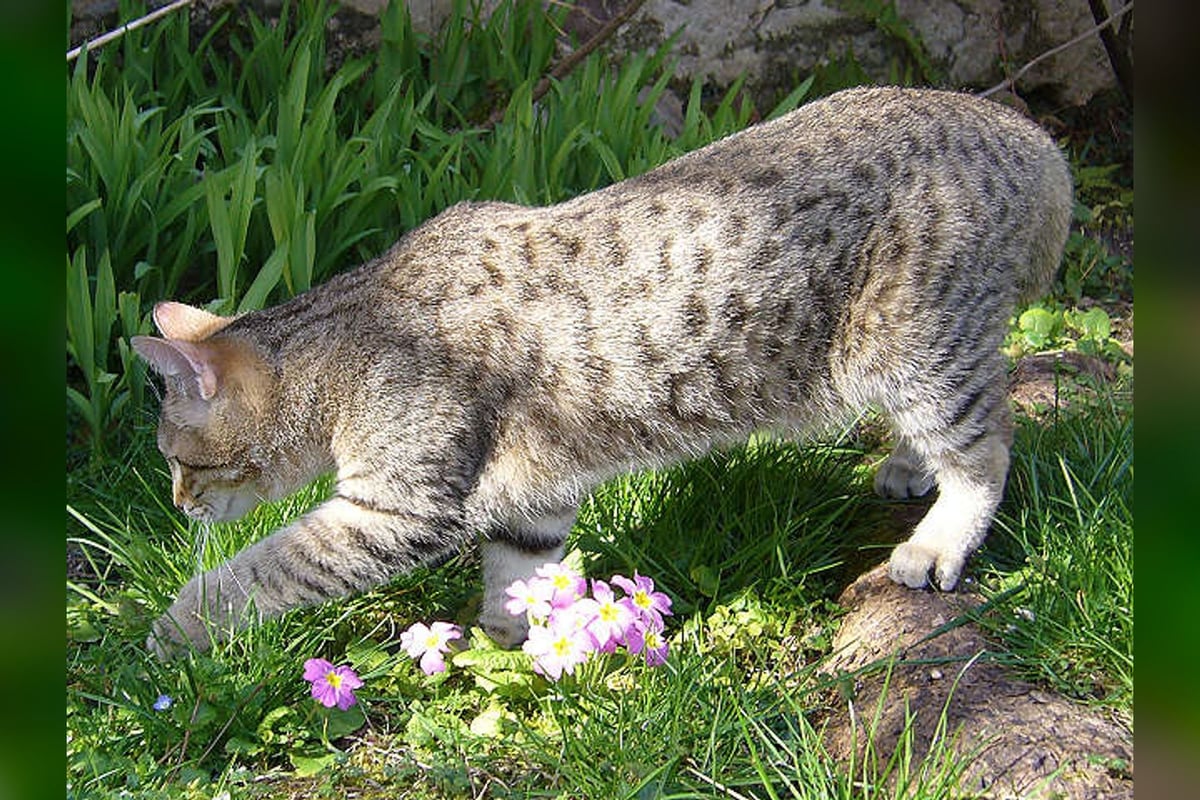
Pixie-Bob
The Pixie-Bob is an American breed with a wild appearance, born in 1985 in Washington State. Massive, muscular body, short tail (5 cm to mid-hock), polydactyly admitted in the standard (up to 7 toes), tabby spotted coat in brown-fawn tones. A fully domestic breed despite the legend of a bobcat ancestor: DNA analysis has never detected a Lynx rufus marker. Pronounced "dog-like" temperament: loyal, leash-walkable, not very vocal.
- Weight
- 3 to 8kg
- Height
- 23 to 36cm
- Life expectancy
- 13years
- Monthly cost
- 55 to 100€
Personality profile
Energy 4/5
Independence 3/5
Trainability 5/5
Good with children 4/5
Talkativeness 2/5
Space needed 4/5
Attachment to home 4/5
Good with strangers 2/5
Good with cats 3/5
Good with dogs 4/5
Coat care 2/5
Exercise needs 4/5
Scores given on measured axes, data confidence: medium.
Living with a Pixie-Bob
Description
The body is long, muscular and heavy, carried on a solid bone structure that gives it a naturally imposing bearing. Adult males reach 5 to 8 kg, females 3 to 5 kg; growth is slow, with full physical maturity only reached between 3 and 4 years old. The head is pear-shaped — wide at the base, tapering slightly toward the chin — with pronounced brow ridges that the TICA standard calls a "hunting brow": a prominent line that gives the cat a focused look reminiscent of a wild predator. The eyes are almond-shaped, gold to green in color. The tail is the second central morphological signature: it measures from 5 cm up to hock length (extended half-hindleg), flexible, jointed, and can show a slight natural kink. Unlike the Manx, the mutation responsible is autosomal dominant with variable expression and shows no lethality in homozygotes. Polydactyly is admitted in the standard and is a distinctive trait: up to 7 toes per paw are accepted in TICA competition, giving the paws a characteristically broad, fleshy look. The coat is tabby spotted exclusively: a brown-beige to fawn agouti base with distinct spots, shaded with reddish, apricot and peach tones. The coat comes in two versions — shorthair (short-to-medium double coat) and longhair (semi-long with a slightly shaggy texture) — both recognized by TICA. Life expectancy: 12 to 15 years.

Temperament
Among the large American breeds, none is as consistently described as "dog-like." It forms an intense, selective attachment to its household — following its owners from room to room, getting involved in everyday activities without being intrusive, and showing a loyalty comparable to that of a companion dog. Its vocal communication is unusual: it makes few classic meows and prefers short chirps and rolling trills to signal its mood or seek attention. Toward strangers it stays reserved — it observes before any contact and does not let unfamiliar people approach it easily. This selective reserve is not fear but deliberate assessment. With children in the household it knows, it is patient and interactive. Its sociability with other species is good, particularly with dogs introduced gradually, which further reinforces its unusual profile in the feline world. It can endure moderate periods of solitude but suffers from prolonged isolation: an active household or the presence of another animal suits it better.
Training
Few cat breeds take this well to formal training. Its human-oriented temperament, its motivation for interaction and its operational curiosity make it a natural candidate for clicker training: it learns to give a paw, fetch a toy, answer to its name and run a small obstacle course in just a few short sessions. Wearing a harness is achieved the same way, through gradual introduction from a young age. Training sessions should stay short (5-10 minutes), based exclusively on positive reinforcement. Cognitive activities — food puzzles, long-distance hunting games down a hallway or in the garden — effectively channel the breed's sustained energy and prevent boredom, which matters particularly for cats living in an apartment without outdoor access. The breed remembers negative interactions for a long time: no physical restraint.

Feeding
Growth is slow — maturity at 3-4 years — and the diet should follow this extended development. For kittens up to 15 months, favor large-breed kitten kibble rich in animal protein. In adulthood, an active 6-7 kg male needs roughly 240-300 kcal/day depending on activity level and outdoor access. Favor premium food high in taurine (preventive heart support). Two split meals a day rather than free feeding. Monitor weight after neutering.
Affiliate links, no extra cost to you. Legal notice

Living conditions
Medium to large build and sustained energy: a house with a secure garden is ideal, where it can freely express its hunting instincts and need for movement. A spacious apartment (≥ 70 m²) remains workable provided it offers vertical structures (tall cat trees, wall shelves), daily interactive stimulation and regular walks on a leash — the harness is something the breed accepts easily. A small apartment is not advisable: the lack of space for an animal this active leads to boredom and unwanted behavior. Native to the northwestern United States, it copes without difficulty with temperate to cool temperatures. It tolerates heat moderately and needs a cool or ventilated space in summer. Living exclusively indoors is acceptable if enrichment is substantial — food puzzles, daily leash activity, interactive hunting-style play.

Grooming and coat care
Two versions coexist, shorthair and longhair, with different grooming needs. In the shorthair version — the more common one in breeding — the short-to-medium double coat is low maintenance: a weekly brushing with a medium-toothed metal comb is enough under normal conditions, stepped up during seasonal molts. In the longhair version, the semi-long, slightly shaggy coat needs regular brushing two to three times a week to prevent tangles, particularly around the ruff and britches. In both cases, a bath is rarely needed. Polydactyl paws deserve particular attention: the claws on the extra toes often grow without touching the ground and don't wear down naturally — check and trim them regularly to prevent ingrown nails. Clean the ears once a month.

Health
This is a robust breed, with no major genetic condition documented to date. The absence of tight founder inbreeding (Carol Ann Brewer's program incorporated varied domestic cats from the start) favored a diversified genetic base. The tail mutation — autosomal dominant with variable expression — can in rare cases be associated with mild vertebral anomalies in cats with a very short or absent tail; serious breeders exclude affected individuals from breeding. Polydactyly, though accepted in the standard, generates no documented health problem in itself — it's a benign anatomical variation. Health-wise, the wild ancestry of the founding legend is not a factor: DNA tests have found no wild felid marker, so there is no "hybrid" fragility to worry about. Hypertrophic cardiomyopathy (HCM) still needs echocardiographic monitoring in adult breeding cats, in the absence of a validated DNA test for the breed — no equivalent of the Maine Coon's MyBPC3 exists here.
Breed history
The story of the Pixie-Bob begins in the spring of 1985 near Mount Baker, in Washington State (northwestern United States), when Carol Ann Brewer acquired a male with an unusually marked tabby spotted coat. In January 1986, she obtained a second, large male named Keba, whose owner claimed he had been sired by a wild bobcat (Lynx rufus). Keba, weighing nearly 8 kg, mated with a neighbor's spotted female; the litter born in April 1986 included a female with a remarkable coat that Brewer named Pixie — the founding queen the breed owes its name to. Carol Ann Brewer developed her breeding program from Pixie and other spotted domestic cats collected in the Washington area, all the while advancing the theory of a partly wild genetic heritage. She codified the breed's distinctive traits — short tail, polydactyly, pear-shaped head, "hunting brow" — and submitted a standard to TICA. The breed achieved "New Breed and Colour" status with TICA in 1994, advanced in 1996, and reached full Championship status in 1998. The question of bobcat ancestry long fueled breeding circles and added to the breed's prestige. Genetic studies conducted from the 2000s onward, using microsatellite DNA markers, definitively closed the debate: no Lynx rufus marker in the tested populations. The clarification did not hurt the breed's popularity in the United States, where it remains well established. In France and Europe it stays rare: TICA recognizes it in two variants (shorthair and longhair), but the LOOF has not to date listed it among its officially recognized breeds, which limits its development in French breeding circles.
Getting ready for your Pixie-Bob
Four essentials to line up before day one.
Affiliate links, no extra cost to you. Legal notice
FAQ: Pixie-Bob
Sources
- Wikipedia EN — Pixie-bob · Founded 1985 by Carol Ann Brewer, Mount Baker WA. Tail 5 cm to mid-hock. TICA New Breed 1994, Championship 1998. DNA testing: genetically a pure domestic cat, no Lynx rufus marker.
- TICA — Browse All Breeds (Pixiebob + Pixiebob Longhair) · Two variants recognized in Championship: Pixiebob (shorthair) and Pixiebob Longhair. Breed listed among the 73 TICA-recognized breeds.
- LOOF — Recognized cat breeds · The Pixie-Bob does not appear in the LOOF's official list of recognized breeds as of the time of writing (May 2026). The breed is only available through TICA breeders in France.

